Your Nervous System Has Two Modes. Most People Are Stuck in the Wrong One.
You're not lazy, weak, or broken. Your nervous system is stuck in survival mode. Learning to shift states is one of the most valuable skills you'll ever develop.
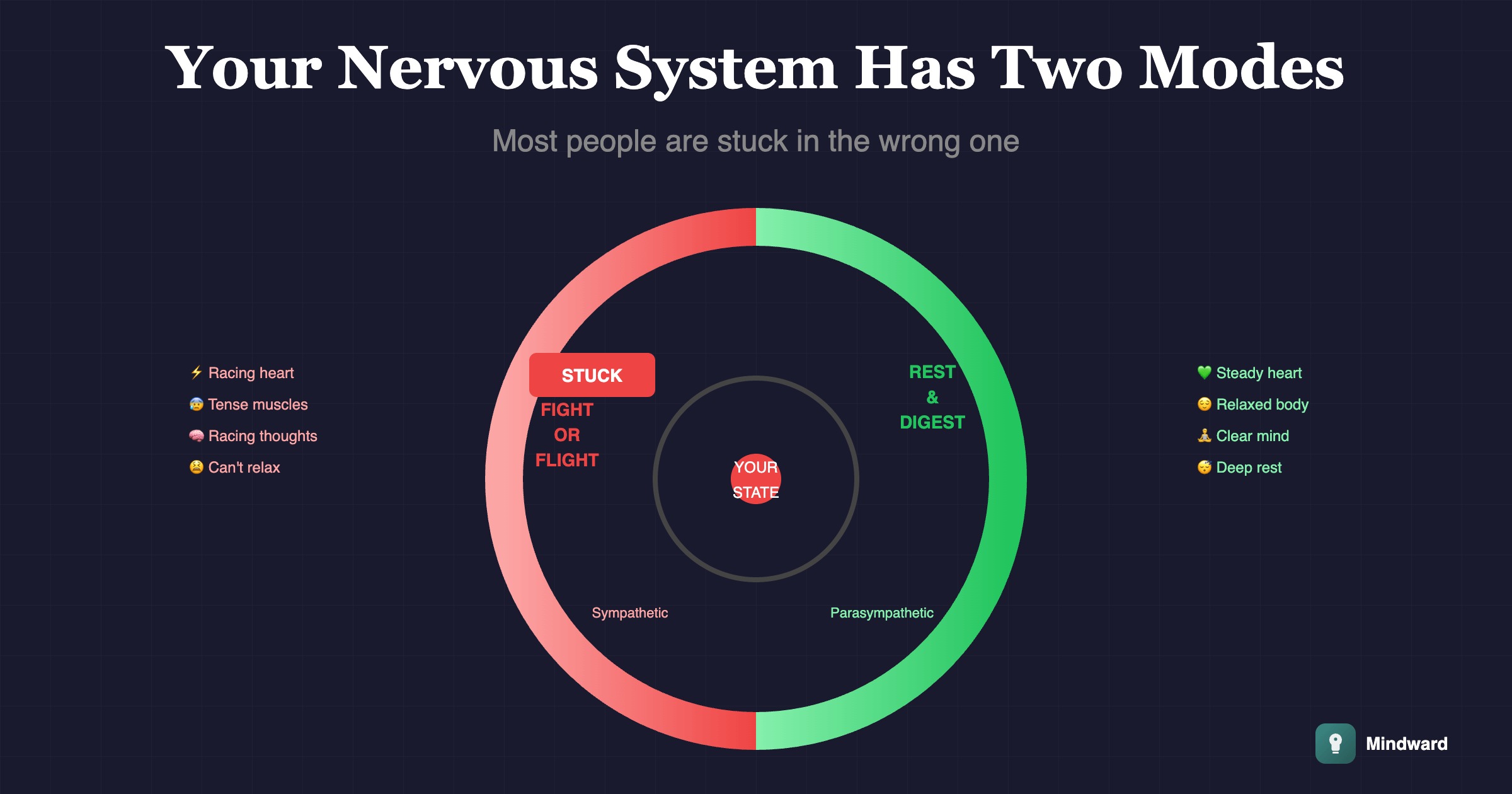
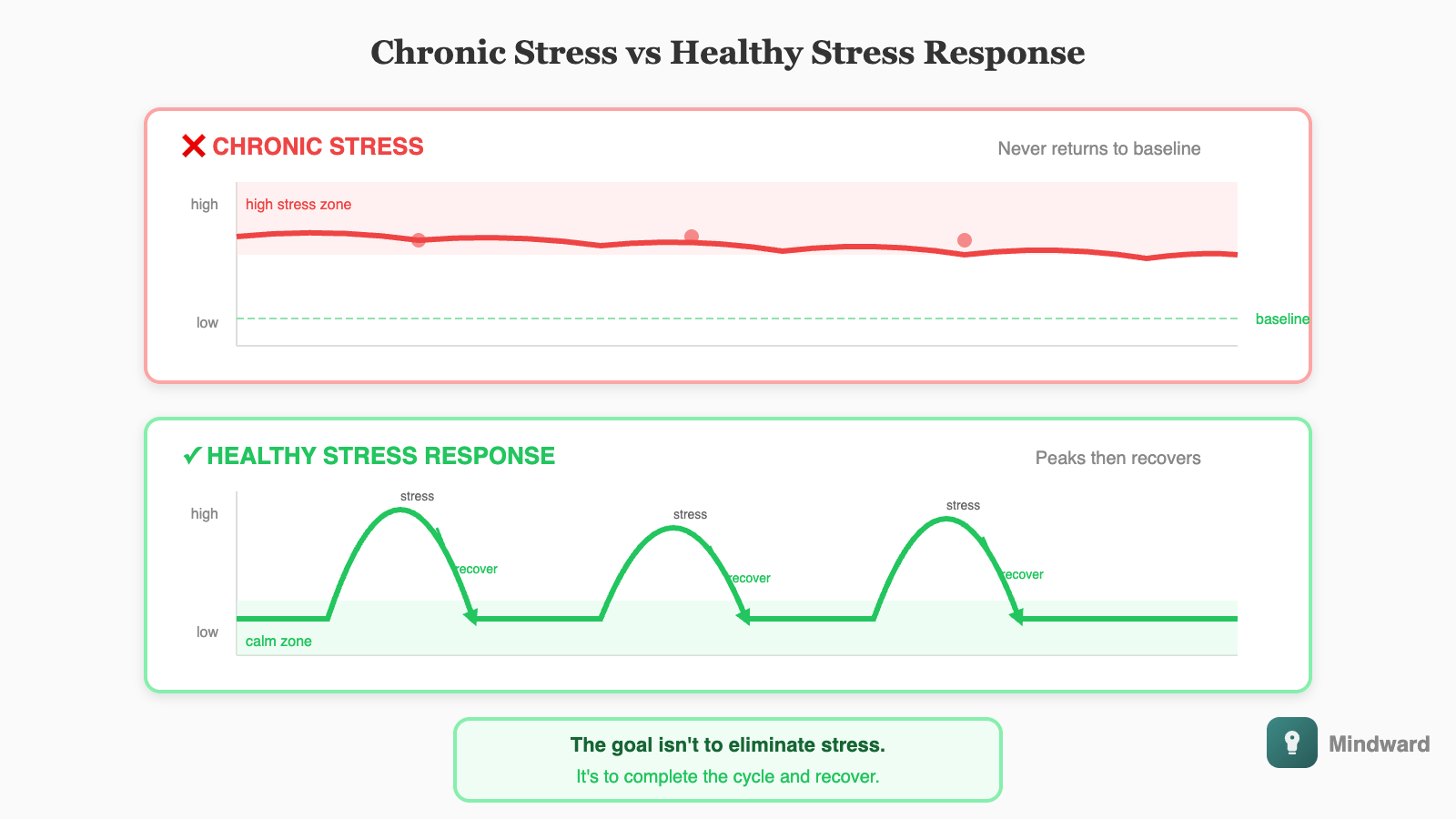
Your body has a built-in stress response. It's supposed to save your life—flood you with adrenaline, sharpen your focus, prepare you to fight or flee. Then, when the threat passes, it's supposed to turn off.
The problem is it doesn't turn off anymore. For most people, the stress response is always on, humming in the background, activated not by predators but by emails, notifications, deadlines, and the general anxiety of modern life.
You feel it as tension you can't release. Racing thoughts you can't quiet. Exhaustion that sleep doesn't fix. A body that won't relax even when there's nothing to do. You're not imagining it. Your nervous system is genuinely stuck.
The good news: you can learn to unstick it. Not by thinking your way out, but by working directly with the body's own switching mechanisms.
The Two Branches
Your autonomic nervous system—the part that runs without conscious control—has two main branches. They're meant to work in balance, like a seesaw.
The sympathetic branch is your accelerator. It activates when you perceive threat, releasing stress hormones, increasing heart rate, tensing muscles, sharpening focus on danger. This is fight-or-flight mode. It's essential for survival and can help you perform under pressure. But it's meant to be temporary.
The parasympathetic branch is your brake. It activates when you feel safe, slowing heart rate, relaxing muscles, promoting digestion, enabling repair. This is rest-and-digest mode. It's where healing happens, where you recover, where you actually feel at ease.
You can't heal, digest, think clearly, or sleep well in fight-or-flight mode. Those functions require the other branch.
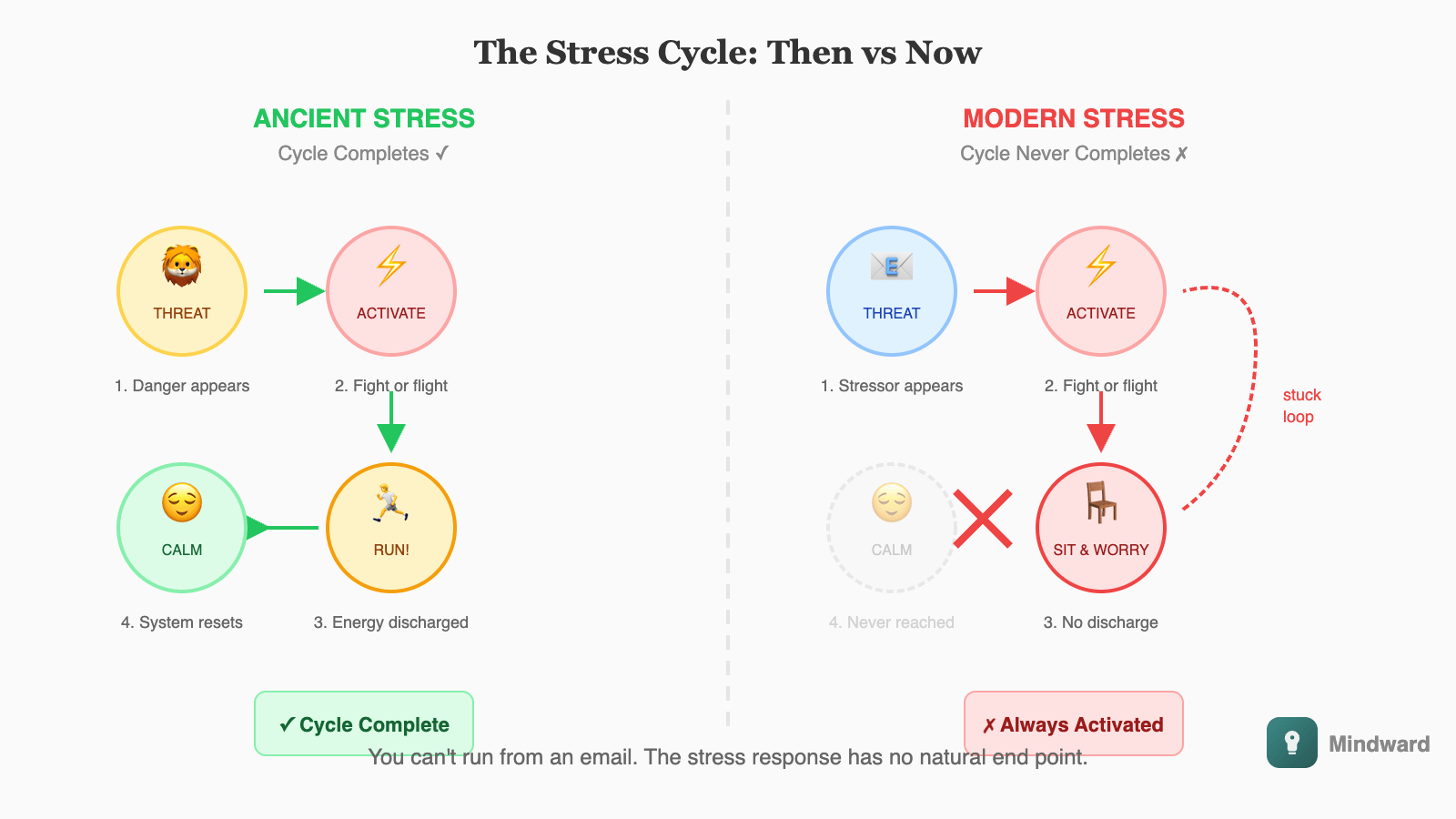
The problem isn't that you have a stress response. The problem is that the stress response never fully completes. You get activated, but you don't discharge. The energy stays stuck in your system, keeping the sympathetic branch dominant even when you're safe.
Why You're Stuck
Modern stressors don't resolve the way ancient ones did. When our ancestors faced a predator, they either fought, ran, or got eaten. The stress response had a clear end point—physical action that discharged the activation.
But you can't run from an email. You can't fight a deadline. You can't physically escape financial worry. The threat persists, low-grade but constant, and your body stays primed for action that never comes.
Add to this the constant stimulation of screens, the pressure of always being reachable, the ambient anxiety of news cycles, and the loss of natural rhythms that once helped regulate our systems. The inputs keep coming. The discharge never happens. The nervous system adapts by staying perpetually on guard.
This isn't a character flaw. It's a mismatch between ancient biology and modern environment. Your nervous system is doing what it's designed to do—it just wasn't designed for this.
The Signals That Switch States
Here's what most people miss: you can't think yourself into a different nervous system state. The autonomic system doesn't take orders from the conscious mind.
But it does respond to certain physical signals. These are the body's own cues for safety—signals that tell the nervous system the threat has passed and it's okay to stand down.
The most powerful of these signals travel through the vagus nerve, the main highway of the parasympathetic system. When you stimulate the vagus nerve correctly, you activate the brake. The heart slows. The muscles relax. The stress response dials down.
You can't think your way to calm. But you can breathe your way there.
Breathing: The Master Switch
Breath is unique—it's controlled both automatically and voluntarily. This makes it a bridge between the conscious and autonomic systems, a lever you can actually pull.
When you're stressed, breathing becomes fast and shallow, centered in the chest. This signals danger to the nervous system. When you're safe, breathing becomes slow and deep, centered in the belly. This signals calm.
You can reverse-engineer this. By deliberately slowing and deepening your breath, you send safety signals that shift your nervous system state. Not by pretending to be calm, but by giving your body the physical inputs that produce calm.
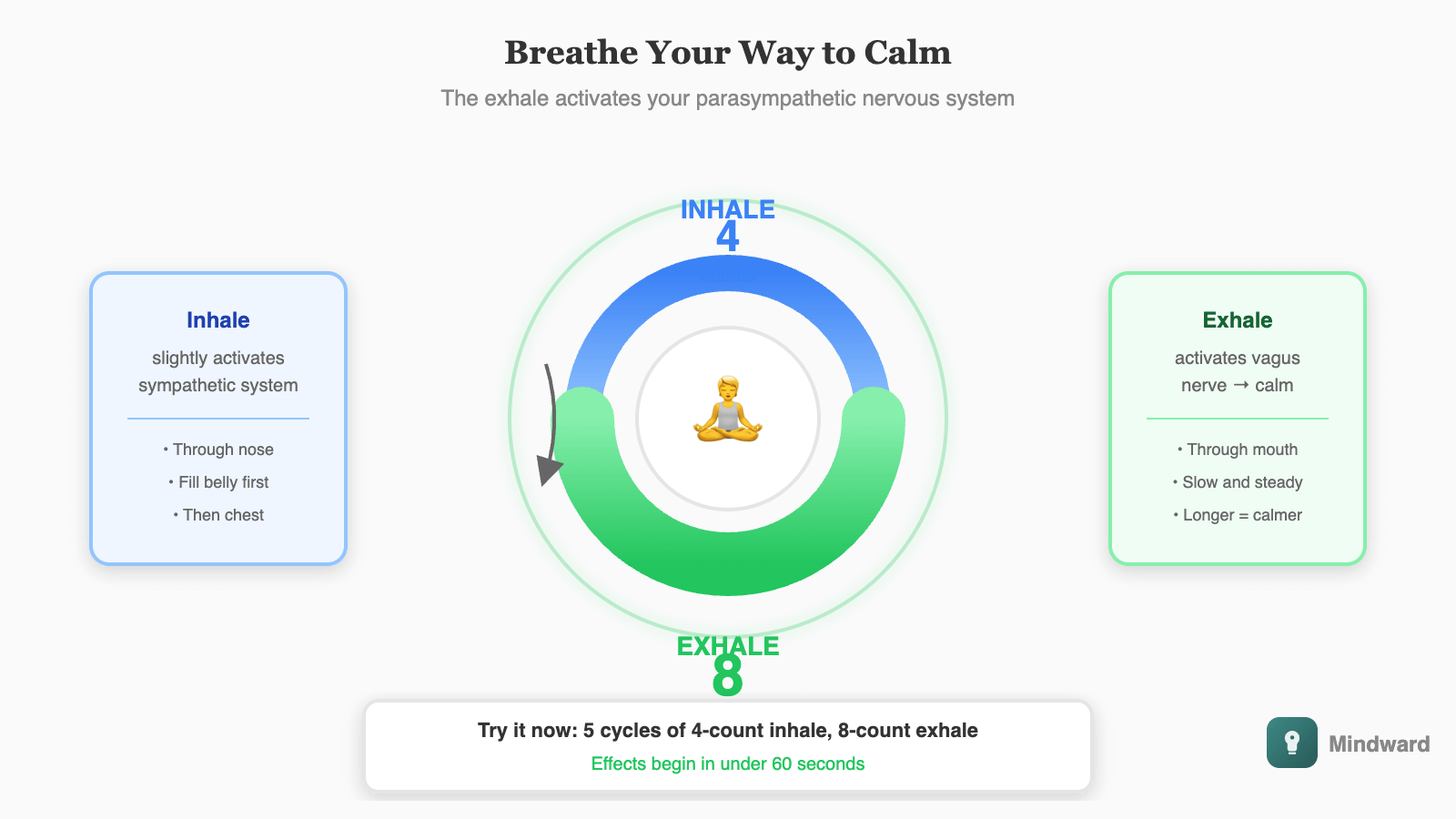
The key is the exhale. A long, slow exhale activates the vagus nerve and triggers parasympathetic response. The inhale activates slightly sympathetically; the exhale does the opposite. By extending your exhale longer than your inhale, you tilt the balance toward calm.
- Try this: Inhale for 4 counts. Exhale for 8 counts. Repeat for 5 cycles.
- Or: Box breathing—4 counts in, 4 counts hold, 4 counts out, 4 counts hold.
- Or: Simply make your exhale twice as long as your inhale, whatever pace feels natural.
This isn't woo. It's basic physiology. Clinical studies show controlled breathing reduces cortisol, lowers blood pressure, decreases anxiety, and shifts heart rate variability toward parasympathetic dominance. It works in minutes.
Other Reset Switches
Breath is the most accessible tool, but it's not the only one. Your nervous system responds to multiple signals of safety.
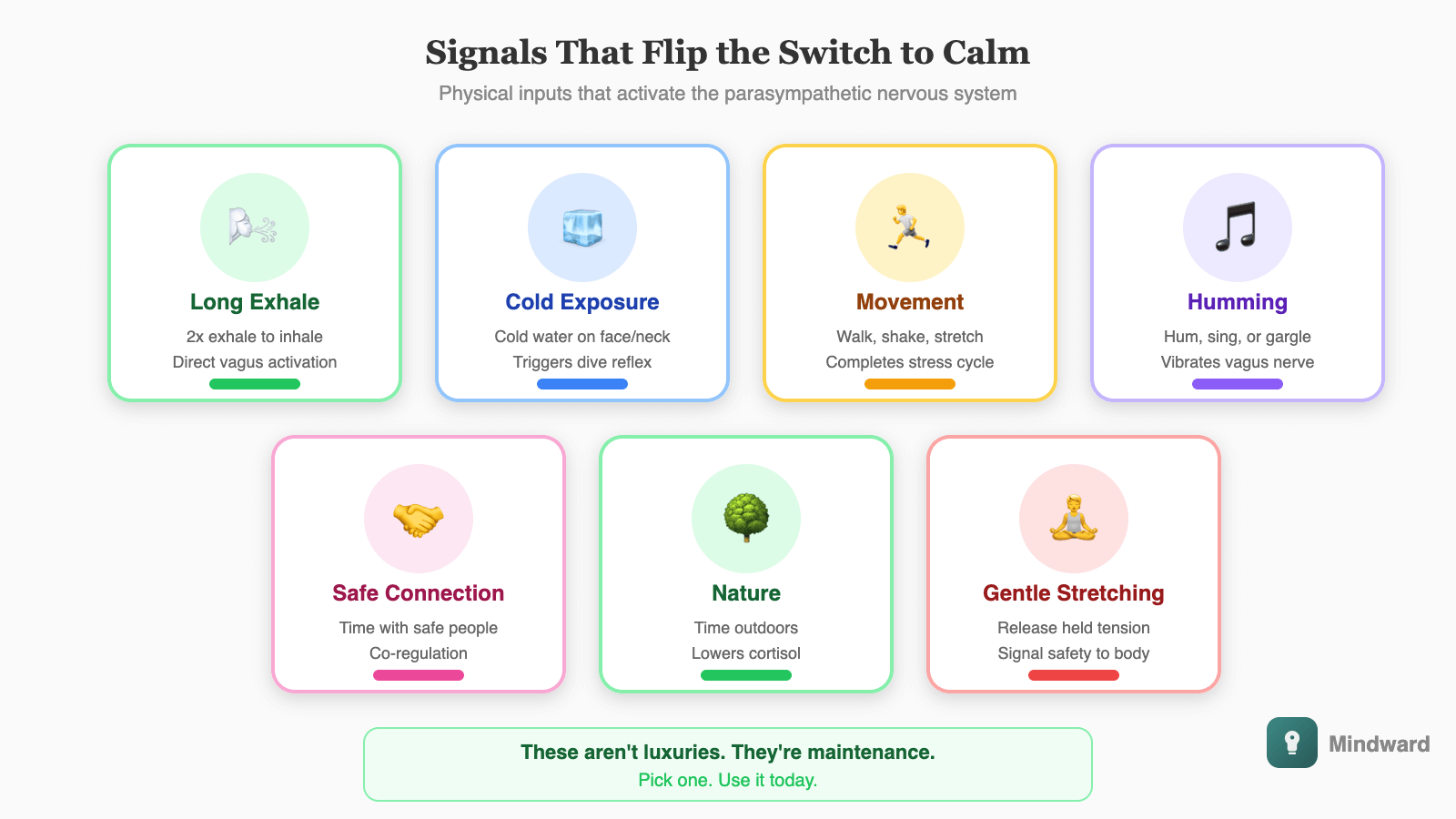
Cold exposure triggers a dive reflex that activates the vagus nerve—splashing cold water on your face, taking a cold shower, or simply holding something cold against your neck. The shock momentarily overrides the stress response and resets the system.
Physical movement completes the stress cycle. When you feel activated, moving your body—walking, shaking, stretching, even just tensing and releasing muscles—allows the stored stress energy to discharge. This is why you feel better after exercise even when nothing about your situation has changed.
- Long exhale breathing (2x exhale to inhale ratio)
- Cold water on face or neck
- Physical shaking or movement
- Humming, singing, or gargling (vibrates vagus nerve)
- Social connection with safe people
- Time in nature
- Gentle stretching or yoga
These aren't luxuries or self-indulgence. They're maintenance for a system that's being overworked. Skipping them isn't discipline—it's neglect.
Building the Habit of Calm
A single breathing exercise won't fix chronic stress. But regular practice builds capacity. Your nervous system becomes more flexible, quicker to return to baseline, less likely to get stuck in overdrive.
The goal isn't to eliminate stress—that's neither possible nor desirable. The goal is to complete the stress cycle, to let your system return to rest after activation, to spend less time stuck and more time recovered.
Start small. One minute of extended exhale breathing in the morning. A brief body shake after a stressful meeting. Cold water on your face when you feel overwhelmed. These micro-interventions, repeated consistently, train your nervous system to find its way back to balance.
You're not broken. You're not weak. Your nervous system is responding exactly as designed—it just needs help completing the cycle. Give it the signals it needs, and it will do what it was built to do: return you to a state where rest, recovery, and clear thinking are possible.
Learn to flip the switch. It might be the most important skill you ever develop.


Comments
How did you like this article?
No comments yet. Be the first to share your thoughts!