Why You Forget What You Read (And How to Actually Retain It)
You've read dozens of books this year. You can barely remember what was in them. The problem isn't your memory—it's how you're reading. Here's what actually makes knowledge stick.
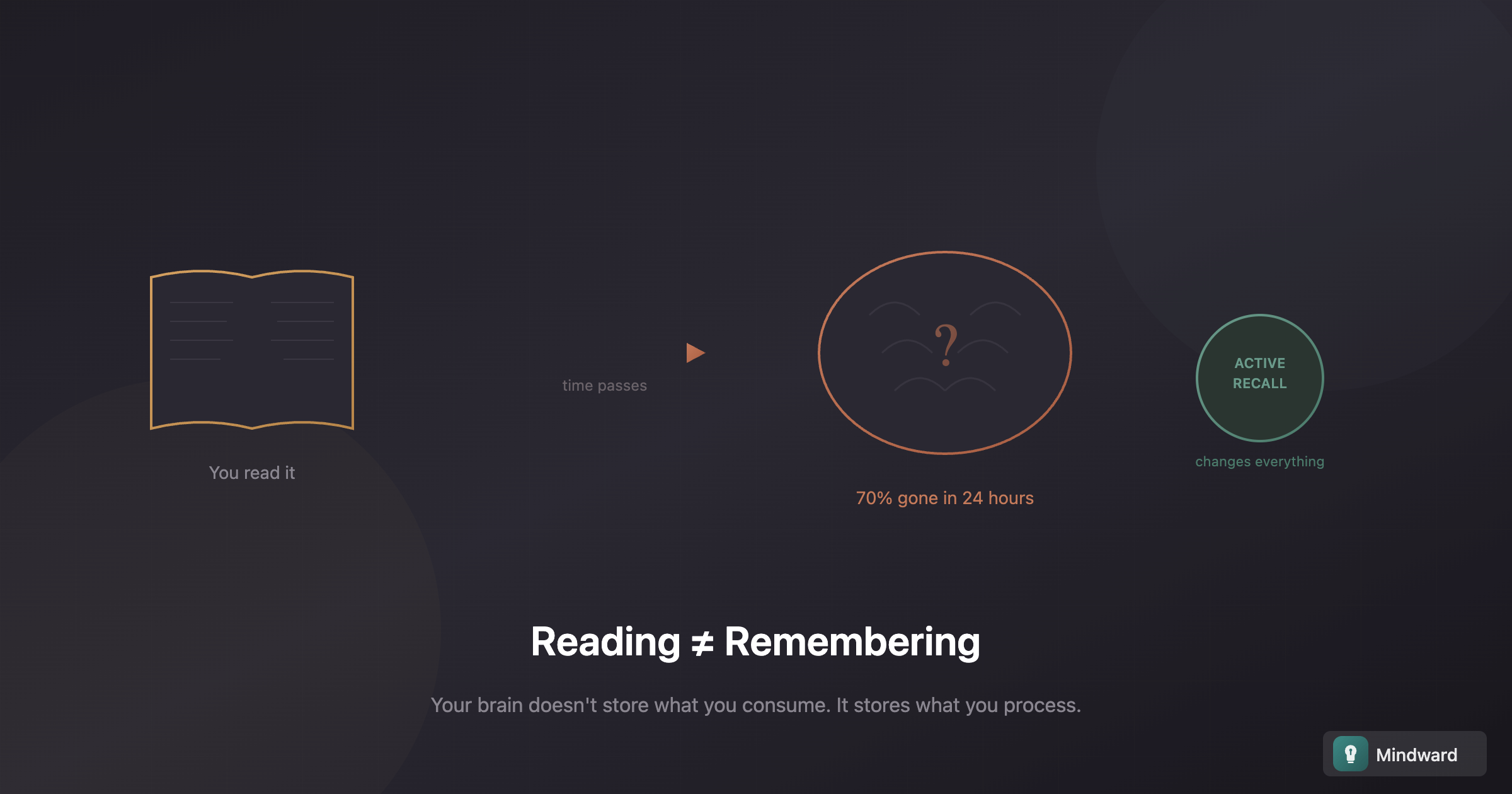
You finished the book two months ago. Someone asks what it was about, and you freeze. You remember liking it. You remember it was 'really good.' But the actual ideas? Gone. Dissolved into the vague sense that you once knew something.
This isn't a memory problem. It's a method problem. The way most people read—passively consuming words and moving on—is almost perfectly designed for forgetting. Your brain isn't broken. Your approach is.
The Forgetting Curve Is Real
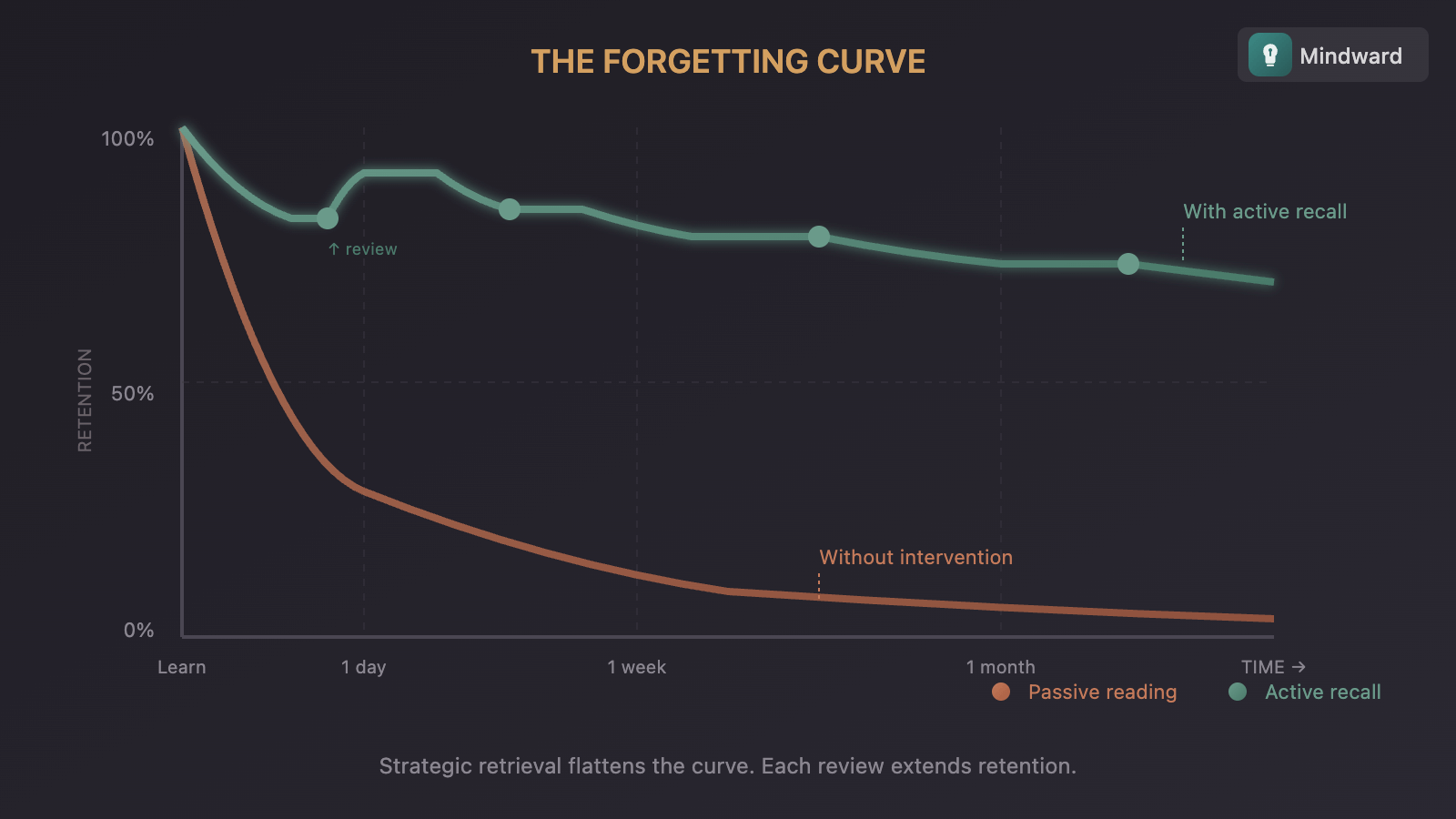
Within 24 hours of learning something new, you forget roughly 70% of it. Within a week, that number climbs higher. This isn't a flaw—it's a feature. Your brain is constantly filtering out information it deems unimportant, and 'things you passively read once' sits firmly in that category.
The forgetting curve, discovered over a century ago, shows that memory decay is predictable and steep. But it also shows something else: strategic intervention can flatten that curve dramatically. The information isn't gone—it just needs a reason to stay.
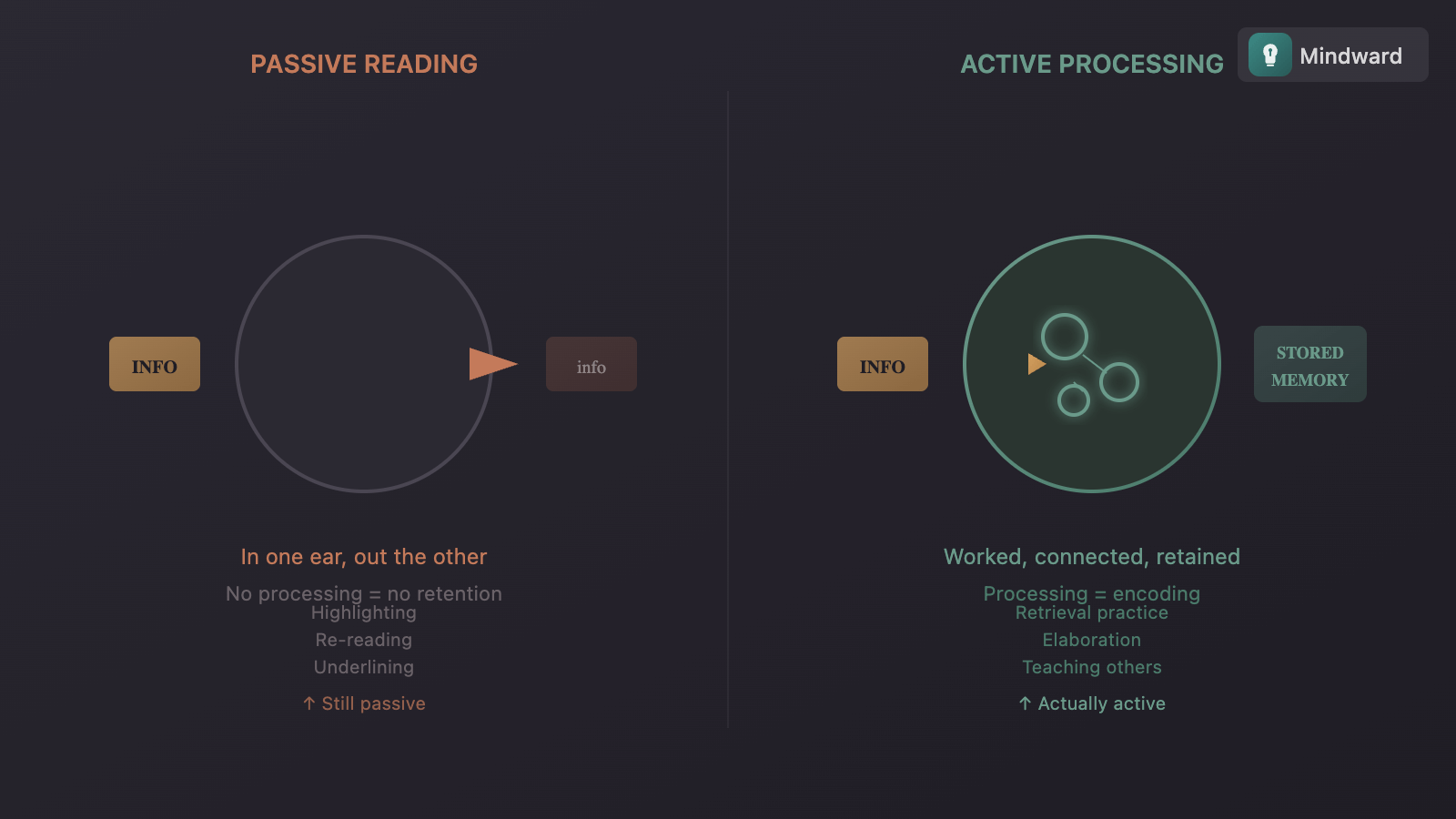
Your brain doesn't store what you consume. It stores what you process.
Why Passive Reading Fails
Reading feels like learning. Your eyes move across words, your brain processes language, you might even feel enlightened in the moment. But feeling like you're learning and actually encoding information are different things.
Passive reading creates recognition, not recall. You'll recognize an idea if you see it again. But you won't be able to summon it when you need it. Recognition is shallow; recall is useful. And recall requires effort that passive reading never demands.
Highlighting, underlining, reading more carefully—none of it helps much. These are all still passive. The information flows in and flows out because nothing forces your brain to actually grapple with it.
What Forces Retention
Retention requires one thing: active processing. Your brain needs to do something with the information beyond simply receiving it. The harder the processing, the stronger the memory trace.
- Retrieval practice: Close the book and try to recall what you just read. The act of pulling information out strengthens the neural pathway far more than putting it in again.
- Elaboration: Connect new ideas to things you already know. Ask 'how does this relate to X?' The more connections, the more retrieval routes.
- Spacing: Spread your engagement over time. Three short sessions beat one long one. Each return trip fights the forgetting curve.
- Teaching: Explain the concept to someone else, real or imagined. If you can't explain it simply, you don't understand it yet.
The Minimal Viable System
You don't need an elaborate note-taking system or a second brain. You need friction at the point of consumption—something that forces active engagement before you move on.
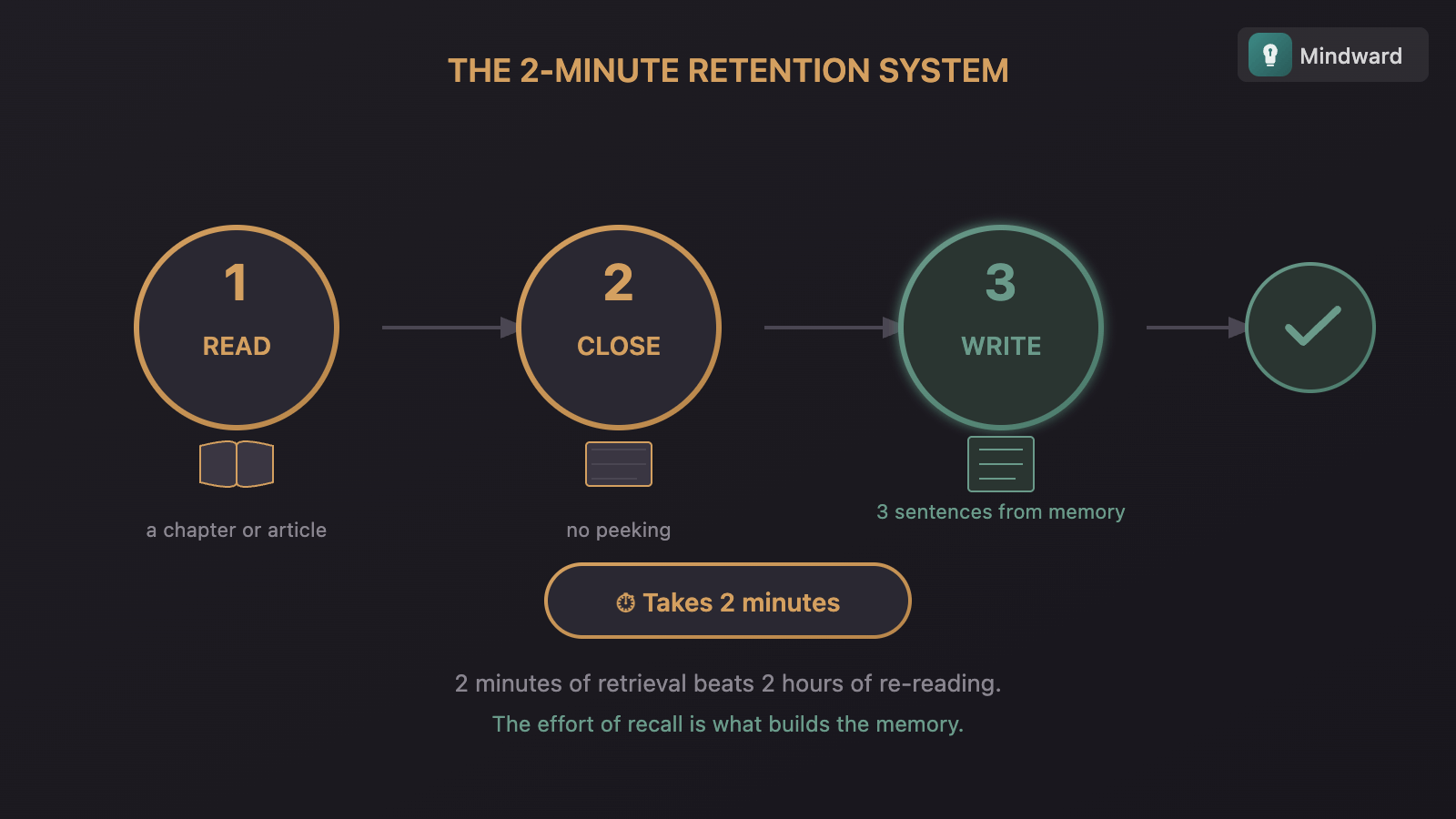
The simplest version: after every chapter or article, close it and write three sentences about what you just read. No looking back. Just retrieve what you can. This takes two minutes and multiplies retention dramatically.
If you want to go further, add a weekly review. Spend fifteen minutes looking at your sentence summaries and trying to recall the fuller context. Each review extends how long you'll retain the information.
Two minutes of retrieval beats two hours of re-reading.
Reading Less, Retaining More
The uncomfortable implication: reading more isn't the goal. Retaining what matters is. Ten books you remember beat fifty books that dissolved. Speed and volume are vanity metrics when the knowledge doesn't stick.
This might mean reading slower. It might mean reading fewer things more deeply. It definitely means changing your relationship with consumption—treating reading not as an end in itself, but as the first step in a process that requires follow-through.
You're not a vessel to be filled. You're a system that transforms input into usable knowledge. And transformation requires effort that passive consumption will never provide.
The books aren't failing you. The method is. Change the method, and you'll finally keep what you read.


Comments (1)
How did you like this article?
Metsing
April 14, 2026
useful advice
Need to be tested by individual