Why Learning Should Feel Harder Than It Does
If studying feels easy, you're probably not learning. The most effective techniques feel frustrating—and that's exactly why they work.
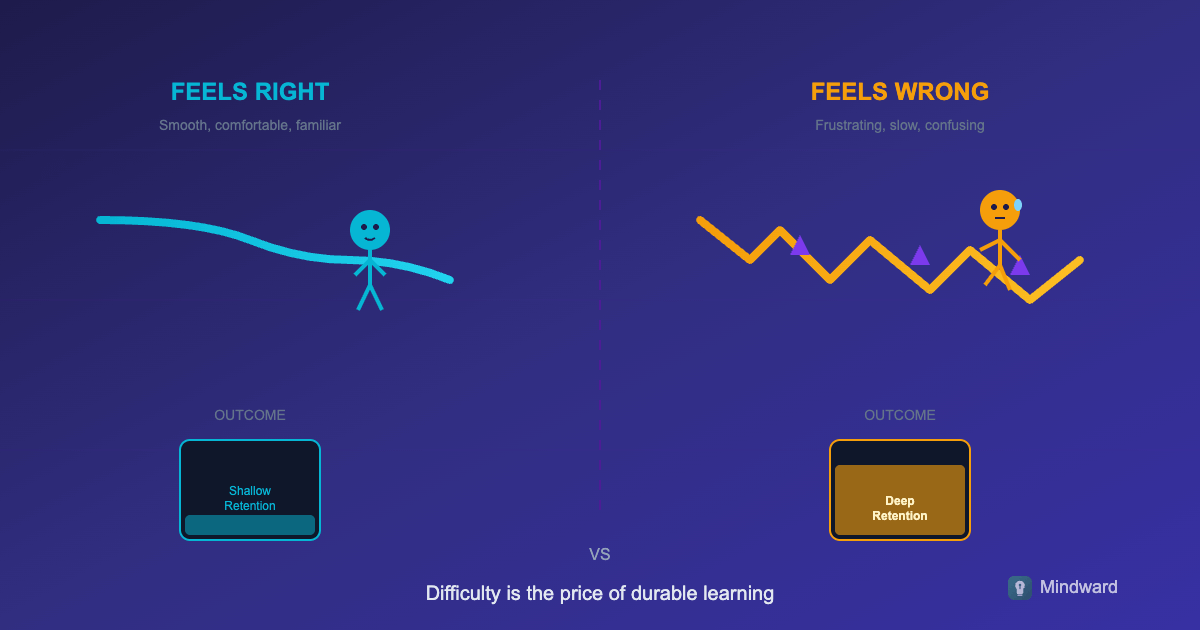
You re-read the chapter until it feels familiar. You watch the tutorial until the steps make sense. You review your notes until everything looks right. Then the test comes, or the real project, and you realize you knew far less than you thought.
This gap between feeling like you've learned and actually having learned is one of the most documented phenomena in cognitive science. And it reveals something counterintuitive: the methods that feel most effective are often the least effective, while the approaches that feel frustrating and slow tend to produce the deepest learning.
The Fluency Illusion
When information flows easily—when you read smoothly, when examples make immediate sense, when you nod along without effort—your brain interprets that ease as mastery. Psychologists call this the fluency illusion. It feels like learning because it feels familiar.
But familiarity isn't the same as knowledge. Recognizing something when you see it is entirely different from producing it when you need it. You can re-read a chapter ten times and still fail to explain its core concepts without the book in front of you.
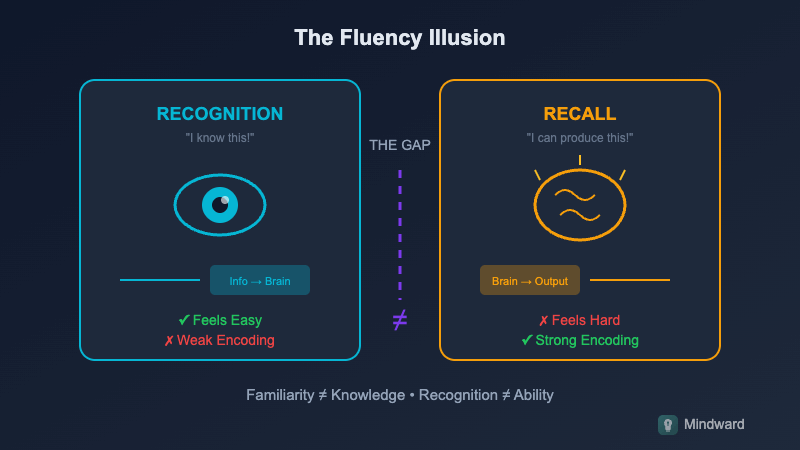
If it feels too easy, your brain isn't working hard enough to form lasting connections. Comfort is the enemy of retention.
Desirable Difficulties
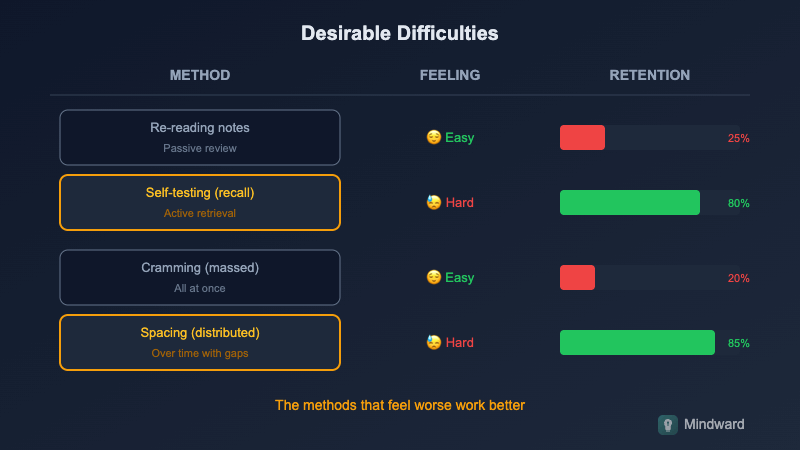
Cognitive scientist Robert Bjork introduced the concept of desirable difficulties—obstacles that slow down learning in the short term but dramatically improve it in the long term. These include spacing out practice, mixing up topics, testing yourself before you feel ready, and working without immediate feedback.
Each of these feels worse than the alternative. Spacing feels inefficient compared to cramming. Mixing topics feels confusing compared to blocked practice. Self-testing feels uncomfortable compared to re-reading. But the research is overwhelming: difficulty during learning predicts durability of learning.
Why Struggle Strengthens Memory
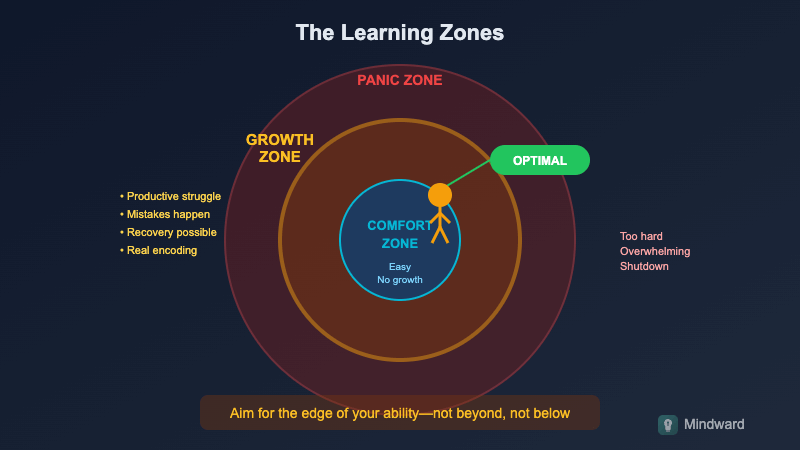
When you struggle to retrieve information, make mistakes, and work through confusion, your brain encodes the material more deeply. The effort itself is the signal that this information matters. Neural pathways strengthen not from passive exposure but from active reconstruction.
This is why students who take difficult tests—even before they've studied the material—outperform students who spend that time reviewing. The act of struggling to retrieve, even unsuccessfully, primes the brain to pay attention when the answer appears.
Mistakes aren't evidence of failure. They're the mechanism of learning. Every error your brain corrects carves the right answer deeper than getting it right the first time ever could.
The Problem With Modern Learning Tools
Most learning products are designed to feel good, not to work well. Tutorials that hold your hand. Apps that gamify progress with easy wins. Courses that never let you fail. These tools optimize for engagement metrics, not actual skill development.
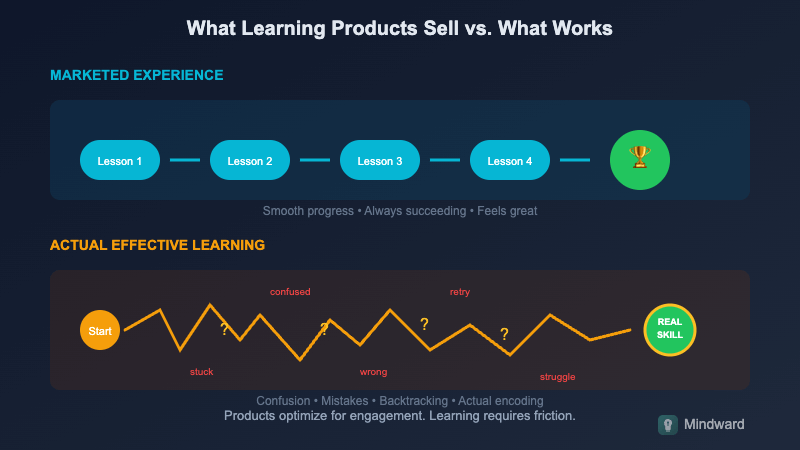
The market rewards products that feel effective immediately. But genuine learning often feels like you're going backward—confused, slow, making errors you thought you'd moved past. This is precisely when the real work is happening.
Be suspicious of any learning experience that feels consistently smooth. You might be building confidence without building competence.
How to Embrace Productive Struggle
You don't need to make learning miserable. You need to make it appropriately challenging. The goal is the edge of your ability—hard enough to require effort, not so hard that you can't make progress.
- Test yourself before you feel ready—retrieval attempts strengthen memory even when you fail
- Wait longer between practice sessions than feels comfortable
- Mix different topics or problem types instead of practicing one thing repeatedly
- Try solving problems before looking at solutions, even if you get stuck
- Remove scaffolding earlier than feels safe—struggle without the safety net
The discomfort you feel during these approaches isn't a sign something's wrong. It's a sign something's working. Your brain is being forced to build rather than coast.
Redefining What Progress Feels Like
Real learning often looks like stagnation. You'll have days where you feel worse than when you started, where previously easy things suddenly feel hard, where you question whether you're cut out for this at all. These experiences are normal—even necessary.
The smoothest path forward is rarely the one that builds the most capability. Skill isn't deposited through effortless consumption. It's forged through repeated, uncomfortable retrieval and application.
So the next time learning feels like a grind—when you're frustrated, when you're making mistakes, when you want to retreat to easier methods—consider that you might finally be doing it right.


Comments
How did you like this article?
No comments yet. Be the first to share your thoughts!