Why Teaching What You Learn Multiplies What You Keep
The fastest way to master something isn't more studying—it's explaining it to someone else. Teaching forces a depth of understanding that passive learning never reaches.
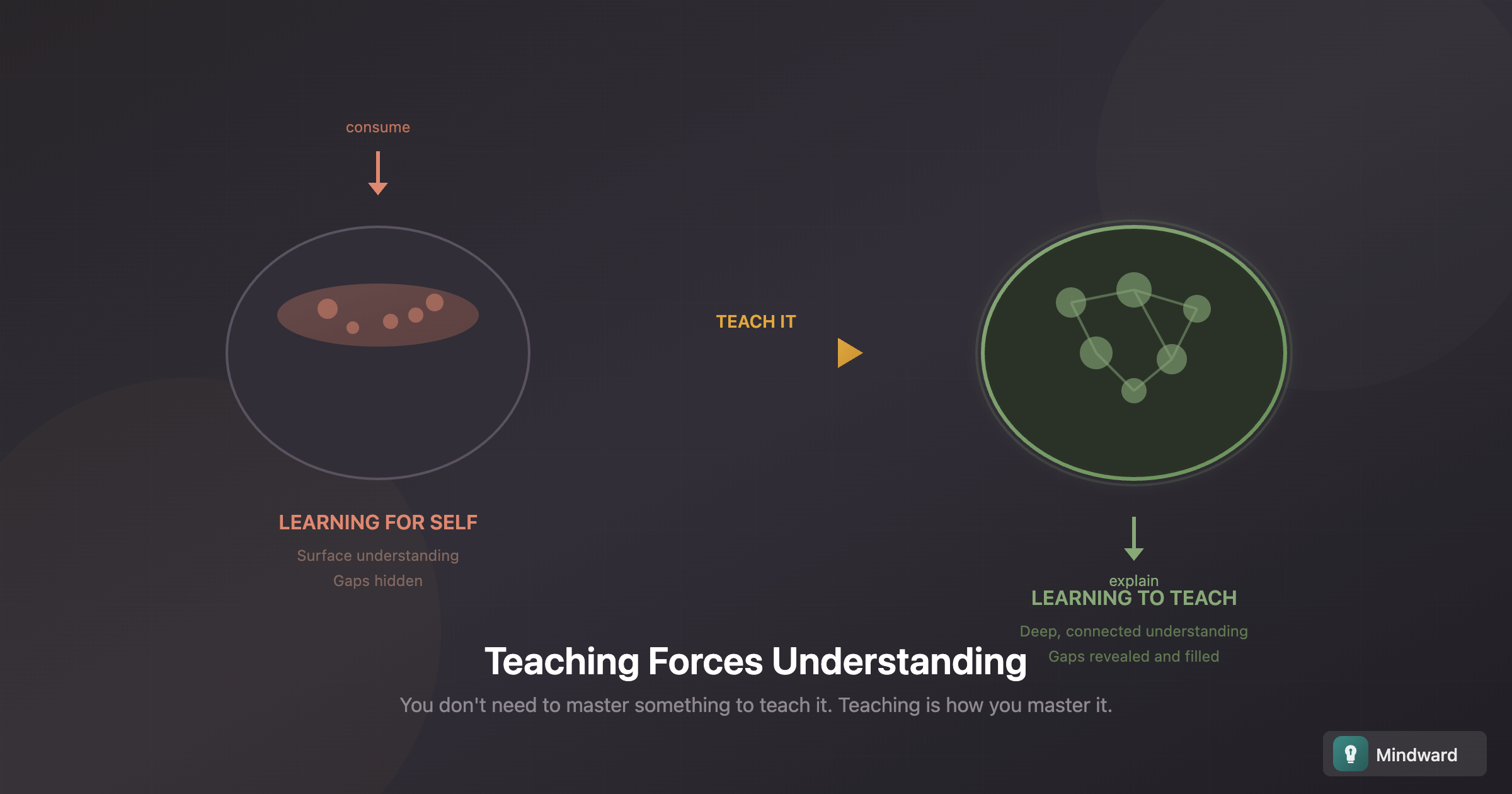
You read the chapter and felt like you understood it. Then someone asked you to explain it, and you realized you couldn't. The words were there, the general idea was there, but when you tried to articulate it clearly, everything fell apart.
This is the gap between thinking you know something and actually knowing it. And the fastest way to close that gap isn't more reading—it's teaching. The act of explaining transforms shallow familiarity into deep understanding.
The Protégé Effect
Researchers call it the protégé effect: people learn material better when they expect to teach it than when they expect to be tested on it. The mere anticipation of having to explain something changes how your brain processes the information.
When you're learning for yourself, your brain takes shortcuts. Good enough feels good enough. But when you're learning to teach, you can't skip the parts that are fuzzy. You can't gloss over the connections you don't fully understand. Teaching demands completeness in a way that personal comprehension doesn't.
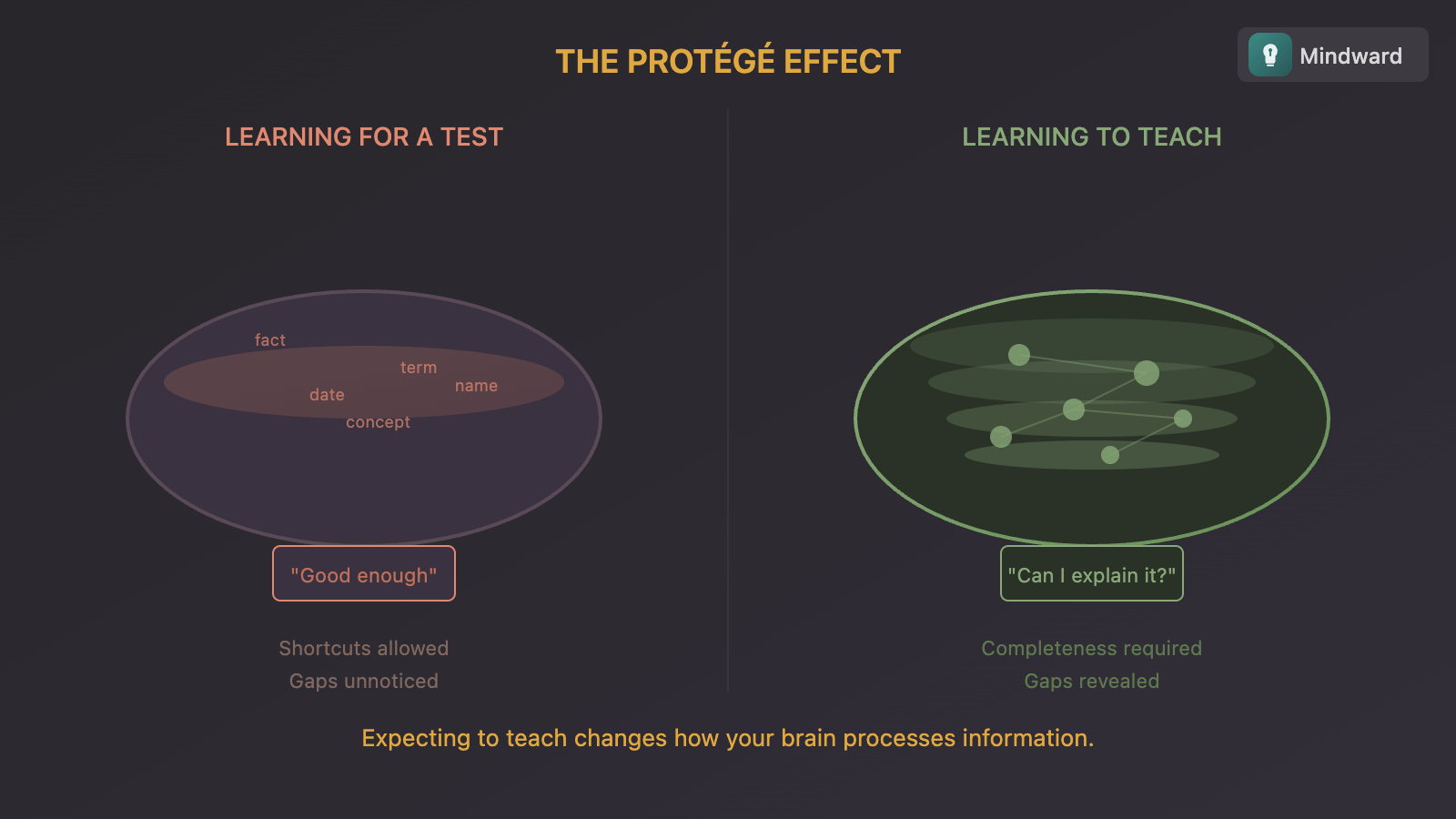
If you can't explain it simply, you don't understand it yet. Teaching reveals exactly where your understanding breaks down.
Why Explaining Forces Understanding
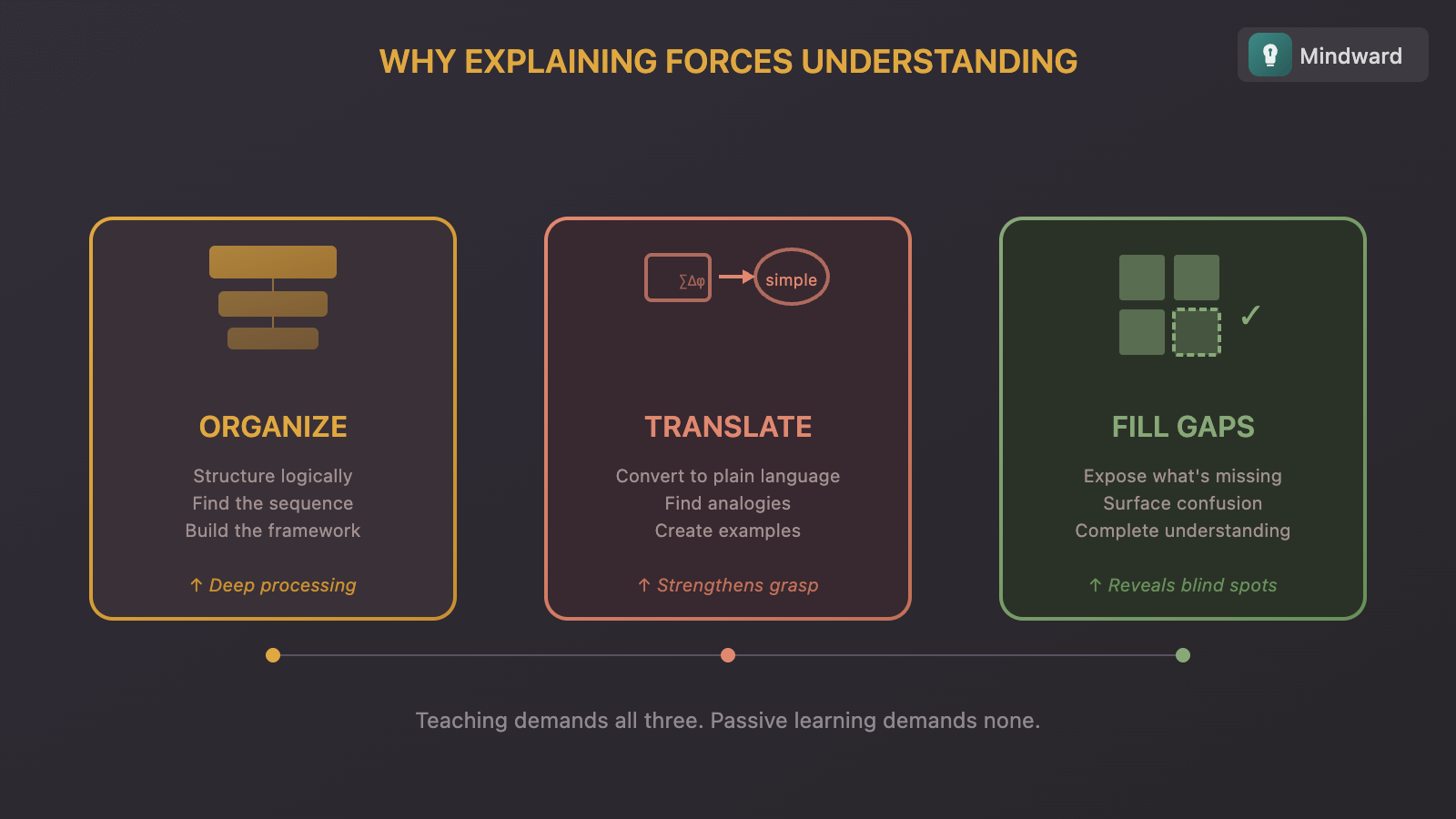
Teaching requires three things that passive learning doesn't: organization, translation, and gap-filling.
Organization means structuring the information in a logical sequence. You can't explain something in the random order you encountered it. You have to find the through-line, the building blocks, the dependencies. This restructuring is itself a form of deep processing.
Translation means converting abstract knowledge into concrete language someone else can follow. Jargon won't work. Assumptions won't work. You have to find analogies, examples, simpler framings. Every translation strengthens your own grasp.
Gap-filling happens automatically when you try to explain. You hit a point where you realize you don't actually know why something works, or how two ideas connect. Teaching surfaces these gaps in real time, exactly when you can do something about them.
You Don't Need to Be an Expert
Here's what stops most people: the belief that you need to master something before you can teach it. That teaching is for experts, and explaining before you're ready is somehow fraudulent.
This gets it backward. Teaching is how you become an expert. The person who learned something yesterday and explains it today will understand it better than the person who learned it a month ago and never articulated it.
- Explain to a friend who knows less than you
- Write a summary as if for a beginner
- Record yourself explaining the concept out loud
- Answer questions in communities where you're slightly ahead
- Teach an imaginary student—even talking to yourself works
The audience doesn't need to be advanced. The audience doesn't even need to be real. The cognitive benefits come from the act of formulating the explanation, not from who receives it.
The Feedback Loop
Teaching also creates a feedback loop that isolated learning can't match. When you explain something and get a confused look, you've learned something valuable: your explanation didn't work, which means your understanding has a hole.
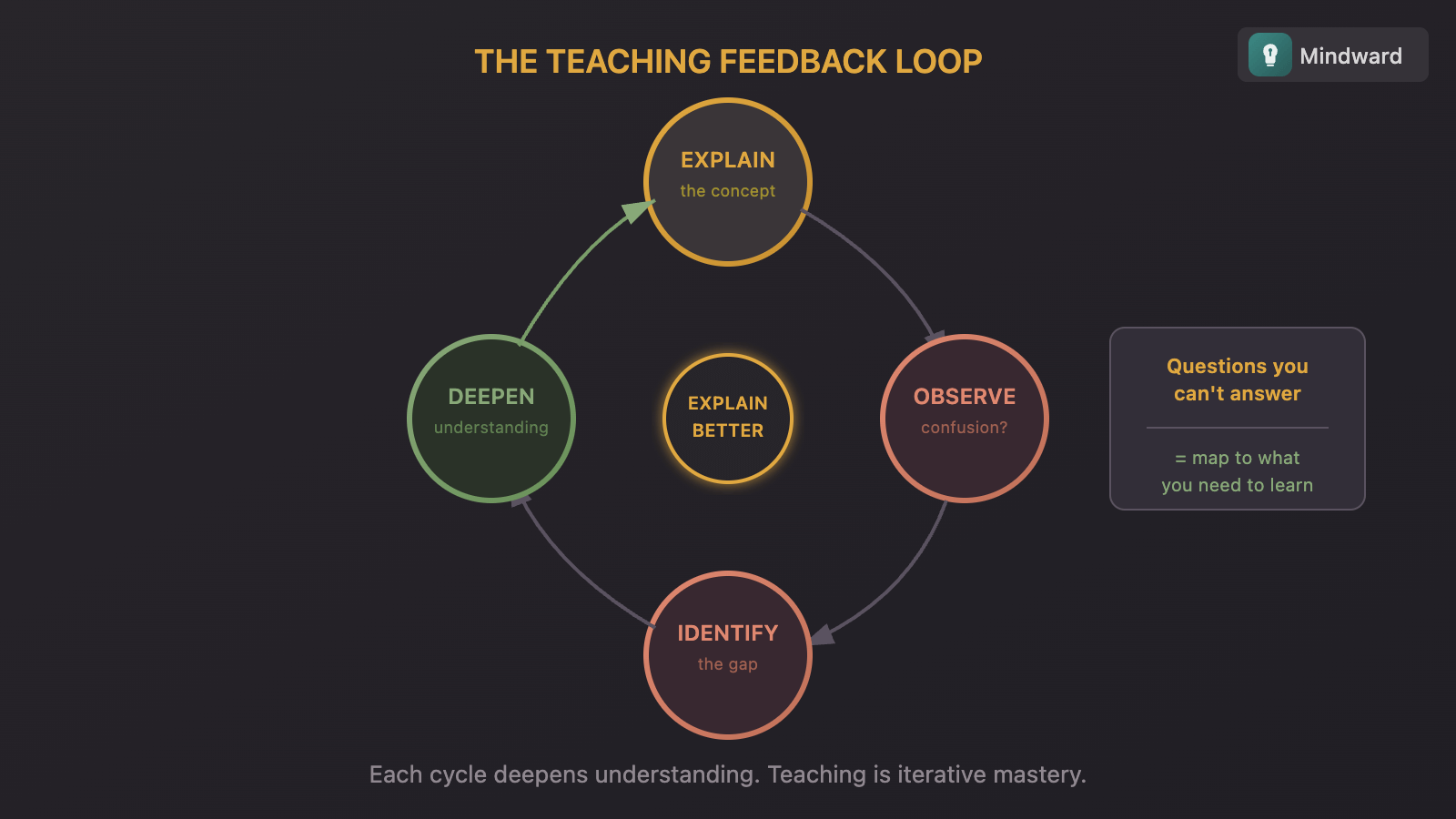
Questions from learners are gifts. They point directly at the weak spots in your knowledge. Every question you can't answer easily is a map to what you need to learn next.
The questions you can't answer are more valuable than the ones you can. They show you exactly where to focus.
Making It Practical
You don't need a classroom. You don't need students. You just need the habit of articulating what you learn instead of letting it sit passively in your head.
After reading something important, spend two minutes explaining the key idea out loud—to no one, to your phone, to a rubber duck on your desk. After learning a new skill, write a short guide for someone who's one step behind you. After solving a problem, document how you solved it as if someone else would need to follow your steps.
These small acts of teaching compound. Each explanation strengthens the neural pathways. Each articulation surfaces another gap to fill. Over time, you're not just learning more—you're learning more durably.
The best learners aren't the ones who consume the most. They're the ones who explain the most. They teach their way to understanding, and they keep what they learn because they've processed it deeply enough to give it away.


Comments
How did you like this article?
No comments yet. Be the first to share your thoughts!