The Valley Before the View: Why Habits Take Longer Than You Think
Most people quit right before the breakthrough. The gap between starting a habit and seeing results isn't failure—it's the hidden work that makes transformation possible.
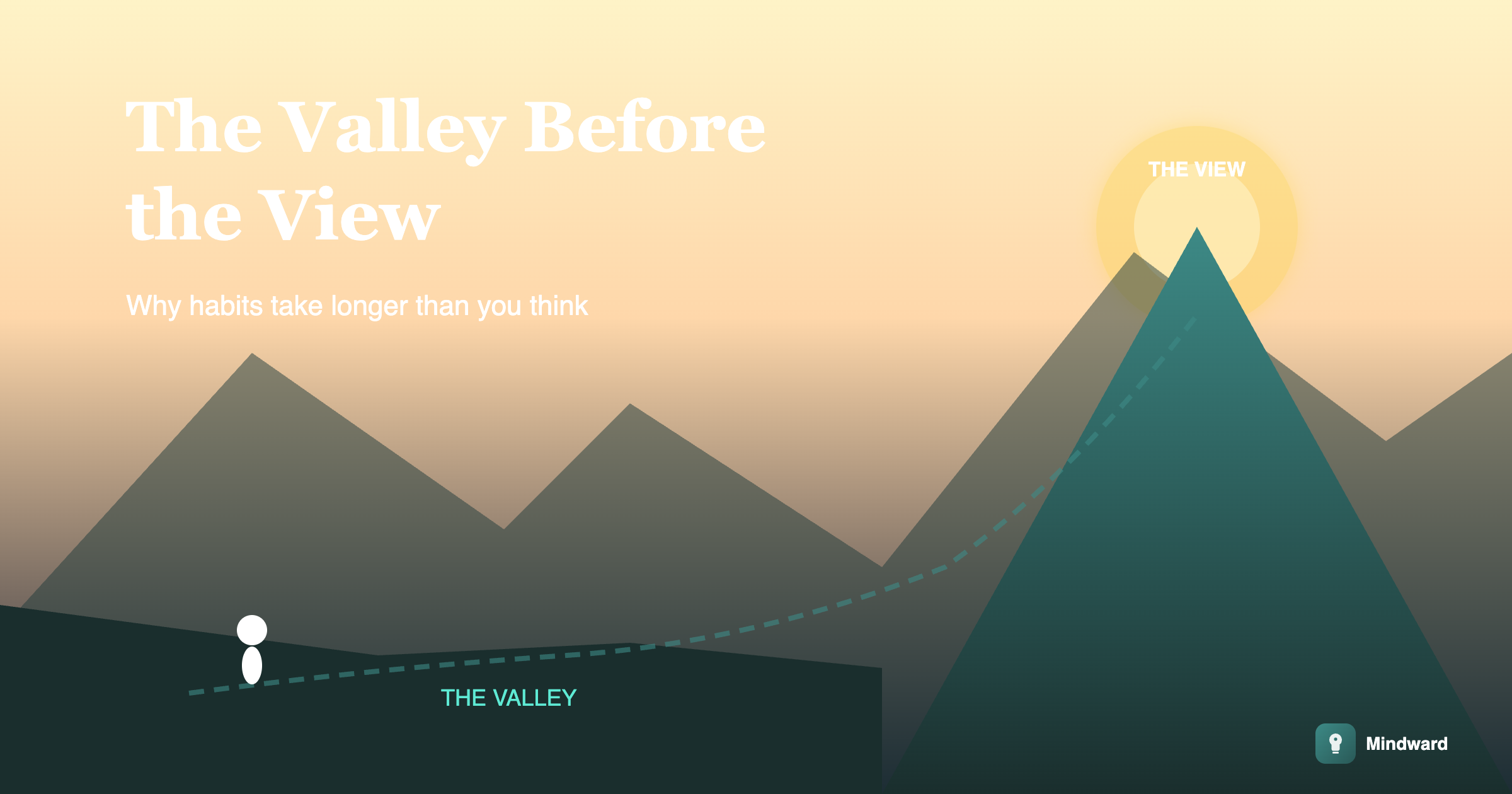
You've been at it for three weeks. Maybe six. You're doing the thing—showing up, putting in the reps, following through. And nothing has changed.
The scale hasn't moved. The skill still feels awkward. The results you expected haven't materialized. So you start to wonder: is this even working?
This is the moment most people quit. Not because the habit failed them, but because they misunderstood the timeline.
There's a valley between starting and succeeding—a stretch where effort feels wasted and progress stays invisible. Most people interpret this valley as evidence that their approach isn't working. In reality, it's evidence that transformation is underway.
The Expectation Gap
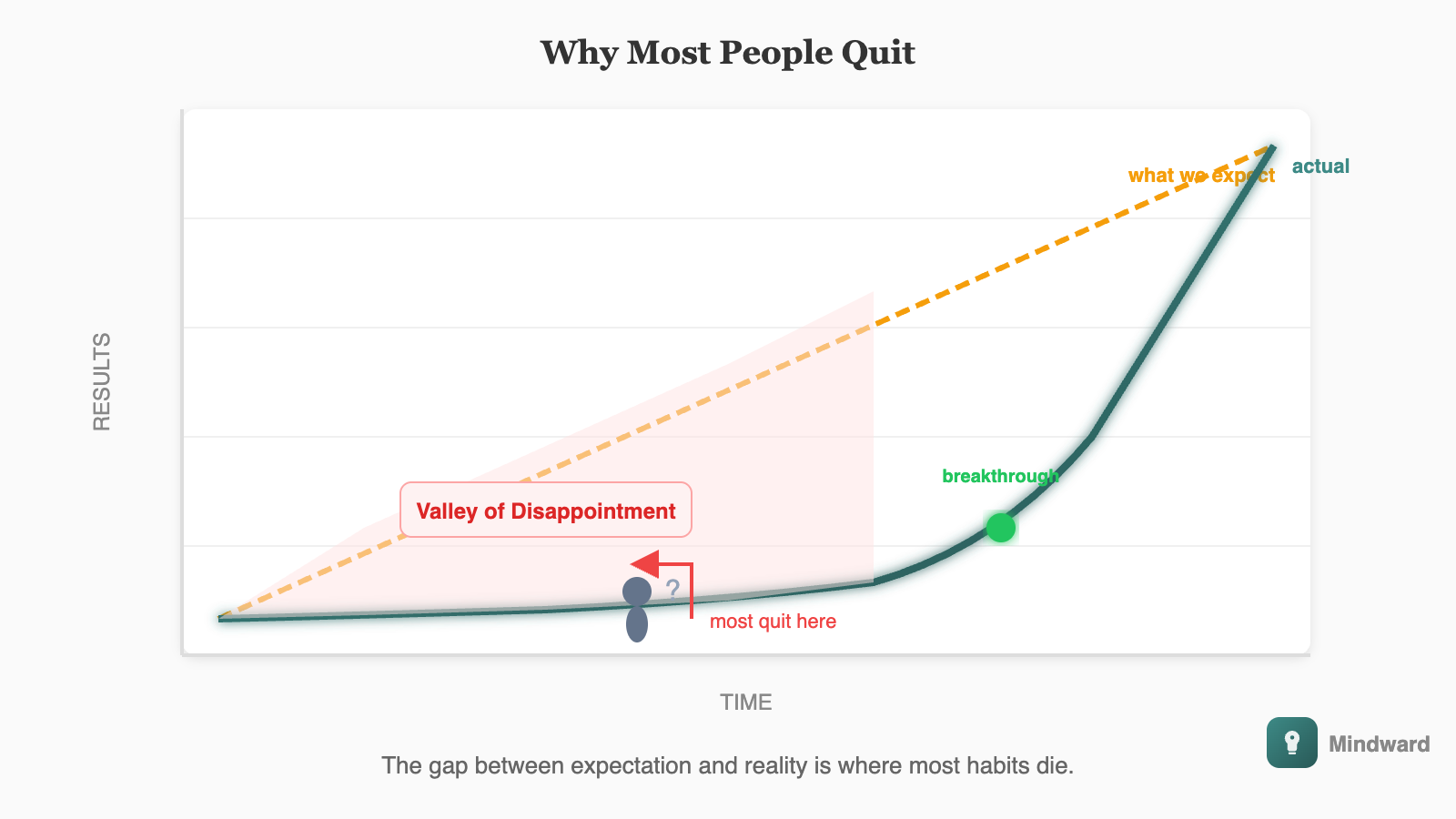
When you start a new habit, you carry an implicit expectation: effort in, results out. Linear. Proportional. Immediate. You put in the work, you see the change.
But habits don't work linearly. They work exponentially—which means the early returns are nearly invisible while the later returns are dramatic.
Think of ice melting. You can heat a frozen block from -20° to -10°, then to -5°, then to -1°. Nothing visible happens. It's still ice. Then you add one more degree and suddenly everything changes. The transformation was building the entire time—you just couldn't see it.
Your habits are working before they appear to be working. The results are accumulating in places you can't measure yet.
This gap between what you expect and what you experience is where most habits die. Not from lack of effort, but from lack of understanding. You're not failing—you're in the valley.
What's Actually Happening
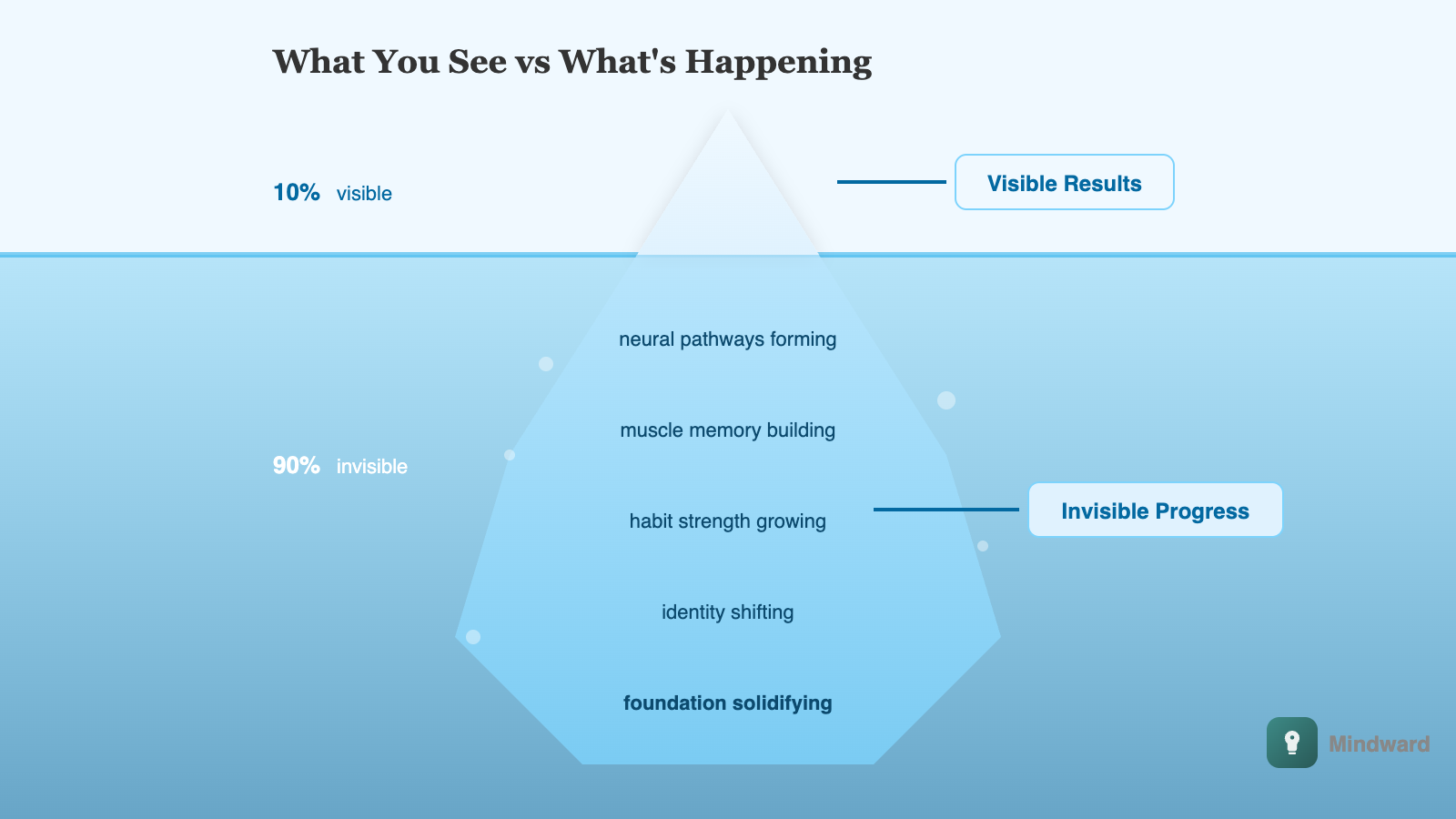
The valley isn't empty. It's full of invisible progress.
When you start running, your cardiovascular system begins adapting before your times improve. Neural pathways strengthen. Mitochondria multiply. Capillaries extend. Your body is becoming a better running machine—it just doesn't show on the stopwatch yet.
When you practice a skill, you're building mental models, developing muscle memory, internalizing patterns. The awkwardness isn't failure—it's the feeling of new neural connections forming. Competence is being constructed beneath the surface.
When you save money, the early months feel pointless—what's another $200 in an account that can't buy anything meaningful? But compound interest is awakening. Each deposit is a seed that will multiply for decades.
The work is working. You just can't see the evidence until enough work has accumulated to break through the surface.
The Breakthrough Is Non-Linear
Breakthroughs don't announce themselves gradually. They arrive suddenly, after long periods of apparent stagnation.
One day you're struggling with a concept; the next day it clicks. One month you're exhausted after every workout; the next month you're adding weight. One quarter your business is scraping by; the next quarter momentum appears out of nowhere.
These moments feel like luck or sudden talent. They're not. They're the visible eruption of invisible accumulation. The breakthrough was always coming—it was being built by every rep, every session, every day you showed up when nothing seemed to change.
The overnight success was years in the making. The sudden breakthrough was months of invisible building. What looks like transformation is actually revelation.
This is why the people who persist through the valley seem to accelerate past everyone else. They didn't find a shortcut. They just didn't stop when results were still underground.
Why We Quit in the Valley
The valley is designed to make you quit. Not intentionally—but functionally.
Your brain is wired to conserve energy, which means it's constantly asking: is this worth the effort? When effort is high and visible reward is zero, the answer feels obvious. The cost-benefit analysis fails. The rational move seems to be stopping.
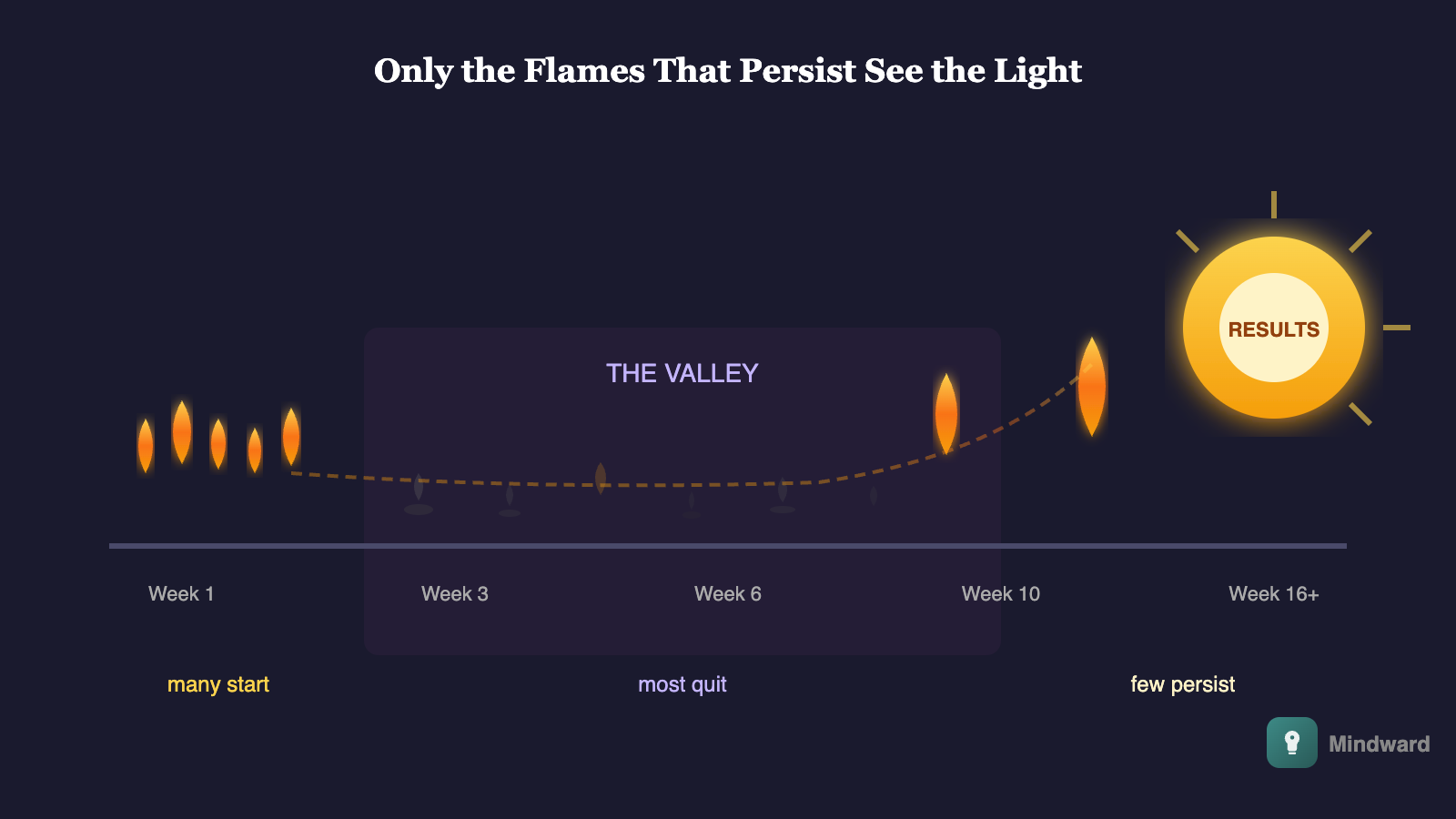
But the analysis is wrong. It's using incomplete data—measuring only what's visible while ignoring everything building beneath the surface. It's like checking whether a seed has grown by looking above the soil while roots spread unseen below.
The valley also plays tricks with comparison. You see others who appear further along and assume they have something you don't. What you're actually seeing is people who entered the valley before you—or who simply didn't quit when they were where you are now.
Every person experiencing visible results was once exactly where you are: questioning whether the effort was worth it, seeing no evidence of progress, wondering if they should try something else.
How to Survive the Valley
Knowing the valley exists doesn't make it comfortable. But it does make it survivable.
First, expect it. The valley isn't a sign something is wrong—it's a predictable phase of any worthwhile habit. When you hit it, recognize it: "Ah, this is the valley. This is supposed to happen." Naming it reduces its power.
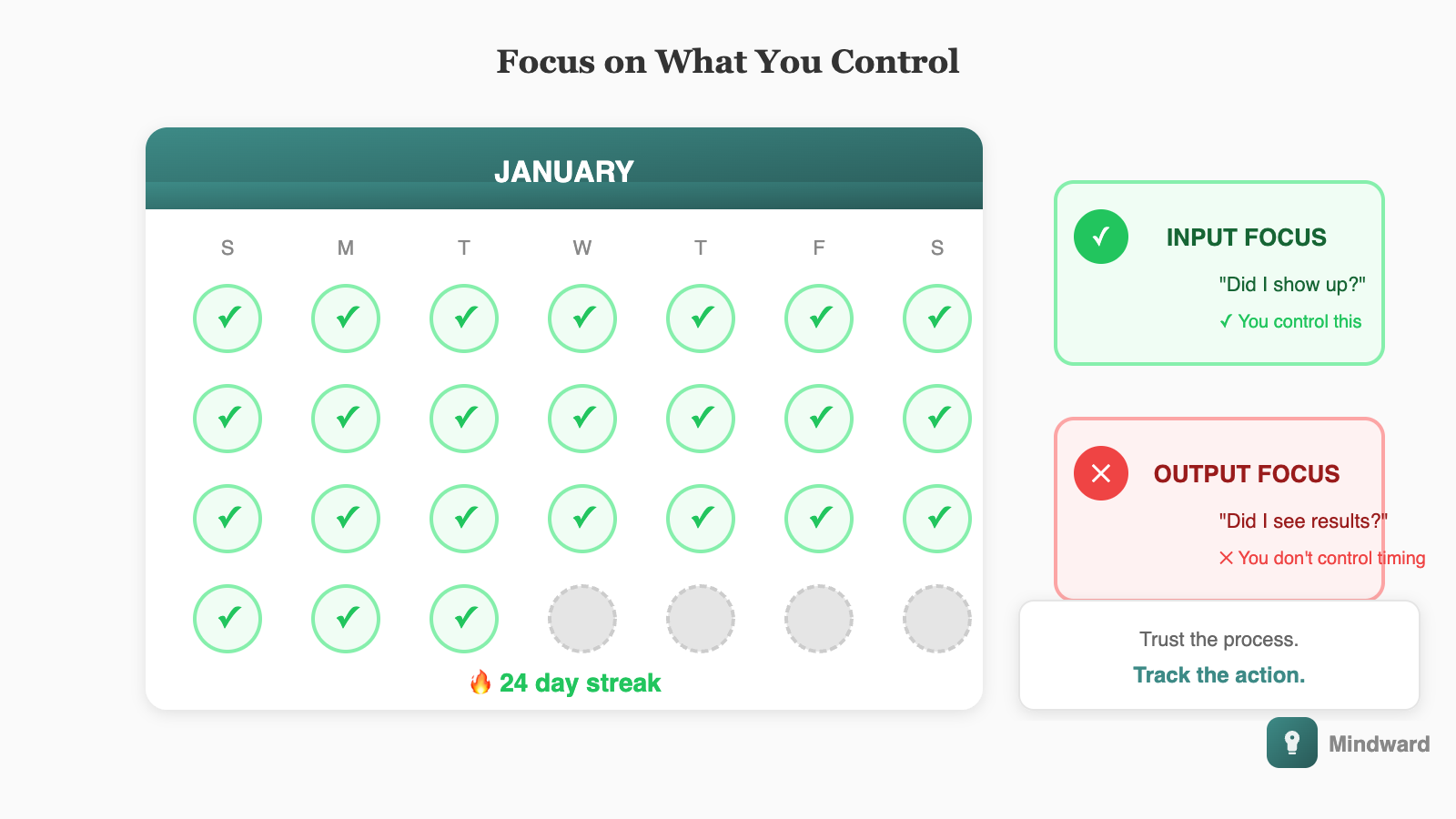
Second, track inputs, not just outputs. You can't control when results appear, but you can control whether you show up. Count your reps, log your sessions, mark your days. The input metrics prove you're doing your part—even when output metrics haven't moved.
- Days practiced instead of skill level reached
- Workouts completed instead of weight lost
- Pages written instead of book finished
- Dollars saved instead of net worth achieved
- Conversations had instead of relationship status
Third, shrink the time horizon. Instead of asking "will this work eventually?"—a question the valley makes impossible to answer—ask "can I do this today?" Stay in motion for 24 hours at a time. Stack enough days and you'll exit the valley without realizing when it happened.
The View Is Worth the Valley
There's a reason the valley exists. It's a filter.
Most meaningful accomplishments require a period of unrewarded effort. This period separates those who are committed from those who are merely interested. It separates the people who will persist from those who will pivot at the first sign of difficulty.
The valley isn't punishment. It's preparation. It's building your capacity to hold results when they arrive. It's strengthening the identity that will sustain the habit long-term. It's proving to yourself that you're the kind of person who continues when continuation is hard.
Everyone wants the view from the summit. Few are willing to walk the valley to reach it. This is precisely what makes the view valuable—and why those who persist find themselves in rare company.
The valley is the price of the view. Pay it once, own the result forever.
You're Closer Than You Think
If you're in the valley right now—showing up, doing the work, seeing nothing—understand what that means.
It means you've already done the hardest part: starting. It means invisible progress is accumulating with every repetition. It means the breakthrough is being built, one session at a time, in places you can't observe yet.
The only way to waste the work you've already done is to stop before it compounds. The only way to guarantee you'll never see results is to quit while they're still forming underground.
Keep going. Not because it feels like it's working—it won't, not yet. Keep going because you understand what the valley actually is: the necessary path between who you are and who you're becoming.
The view is coming. You just have to walk a little further.


Comments
How did you like this article?
No comments yet. Be the first to share your thoughts!