You Don't Need More Motivation. You Need Less Friction.
Stop waiting to feel motivated. Start making the right behavior so easy you do it without thinking.
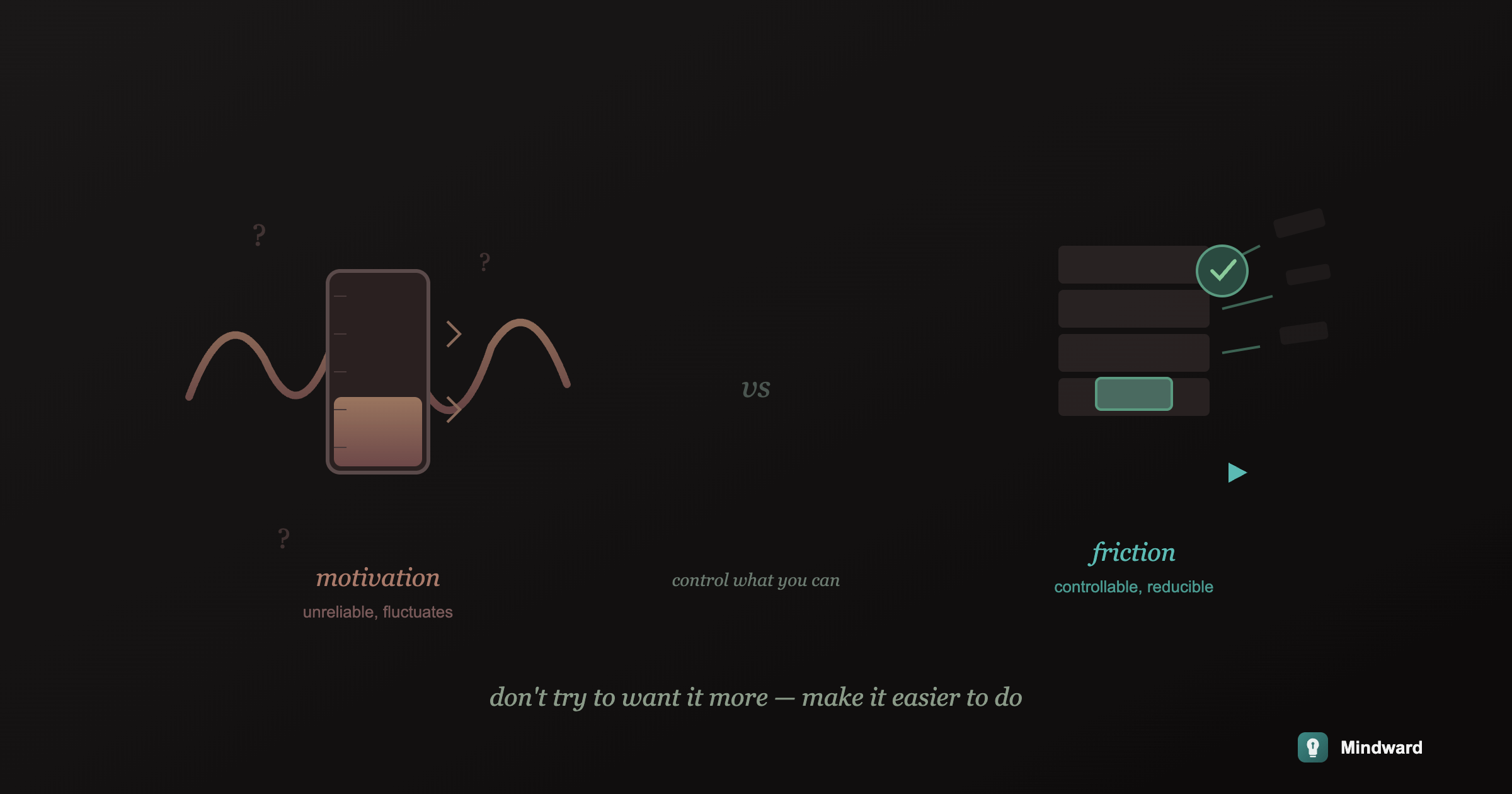
You know what you should be doing. Exercise more. Eat better. Read instead of scroll. Write instead of consume. The goal is clear. The motivation comes and goes. And when it goes, so does the behavior.
So you try to generate more motivation. You watch inspiring videos, read success stories, set ambitious goals. Sometimes it works—for a day, maybe a week. Then the feeling fades and you're back where you started, wondering why you can't seem to stick with anything.
Here's the problem: you're solving for the wrong variable. Motivation is unreliable by nature. It fluctuates with mood, energy, circumstances. Building a system that depends on motivation is building on sand.
The Real Obstacle Is Friction
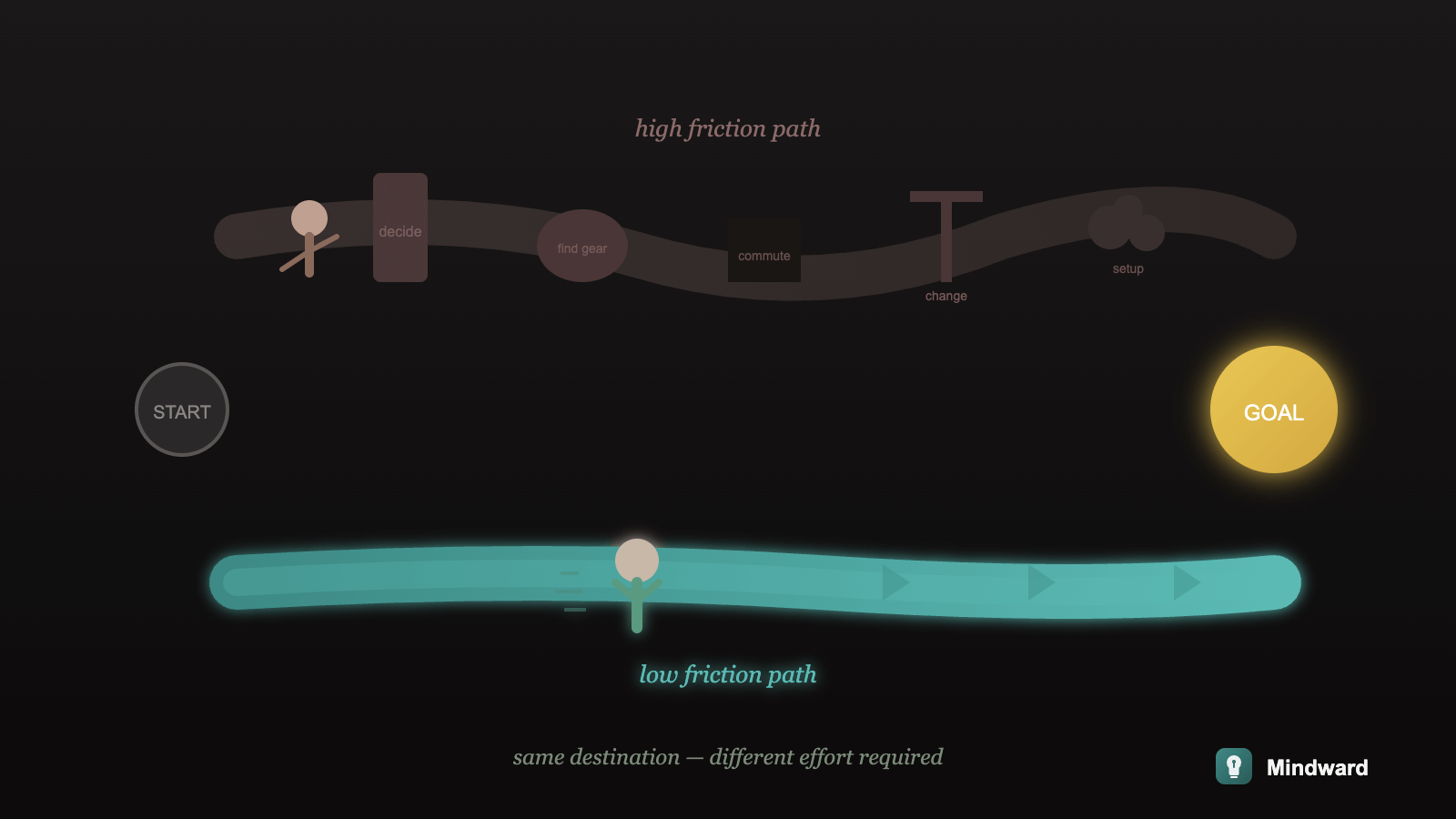
Every behavior has friction—the resistance you face before doing it. Some friction is obvious: the gym is twenty minutes away, your running shoes are in the closet, you have to change clothes first. Some friction is subtle: you have to decide what to do, remember where you left off, overcome the inertia of starting.
Friction determines which behaviors win. When you're tired, you don't do the thing with the most motivation behind it. You do the thing with the least friction in front of it. That's why you scroll your phone instead of reading—not because you want to scroll more, but because scrolling is easier.
The path of least resistance always wins. The question is whether you've designed that path intentionally or left it to chance.
Environment Beats Willpower
Willpower is trying to push through friction. Environment design is removing the friction entirely. One requires constant effort; the other requires a single decision that keeps paying dividends.
Want to read more? Put the book on your pillow. Want to eat healthier? Don't keep junk food in the house. Want to exercise? Sleep in your workout clothes. Want to write? Open the document before you go to bed so it's waiting when you wake up.
These aren't hacks or tricks. They're acknowledgments of how behavior actually works. You're not weak for struggling against friction—you're human. The solution isn't to become superhuman. It's to stop requiring superhuman effort.
The best self-control is not needing self-control. Design your environment so the right choice is the easy choice.
Adding Friction to Bad Habits
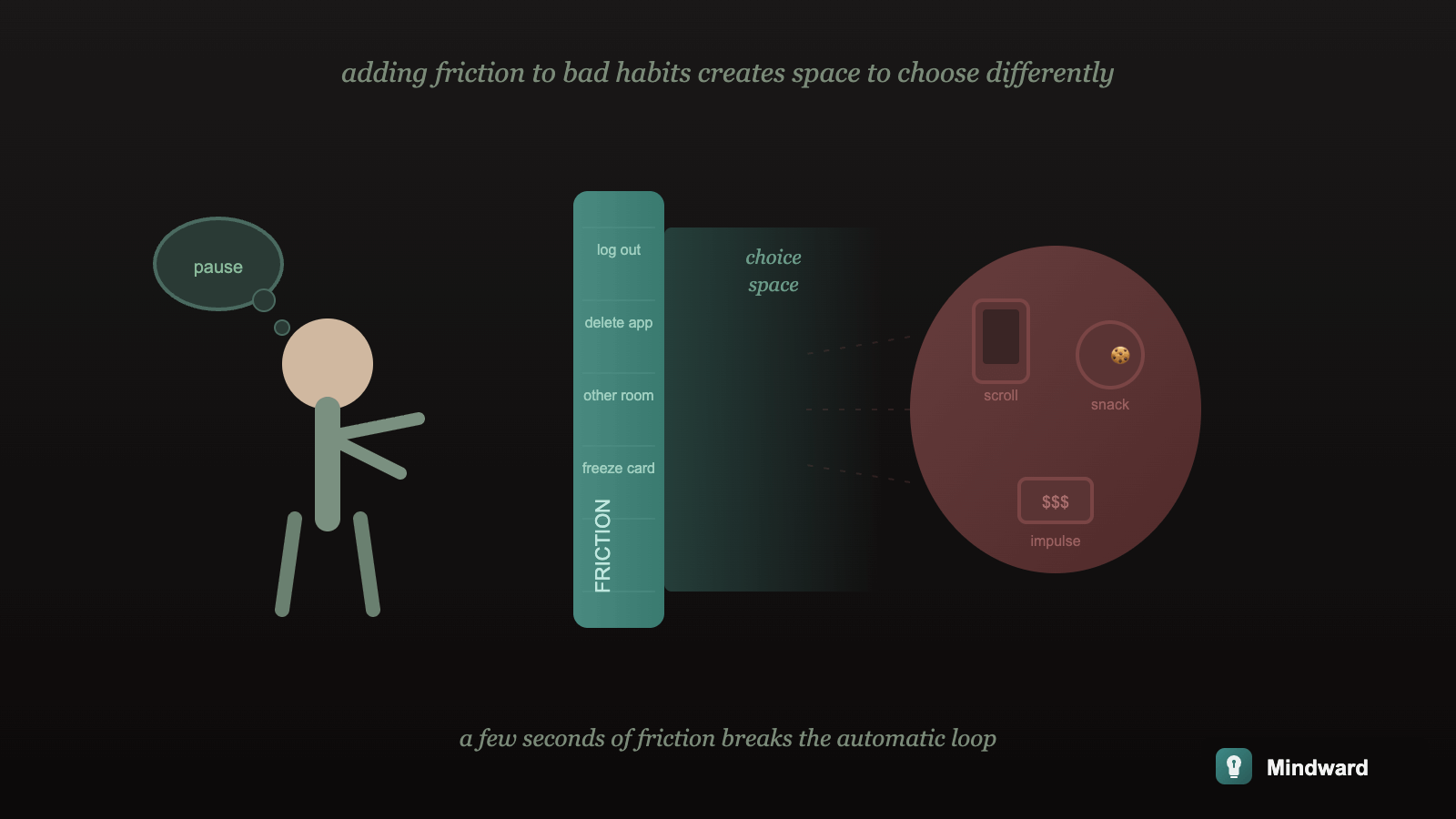
The same principle works in reverse. If friction stops good behaviors, it can also stop bad ones. You don't need willpower to resist the snack drawer if the snacks aren't in the house. You don't need discipline to avoid your phone if it's in another room.
Every step you add between yourself and a bad habit makes that habit less likely. Log out of social media so you have to log in each time. Delete the apps so you have to reinstall them. Put the credit card in a drawer so impulse purchases require deliberate action.
You're not trying to make bad behaviors impossible—just harder. Often, a few seconds of friction is enough to break the automatic loop and let you choose something else.
The Two-Minute Test
Here's a useful filter: can you start the habit in under two minutes? If not, there's too much friction. The goal isn't to complete the habit in two minutes—it's to begin it. Once you've begun, momentum often carries you forward.
If getting to the gym takes twenty minutes, you won't go when motivation is low. But if your workout starts with two pushups next to your bed, you might. If writing requires opening three apps and finding your notes, you won't write. But if the document is already open, you might add a sentence.
Reduce the behavior to its smallest starting point. Make that starting point frictionless. The rest takes care of itself more often than you'd expect.
Design Once, Benefit Daily
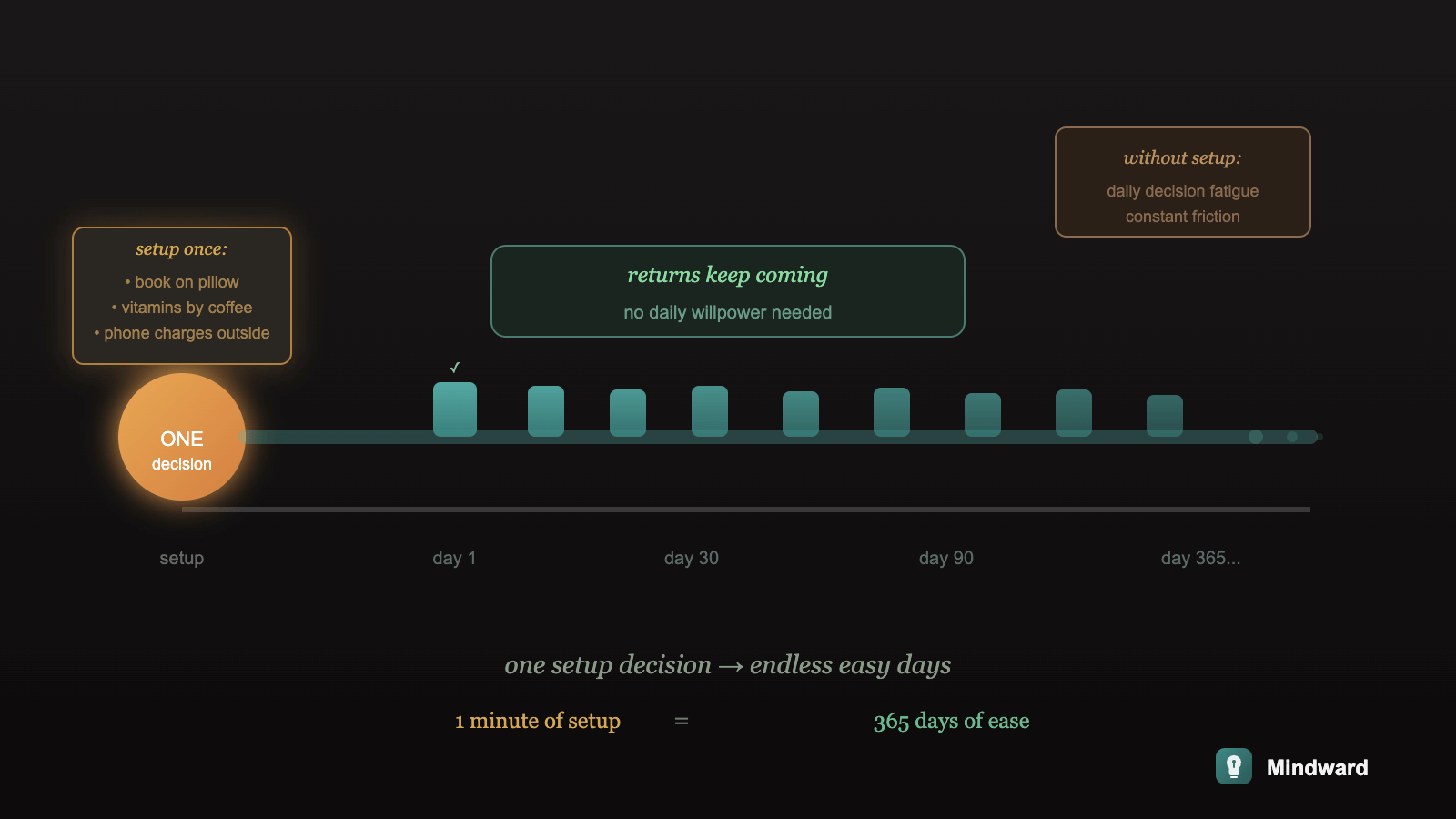
The beautiful thing about reducing friction is that it's a one-time investment with ongoing returns. You don't have to generate motivation every day—you set up the environment once and it keeps working for you.
Put the vitamins next to the coffee maker: done once, works every morning. Keep the guitar out of its case: done once, you play more. Charge your phone outside the bedroom: done once, you sleep better.
Each of these decisions takes minutes to implement but saves hours of willpower over time. You're not relying on future-you to be motivated. You're making it easier for future-you to do the right thing regardless of how they feel.
The Shift in Strategy
Stop asking "How do I get more motivated?" Start asking "How do I make this easier?" The first question puts you at the mercy of your emotional state. The second puts you in control of your environment.
You already know what you want to do. The gap between intention and action isn't motivation—it's friction. Close the gap by removing the obstacles, not by trying to jump higher.
Motivation gets you started once. Low friction keeps you going forever.
Make it easy. The behavior will follow.


Comments
How did you like this article?
No comments yet. Be the first to share your thoughts!