Habit Stacking: Anchor New Behaviors to What You Already Do
You don't need more motivation to build new habits. You need better anchors. By linking new behaviors to existing routines, you borrow momentum instead of creating it from scratch.
You already have dozens of habits. You just don't think of them that way.
You brush your teeth. You make coffee. You check your phone when you wake up. You sit in the same spot for lunch. You follow the same route home. These behaviors happen automatically—no motivation required, no decision-making involved. They're wired into your day.
This existing infrastructure is your greatest asset for building new habits. Instead of trying to create behavior from nothing, you can attach new habits to old ones—borrowing the momentum of what's already automatic.
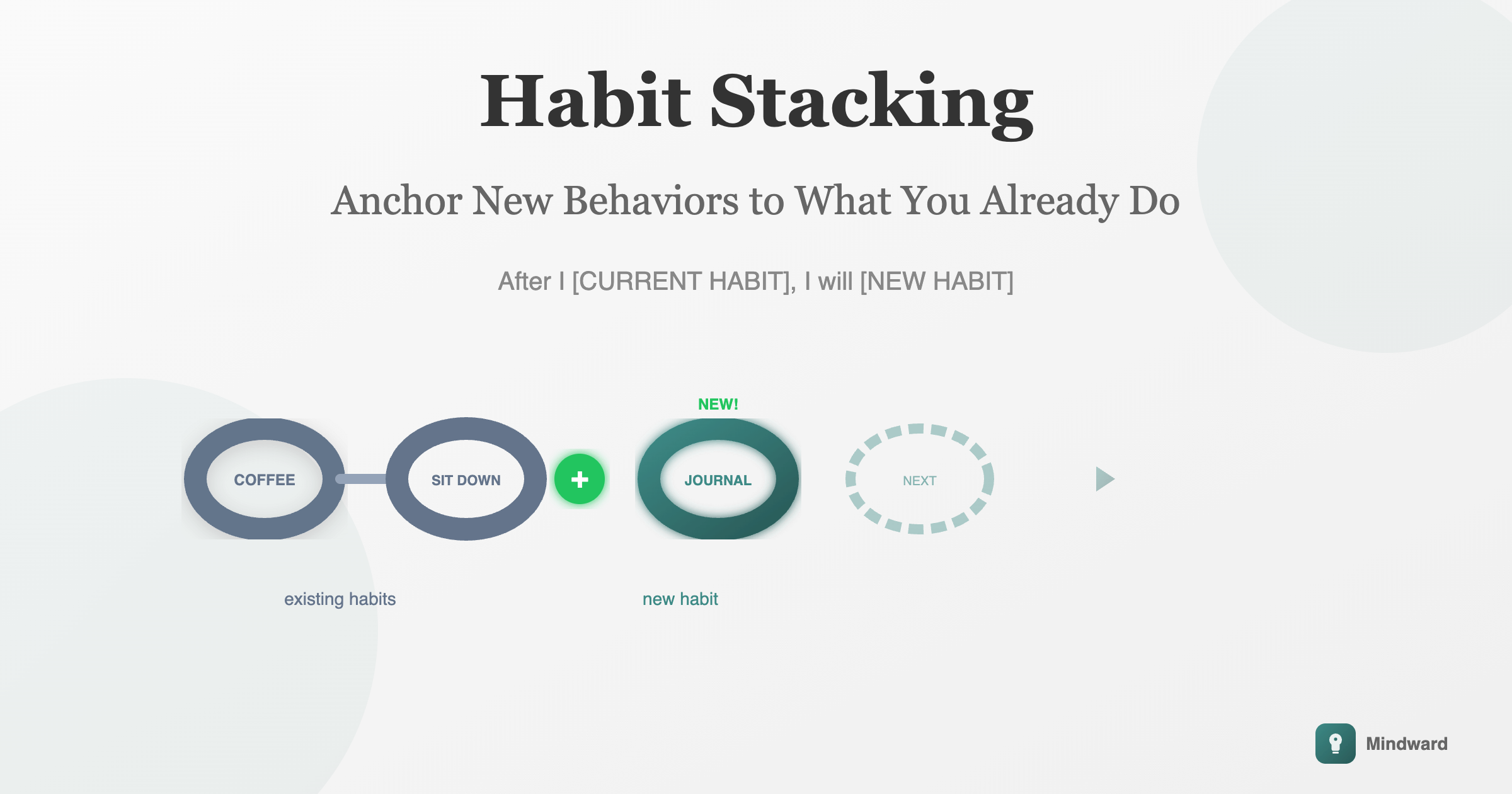
This is habit stacking: using an established habit as the trigger for a new one.
Why Stacking Works
Every habit has a cue—something that triggers the behavior. For most habits, finding a reliable cue is the hardest part. When should you meditate? When should you journal? When should you stretch? Without a clear answer, the behavior floats, waiting for motivation to show up. It rarely does.
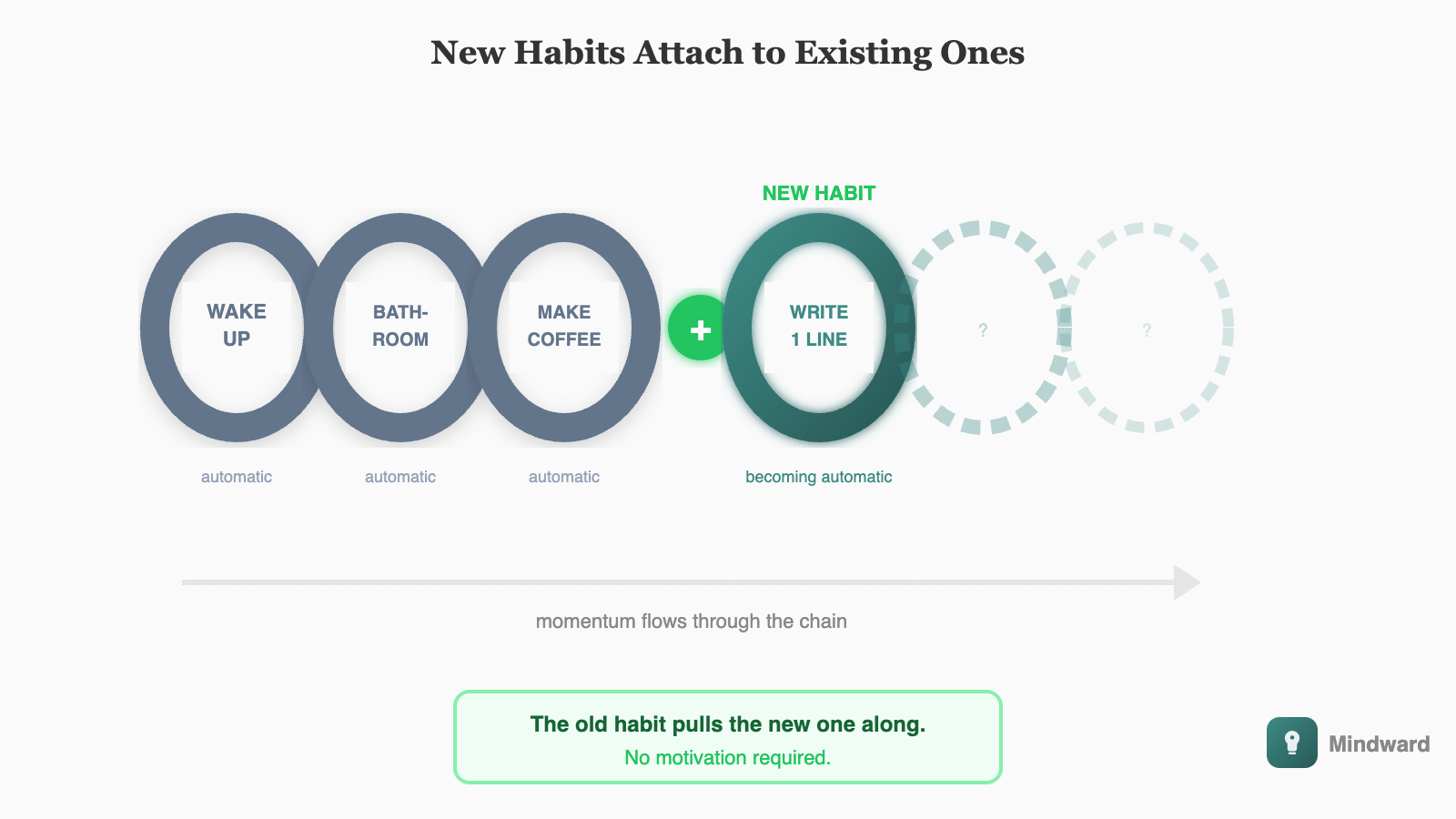
Habit stacking solves this by using an existing habit as the cue. The trigger is no longer vague or dependent on feeling like it. The trigger is something you already do, every day, without thinking.
After I [CURRENT HABIT], I will [NEW HABIT].
After I pour my morning coffee, I will write one sentence in my journal. After I sit down at my desk, I will identify my most important task. After I brush my teeth at night, I will read one page. The current habit becomes the cue. The new habit becomes the response.
This works because you're not relying on memory, motivation, or environmental reminders. You're linking into a neural pathway that already fires reliably. The old habit pulls the new habit along with it.
Finding Your Anchors
The first step is mapping what you already do. Your existing routines are full of potential anchors—you just need to see them.
Think through your day in sequence. What happens when you wake up? What's the first thing you do? What follows? Continue through morning, afternoon, evening, and night. Don't judge whether these habits are good or bad. Just list what actually happens.
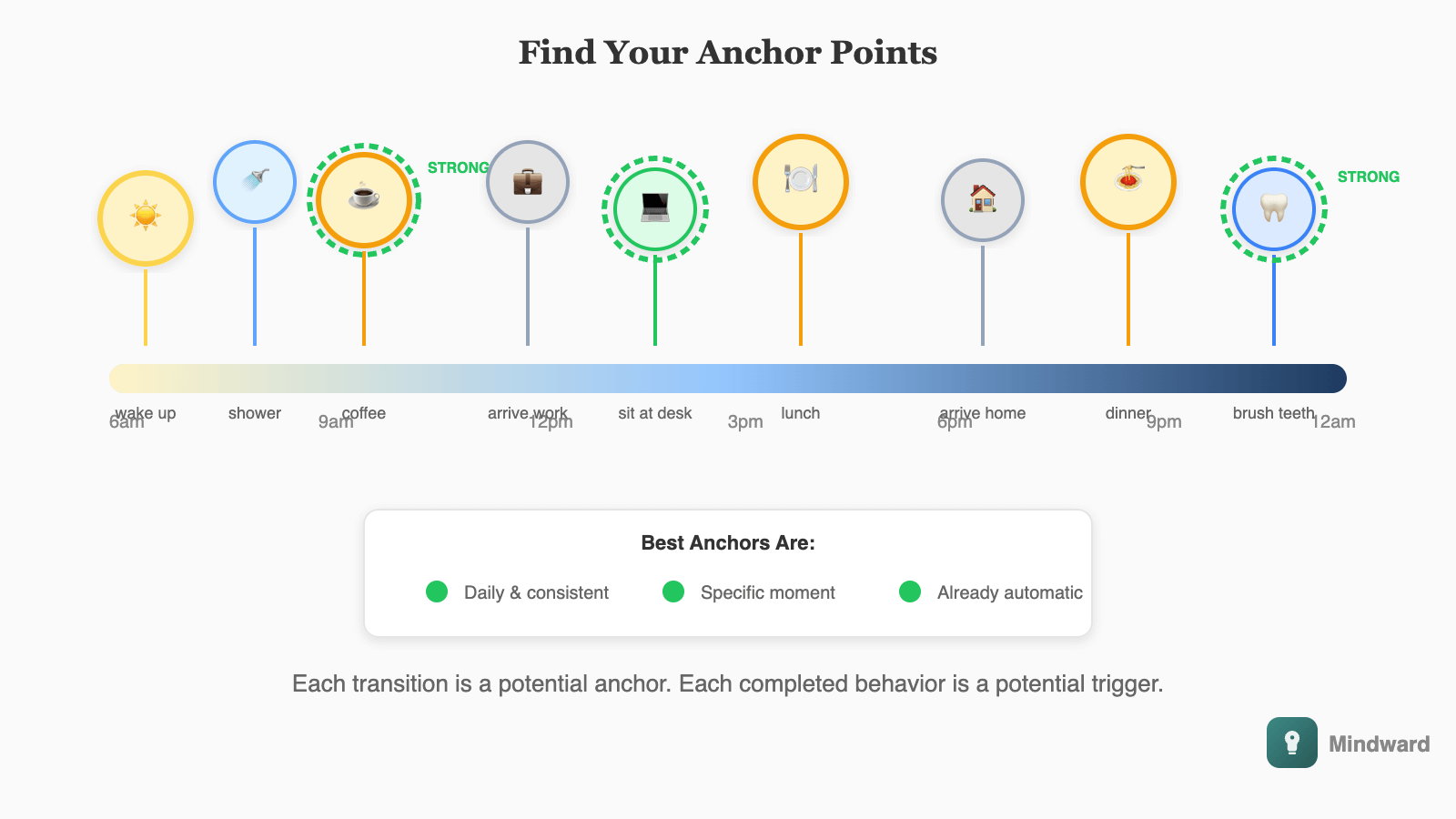
- Wake up → bathroom → shower → get dressed → breakfast → leave house
- Arrive at work → put down bag → sit at desk → open computer
- Finish lunch → clear dishes → return to work
- Arrive home → put down keys → change clothes
- Finish dinner → clear table → evening routine
- Brush teeth → get in bed → sleep
Each transition is a potential anchor. Each completed behavior is a potential trigger. The more specific and consistent the anchor, the better it works. "After lunch" is weaker than "after I put my dishes in the dishwasher."
Matching Habits to Anchors
Not every anchor works for every habit. The key is matching energy, location, and context.
A high-energy habit like exercise pairs poorly with a low-energy anchor like getting into bed. A habit requiring focus pairs poorly with an anchor that happens during chaos. A habit that needs supplies pairs poorly with an anchor away from those supplies.
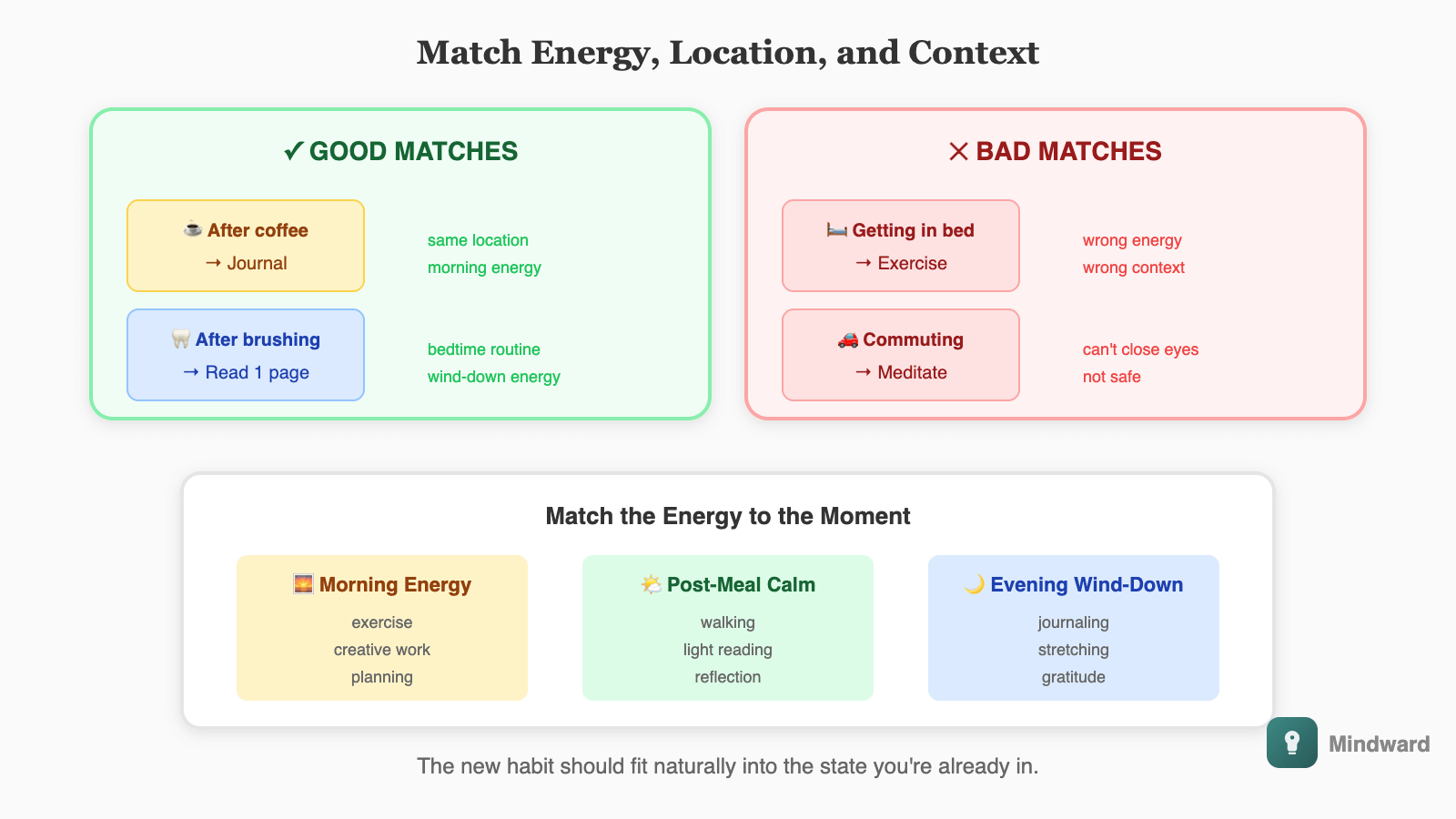
Think about what state you're in when the anchor habit completes. Are you energized or tired? Focused or scattered? Seated or moving? At home or elsewhere? The new habit should fit naturally into that state—not fight against it.
- Morning energy → exercise, creative work, planning
- Post-meal calm → reading, walking, reflection
- Evening wind-down → journaling, stretching, light reading
- Transition moments → breathing, intention-setting, gratitude
The Stacking Formula
Once you have an anchor and a new habit, combine them with this formula:
After I [ANCHOR HABIT], I will [NEW HABIT] for [MINIMUM DURATION].
The minimum duration matters. You're not committing to a full workout or thirty minutes of meditation. You're committing to the smallest viable version—enough to establish the behavior, not enough to trigger resistance.
Examples that work:
- After I pour my first cup of coffee, I will write three things I'm grateful for.
- After I sit down at my desk, I will write down my single most important task for the day.
- After I finish dinner, I will take a ten-minute walk.
- After I get into bed, I will read one page of my book.
- After I brush my teeth in the morning, I will do two minutes of stretching.
- After I close my laptop for the day, I will review what I accomplished.
Notice the specificity. Not "in the morning" but "after I pour my coffee." Not "before bed" but "after I get into bed." The more precise the anchor, the more reliably the new habit triggers.
Building Chains
Once a stacked habit becomes automatic, it can become an anchor for another habit. This is how chains form—one behavior triggering the next, creating sequences that flow without effort.
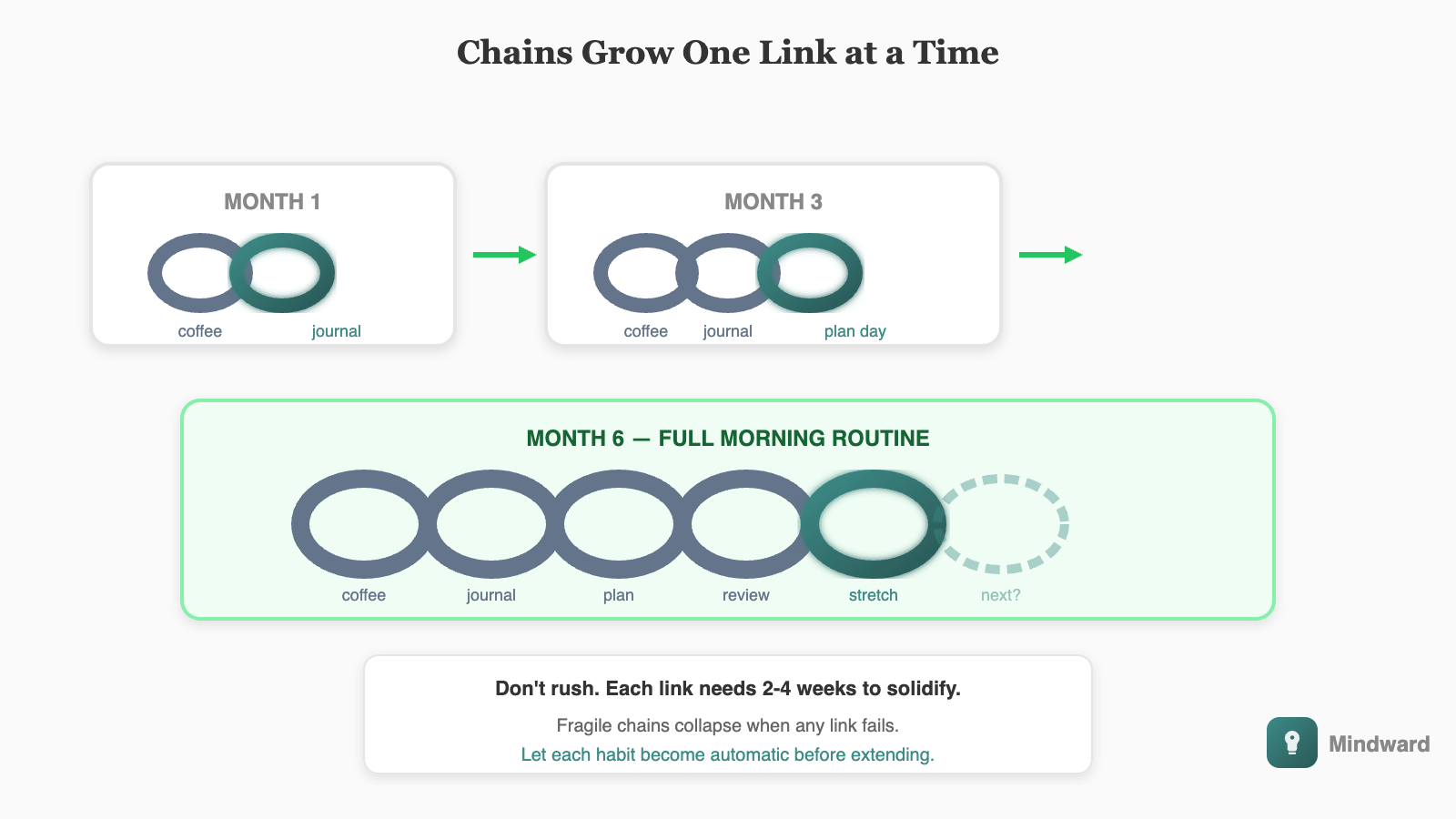
A morning routine might start as: pour coffee → write one sentence. After that's solid, it becomes: pour coffee → write one sentence → review calendar. Then: pour coffee → write one sentence → review calendar → identify top priority.
Each link in the chain started as a fragile new habit. Over time, through stacking and repetition, it becomes as automatic as the original anchor. The entire sequence eventually runs with minimal conscious input.
But don't build chains too fast. Each new link needs time to solidify before adding another. Rushing creates fragile chains that collapse when any link fails. Let each habit become automatic—usually two to four weeks—before extending.
When Stacks Break
Habit stacks are powerful but not invincible. When the anchor habit doesn't happen, the stacked habits often don't either. Travel, illness, schedule changes—anything that disrupts your anchors disrupts everything attached to them.
This is normal, not failure. The solution isn't to rely on willpower when anchors disappear. The solution is to have backup anchors—alternative triggers for important habits.
Your primary stack might be: after morning coffee → journal. Your backup might be: after first bite of lunch → journal. If one anchor fails, the other catches the behavior. The habit survives because it has multiple paths to activation.
Important habits deserve multiple anchors. Don't let a single point of failure collapse an essential behavior.
Start Your First Stack
Pick one habit you've been wanting to build. Just one. Keep it small—something that takes two minutes or less.
Now identify your strongest anchor. What do you do every single day, without exception, at roughly the same time? That's your trigger.
Combine them with the formula: After I [anchor], I will [new habit]. Write it down. Say it out loud. Post it where you'll see it.
Then test it. Tomorrow, when the anchor happens, do the new habit. Don't wait until you feel ready. Don't negotiate. The anchor fires, the habit follows. That's the only rule.
You're not building a habit from scratch. You're attaching a new car to a train that's already moving. The momentum is there. All you have to do is connect.


Comments
How did you like this article?
No comments yet. Be the first to share your thoughts!