Manage Your Energy, Not Just Your Time
You can't manufacture more hours. But you can multiply what you accomplish in them by working with your energy instead of against it.
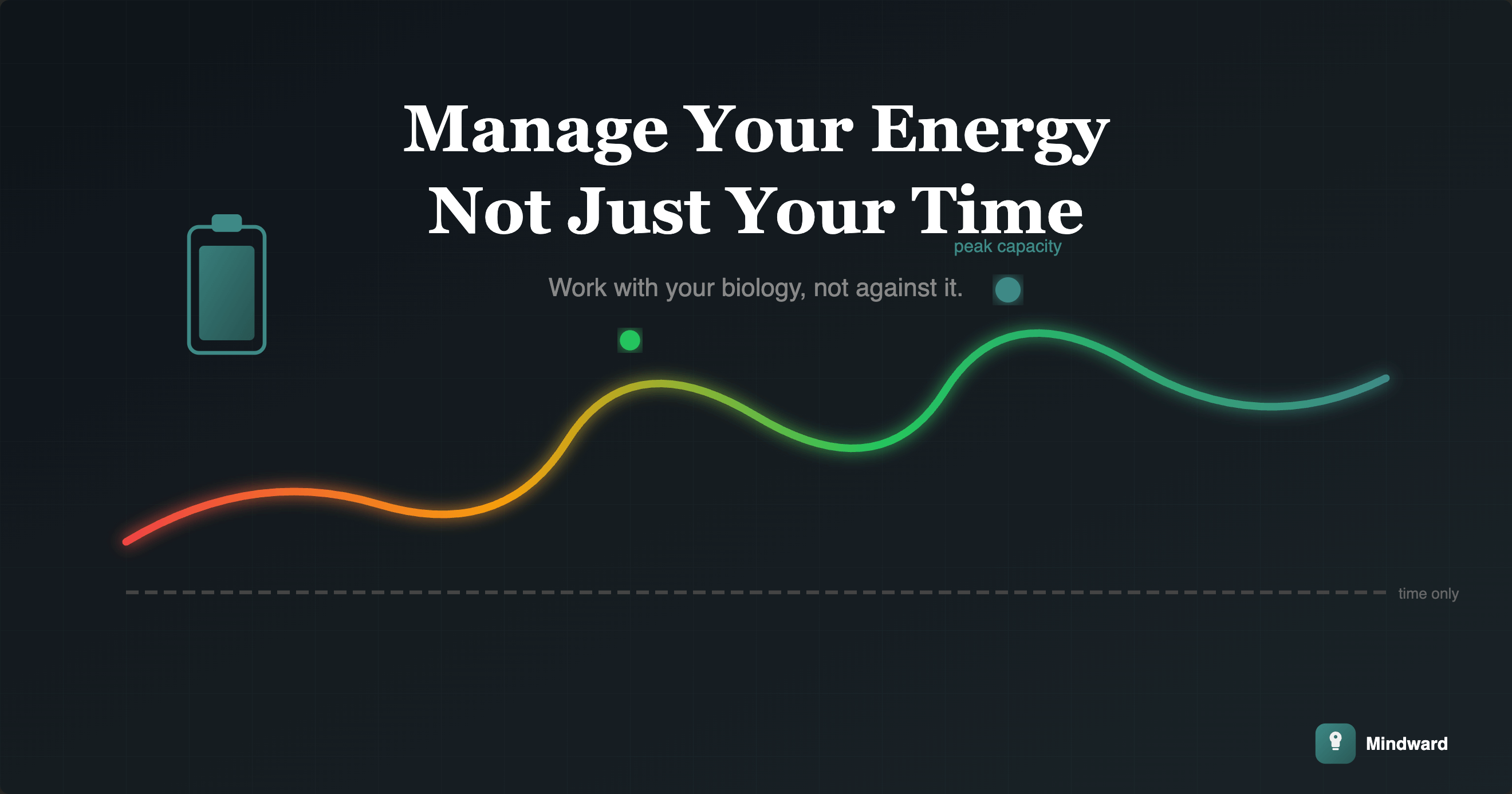
Time management is a lie we tell ourselves.
Not because managing time doesn't matter—it does. But because we treat all hours as equal when they're not. We schedule important work whenever there's an opening, then wonder why we can't focus. We push through exhaustion, calling it discipline. We optimize our calendars while ignoring the engine that actually drives performance.
The engine is your energy. And it fluctuates constantly.
You already know this intuitively. Some hours feel expansive—your mind is sharp, ideas connect, difficult tasks feel manageable. Other hours feel like wading through concrete. Same person, same work, completely different capacity.
The difference isn't willpower. It's biology.
Your Body Runs on Cycles
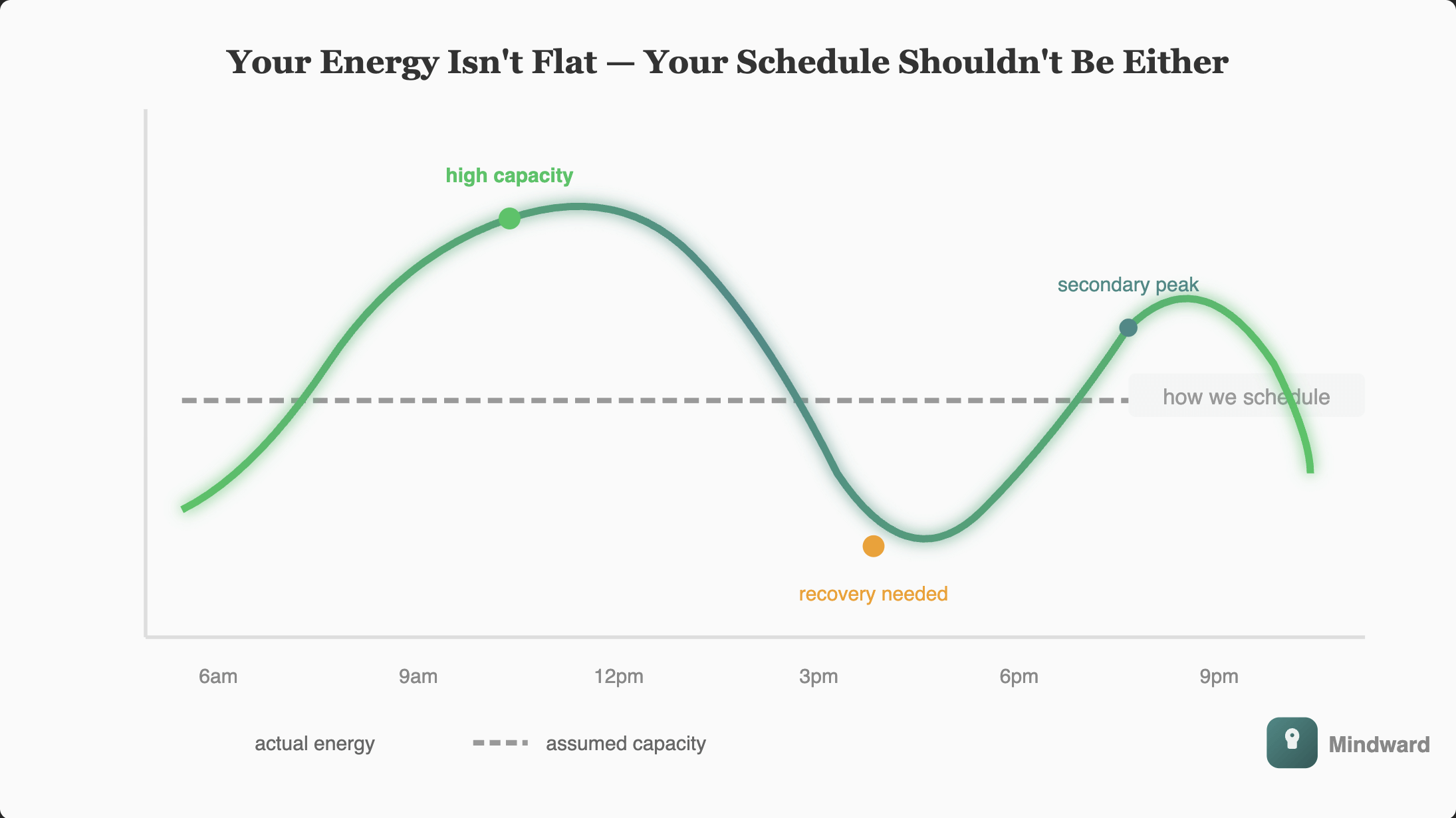
Humans don't operate in steady states. We run on ultradian rhythms—roughly 90-minute cycles of higher and lower alertness that repeat throughout the day. These cycles govern when you're naturally primed for focus and when your brain needs recovery.
On top of these shorter cycles sits your circadian rhythm, the 24-hour pattern that creates predictable peaks and dips. Most people experience their highest cognitive capacity in the late morning, a significant dip in the early afternoon, and a secondary peak in the late afternoon or early evening.
This isn't weakness. It's how human biology works.
Fighting your natural rhythms doesn't make you more productive. It makes you exhausted while accomplishing less.
When you schedule deep work during an energy trough, you're not just working harder—you're working against your own physiology. The task takes longer, the output suffers, and you burn resources you'll need later.
The Four Dimensions of Energy
Energy isn't one thing. Researchers at the Human Performance Institute identified four distinct energy dimensions, each requiring different kinds of renewal.
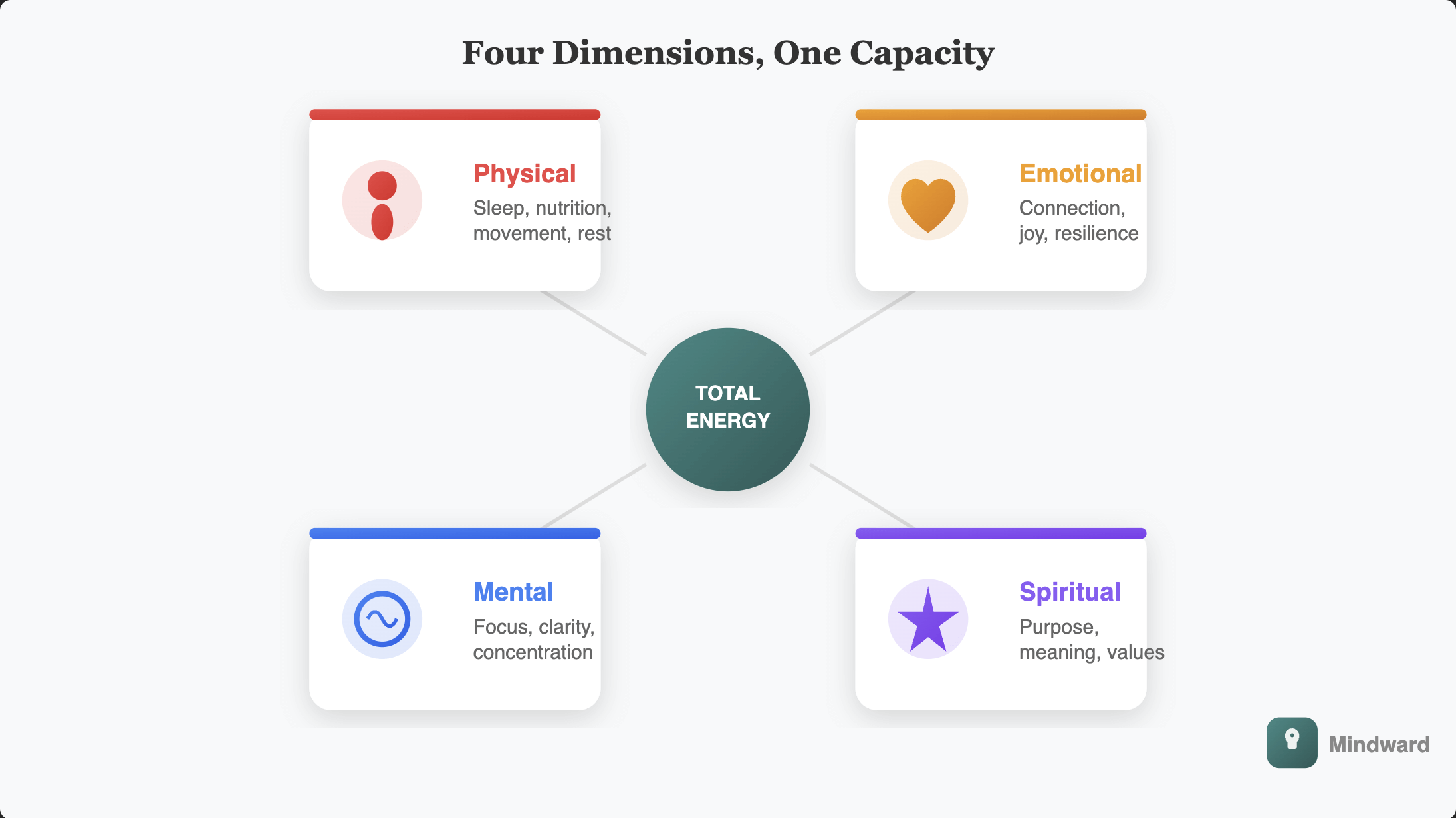
Physical energy is your foundation. Sleep, nutrition, movement, and rest directly determine your baseline capacity. Neglect your body and every other dimension suffers.
Emotional energy governs your internal climate. Anxiety, frustration, and resentment drain it. Connection, gratitude, and enjoyment restore it. You can be physically rested but emotionally depleted—and it shows in your work.
Mental energy is your capacity for focus and cognitive work. It's finite within any given period and depletes faster than we expect. Context-switching, decision-making, and sustained attention all draw from the same limited pool.
Spiritual energy—purpose, meaning, alignment with values—determines whether the other three dimensions get directed toward anything that matters. Without it, you might be energized but aimless.
Sustainable productivity requires managing all four. Optimizing one while depleting another creates the illusion of progress while building toward burnout.
Map Your Peaks
Before you can work with your energy, you need to know your patterns. Most people have never paid attention.
Track your energy for one week. Every few hours, rate your alertness and focus on a simple scale. Note what you were doing, when you ate, how you slept. Patterns will emerge.
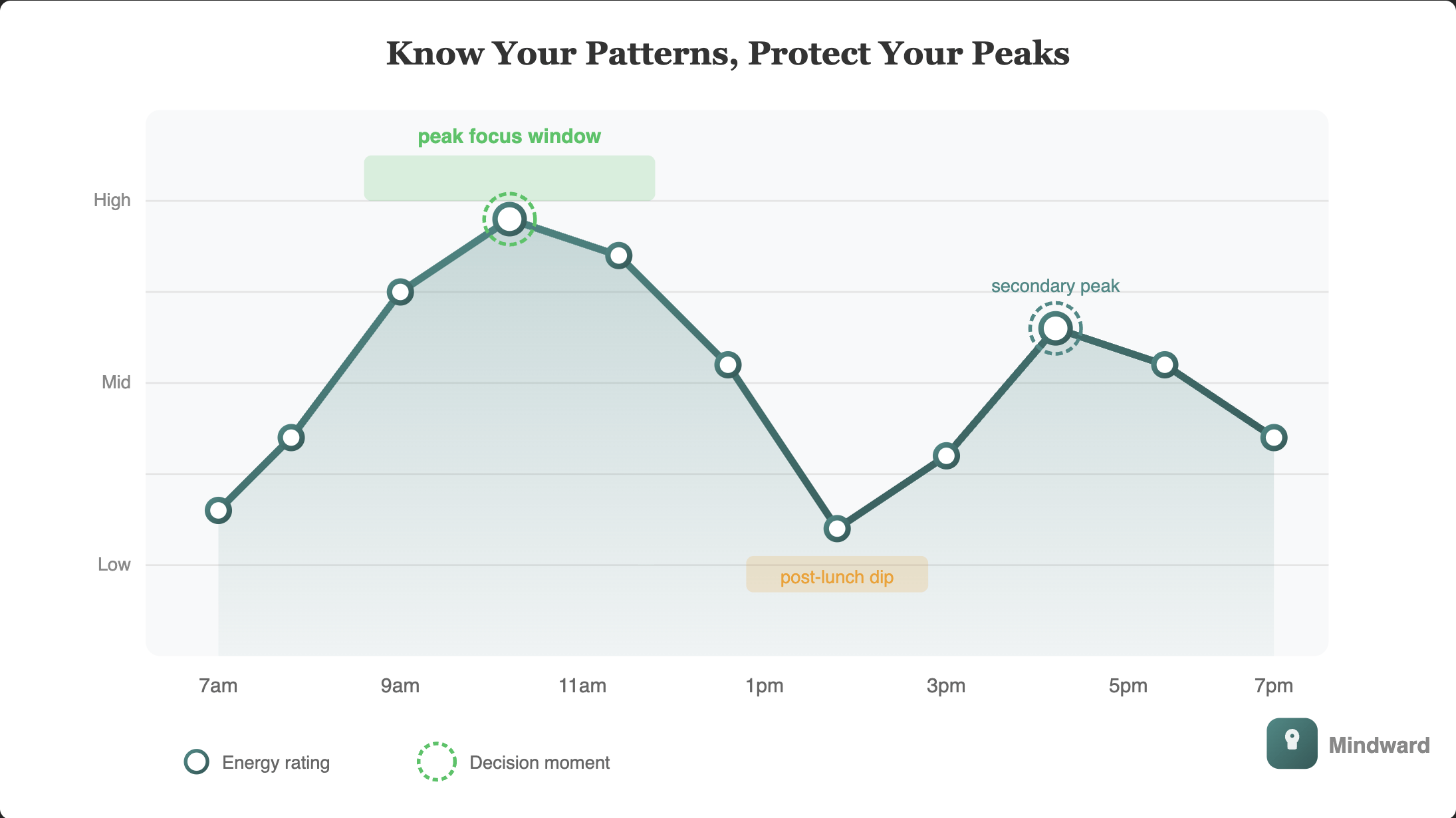
You'll likely discover that your peak window is narrower than you assumed. Most people have two to four hours of genuine high-capacity time per day. Everything else is moderate capacity or recovery.
This isn't a limitation—it's clarity. Knowing when you're at your best lets you protect that time ruthlessly.
Match Tasks to Capacity
Once you know your patterns, align your work accordingly.
- Peak hours: Deep work, creative thinking, complex problem-solving, strategic decisions
- Moderate hours: Collaborative work, meetings, routine tasks requiring some attention
- Low hours: Administrative tasks, email, simple organization, planning tomorrow
This sounds obvious. Almost no one does it.
Instead, we check email first thing because it's easy—burning peak hours on work that could happen anytime. We schedule meetings throughout the day, fragmenting whatever focus blocks remain. We save difficult tasks for the afternoon, then wonder why they feel impossible.
Your most important work deserves your best hours. Everything else can have what's left.
Protecting peak time often means disappointing people. It means blocking your calendar, declining meetings, and letting messages wait. This feels uncomfortable until you see what becomes possible when your best hours go toward your best work.
Build Recovery Into the System
High performance isn't about constant output. It's about strategic oscillation—periods of focused expenditure followed by genuine renewal.
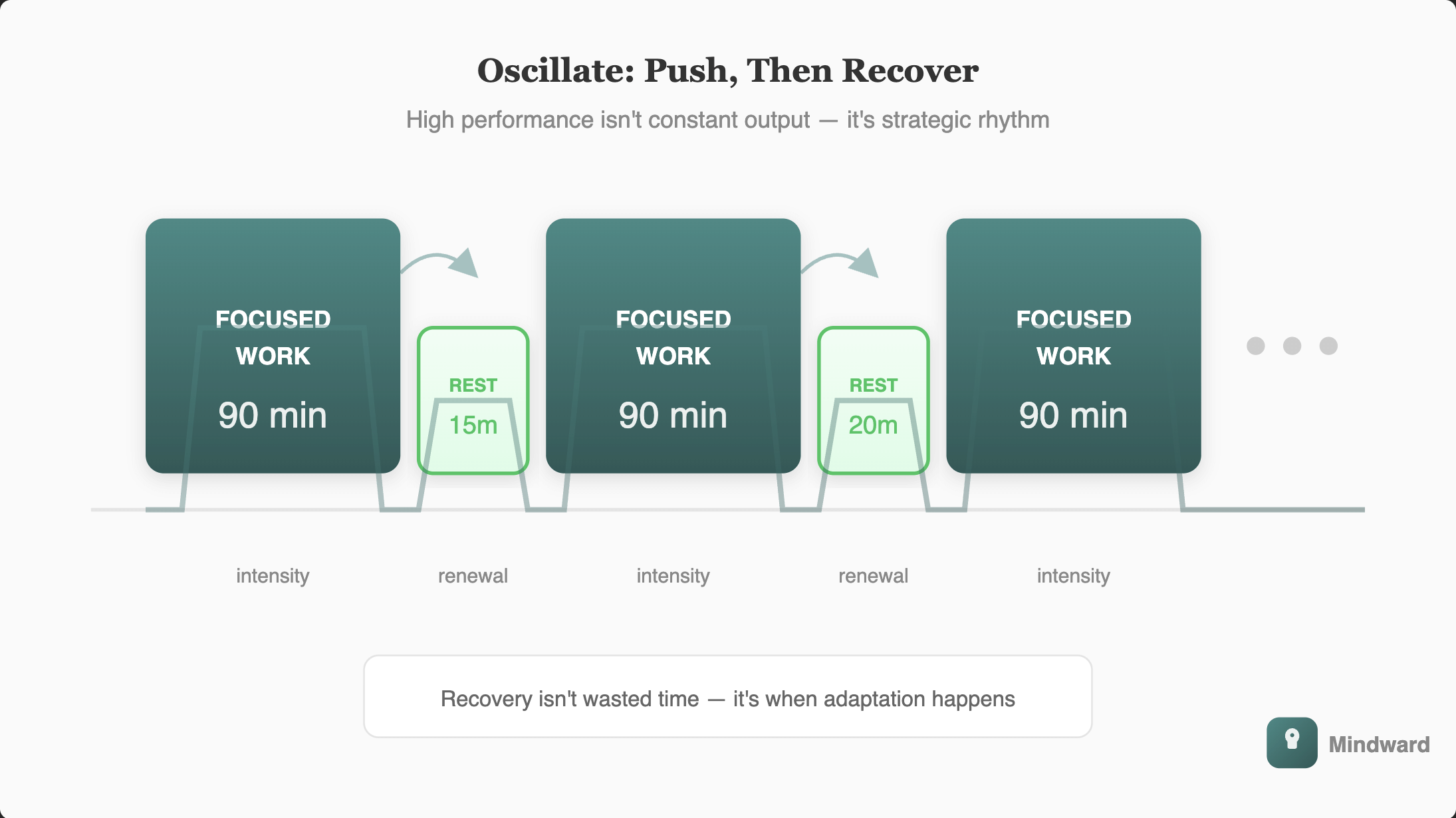
Elite athletes understand this. They don't train continuously—they train intensely, then recover completely. The recovery isn't wasted time; it's when adaptation happens.
Knowledge work follows the same principle. Pushing through fatigue doesn't demonstrate commitment; it demonstrates misunderstanding of how performance actually works.
Real recovery means disengagement. Not switching tasks—actually stepping away. A walk, a conversation, a few minutes outside. The activity matters less than the mental shift.
Build breaks into your schedule before you need them. If you wait until you're depleted, you've already lost output you won't recover.
The Compound Effect of Energy Management
Small energy choices compound dramatically over time.
One night of poor sleep reduces cognitive performance by the equivalent of being legally drunk. One week of six-hour nights creates a cumulative deficit that takes far longer to recover than the hours lost. Chronic under-recovery doesn't just reduce today's output—it degrades your baseline capacity.
Conversely, consistent sleep, regular movement, and genuine renewal don't just maintain your energy—they expand it. You become capable of more sustained focus, faster recovery, better decisions.
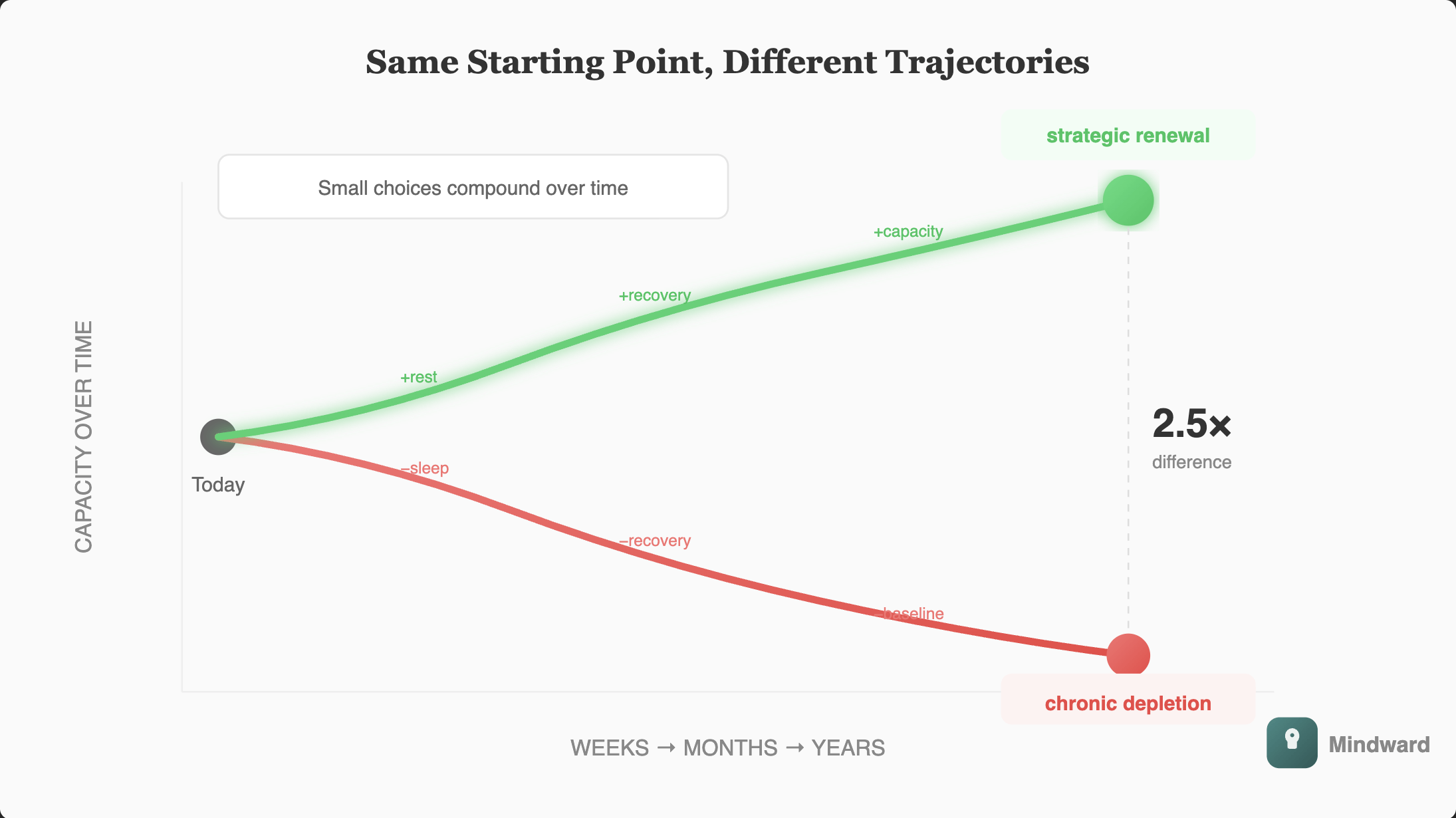
The person who works intensely for focused periods and recovers fully will outperform the person who works constantly at half-capacity. It's not even close.
Start With One Change
You don't need to overhaul everything. Pick one energy dimension that's clearly neglected and make one sustainable change.
Maybe it's protecting your first two hours for deep work instead of email. Maybe it's a consistent bedtime. Maybe it's a fifteen-minute walk after lunch to counter the afternoon dip. Maybe it's ending work at a fixed time to create real recovery.
Small changes, consistently applied, shift your entire baseline over time.
Time is fixed. You get the same 24 hours as everyone else. But energy is renewable, expandable, and—most importantly—manageable.
Stop optimizing your calendar while ignoring your capacity. The hours don't matter if you have nothing left to give them.


Comments
How did you like this article?
No comments yet. Be the first to share your thoughts!