The Real Reason You Can't Start (It's Not Laziness)
The hardest part of any task isn't the work itself—it's the invisible barrier between thinking about it and actually beginning. Here's how to dissolve that friction.
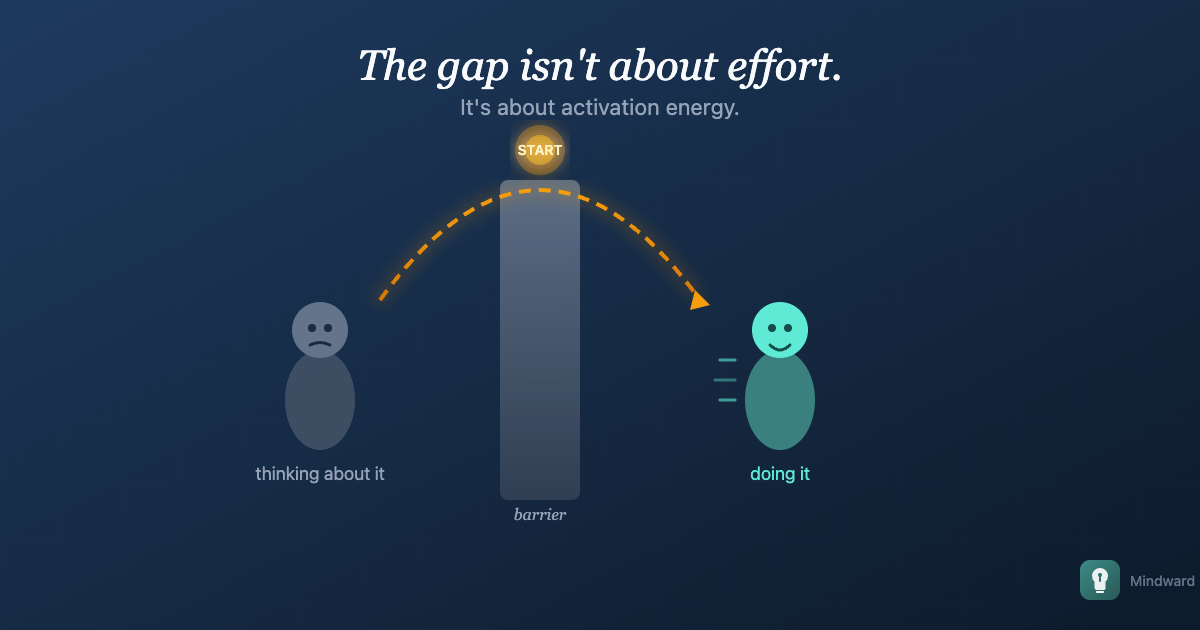
You know you should start. The task isn't even that hard. You've done similar things before, maybe even harder ones. And yet here you are, circling around it like it's surrounded by an invisible force field. Another hour passes. You check your phone. You reorganize something that didn't need reorganizing. The task sits there, unchanged, while guilt accumulates.
This isn't a character flaw. It's physics.
The Activation Energy Problem
In chemistry, activation energy is the minimum energy required to start a reaction. A match can sit next to kindling indefinitely—nothing happens until enough energy is applied to cross the threshold. Once it catches, the fire sustains itself. Your tasks work the same way.
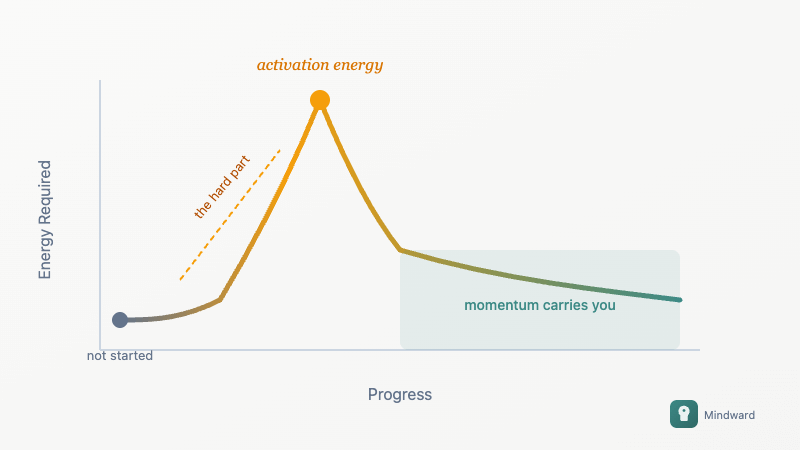
The gap between 'not doing' and 'doing' requires disproportionate effort compared to continuing once you've begun. This is why you can procrastinate for three hours on a task that takes twenty minutes. The twenty minutes of work isn't the problem. The barrier to entry is.
Understanding this changes everything. You're not fighting laziness. You're fighting friction.
Why Some Days Feel Impossible
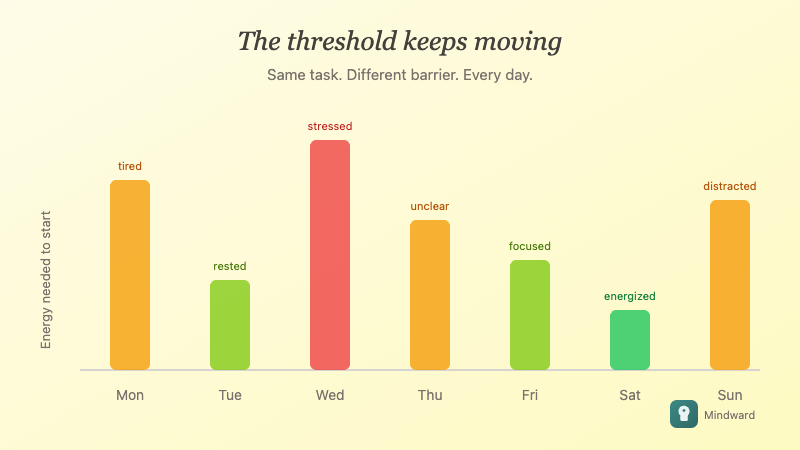
Activation energy isn't fixed. It fluctuates based on factors you might not consciously register: sleep quality, decision fatigue, emotional state, how clearly the task is defined, whether your environment supports focus. On good days, the barrier feels like a small step. On hard days, it feels like scaling a wall.
This explains the frustrating inconsistency of productivity. You're not becoming lazier or more disciplined day to day. The threshold keeps moving.
Productivity isn't about generating more willpower. It's about designing systems that lower the barrier to entry.
Shrink the Start
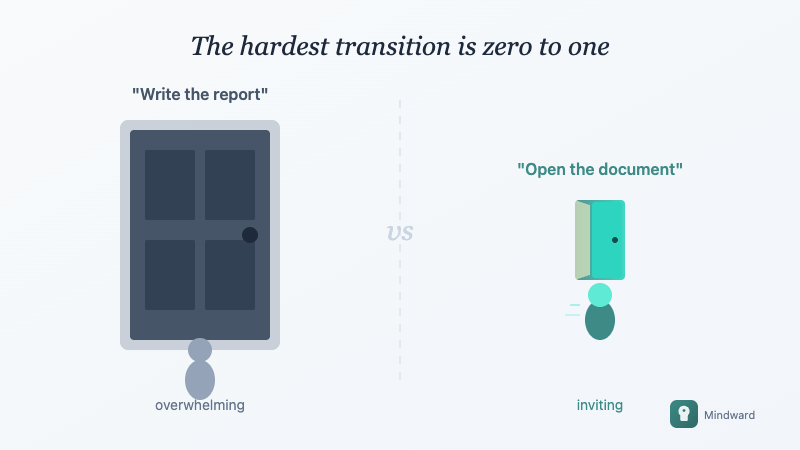
The most reliable way to overcome activation energy is to reduce the initial commitment to something almost absurdly small. Not 'write the report'—open the document. Not 'go to the gym'—put on workout clothes. Not 'clean the kitchen'—wash one dish.
This feels like cheating, like you're tricking yourself. You are. And it works because the hardest transition is from zero to one, not from one to done. Once you've crossed the threshold, momentum carries you forward.
The key is genuine permission. If you tell yourself 'I'll just do one thing and then I can stop,' you have to mean it. Some days you'll do the one thing and stop. That's fine. You still broke the seal.
Remove Decisions from the Equation
Every choice you have to make before starting increases activation energy. What should I work on? Where should I sit? What tool should I use? Which part should I begin with? Each micro-decision adds friction.
The solution is pre-deciding. End each work session by writing down exactly what you'll start with tomorrow—not a vague task, but the specific first action. 'Open quarterly report draft and revise the executive summary section.' When tomorrow arrives, there's nothing to figure out.
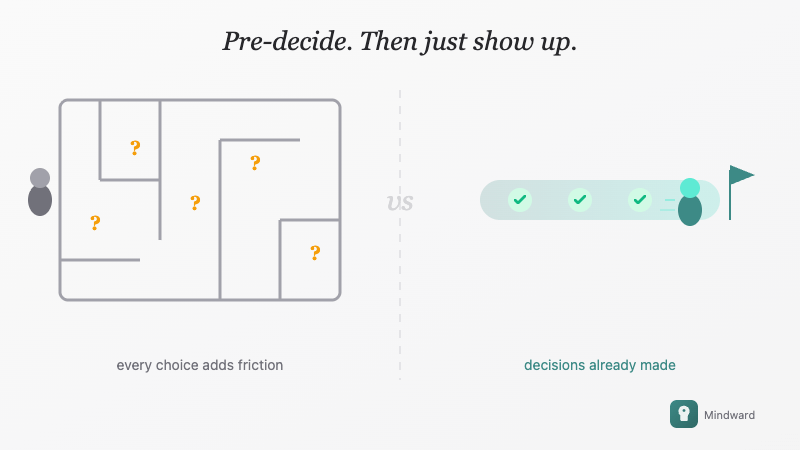
Environment matters too. If starting requires finding the right file, clearing your desk, closing browser tabs, and locating your notes, you've stacked obstacles before the work even begins. Prepare your environment in advance so starting requires nothing but sitting down.
Use Momentum, Don't Fight It
Objects in motion stay in motion. This applies to your attention and effort. Rather than constantly stopping and restarting throughout the day, batch similar tasks together. Group all your calls. Process all your emails at once. Write when you're in writing mode.
Every transition—every time you switch contexts—requires fresh activation energy. By reducing the number of transitions, you reduce the total energy tax on your day.
You don't need more discipline. You need fewer starts.
The Compassionate Reframe
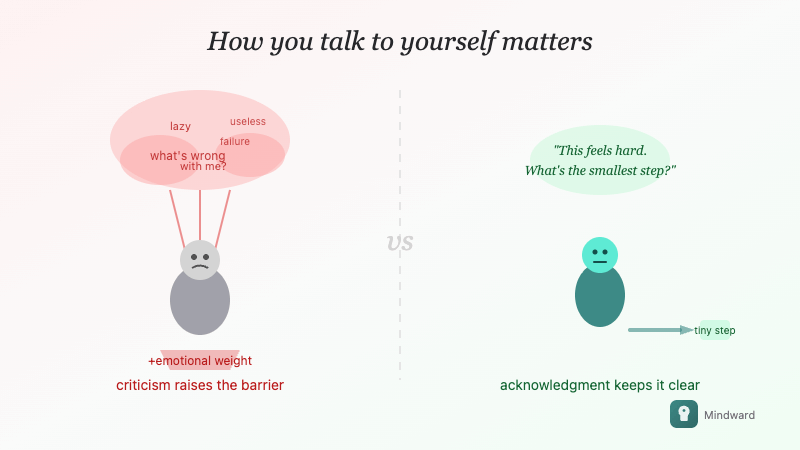
When you've been circling a task for hours, the temptation is self-criticism. Why can't I just do this? What's wrong with me? But criticism raises activation energy by adding emotional weight to the task. Now you're not just starting the work—you're also confronting feelings of inadequacy.
The alternative is recognizing the barrier for what it is: a normal part of how brains work, not evidence of personal failure. You can acknowledge the difficulty without amplifying it. 'This feels hard to start right now. What's the smallest possible step?'
Some tasks will always have high activation energy. Complex projects, emotionally loaded work, anything requiring sustained creative effort. Knowing this helps you plan realistically instead of expecting yourself to leap tall barriers through sheer will.
Building a Lower-Friction Life
Over time, the goal isn't to become someone who can push through any barrier. It's to systematically lower the barriers around things that matter. Routines reduce activation energy by removing novelty. Rituals create psychological on-ramps. Clear systems eliminate the 'figuring out' phase that makes starting feel heavy.
This is sustainable productivity—not white-knuckling your way through resistance, but architecting your days so that starting feels like sliding downhill rather than climbing up.
The match doesn't try harder to light. It just needs the right conditions. So do you.


Comments
How did you like this article?
No comments yet. Be the first to share your thoughts!