Every Time You Switch Tasks, You Pay a Tax You Can't See
Switching between tasks feels efficient. But each transition costs you more focus, more time, and more mental energy than you realize.
You finish a quick email. You glance at a Slack message. You open the spreadsheet you were working on. You check your phone. You go back to the spreadsheet. Twenty minutes have passed and the spreadsheet still looks exactly the way it did before you sat down.
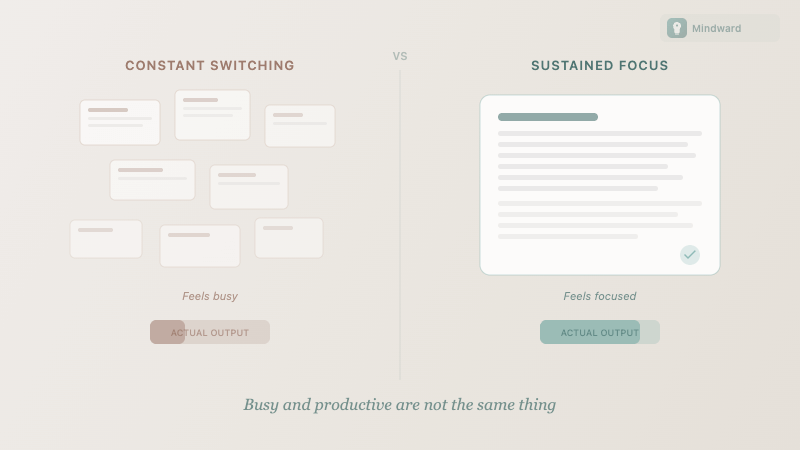
Nothing went wrong. No crisis pulled you away. You were just doing what most people do all day — bouncing between tasks, convinced you're being productive because you're staying busy. But busy and productive are not the same thing. And every time you switch, you're paying a cost you never see on any invoice.
The Tax Nobody Told You About
Researchers call it attention residue. When you move from Task A to Task B, your brain doesn't make a clean break. A piece of your attention stays behind, still processing the thing you just left. You're physically looking at the new task, but cognitively, you're split between two worlds.
Dr. Sophie Leroy's research at the University of Washington found that people who switch tasks before completing the previous one perform significantly worse on the next task. Not because they lack ability — because their attention is fragmented. The residue from the unfinished task clouds everything that follows.
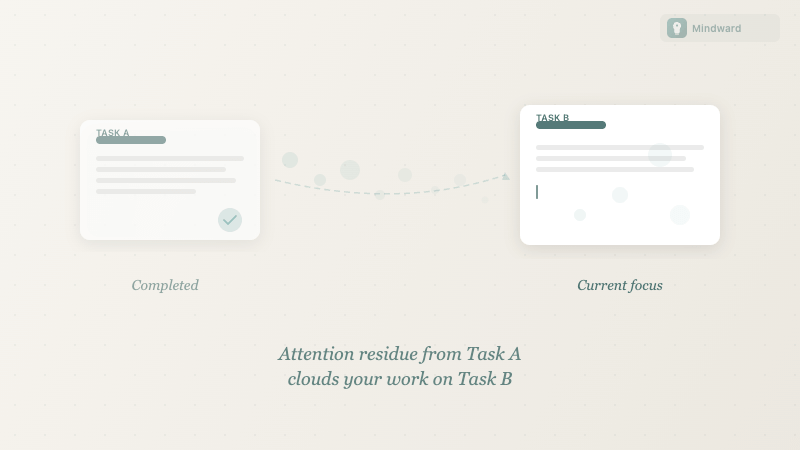
This means your quick check of email between tasks isn't free. That 30-second glance at a notification isn't neutral. Each one deposits a thin layer of cognitive residue that makes the next thing you do slightly harder, slightly slower, slightly worse.
You don't just lose the seconds it takes to switch. You lose the minutes it takes to get back to where you were.
The Recovery Time Is the Real Problem
Studies from the University of California, Irvine found that after an interruption, it takes an average of 23 minutes and 15 seconds to fully return to the original task. Not to glance at it again — to reach the same depth of focus you had before you were pulled away.
Think about what that means in a typical workday. If you switch tasks just ten times — and most people switch far more — you could be losing nearly four hours of deep, focused work. Not to breaks. Not to rest. To recovery from your own transitions.
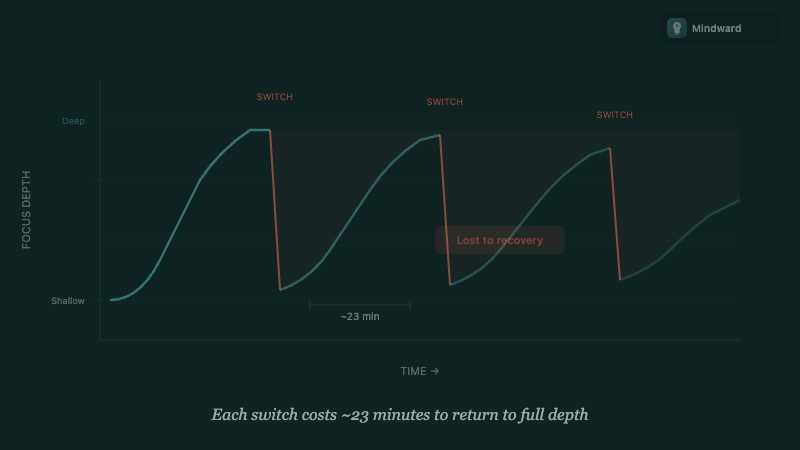
This is why some days you work eight hours and accomplish almost nothing meaningful. It's not a discipline problem. It's a switching problem. Your attention was never in one place long enough to produce anything substantial.
Why It Feels Productive Anyway
Switching feels productive because it keeps you stimulated. Every new task gives your brain a small hit of novelty. Responding to a message feels like progress. Opening a new tab feels like initiative. Your brain is getting rewarded for the motion, not the output.
This is the trap. The more you switch, the busier you feel. The busier you feel, the more productive you believe you are. But the actual work — the deep thinking, the creative problem-solving, the focused execution — that only happens when you stay with something long enough for your full attention to arrive.
Batching Is the Antidote
The most effective counter to context switching isn't willpower. It's batching — grouping similar tasks together so your brain stays in one mode for longer. Instead of answering emails throughout the day, you answer them in two dedicated windows. Instead of jumping between creative work and administrative work, you give each its own block.
Batching works because it respects how your brain actually operates. Switching between similar tasks costs almost nothing. Switching between different types of thinking — analytical to creative, communication to deep focus — is where the real damage happens.
Protect your transitions. The fewer mode-switches you make in a day, the more of your actual capacity you get to use.
Building a Lower-Switching Day
You don't need to overhaul your entire schedule. Start with three adjustments that most people can make immediately.
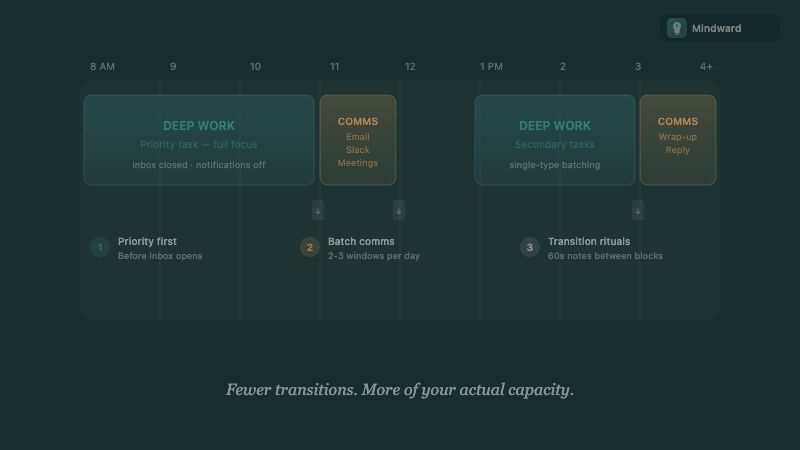
First, define your one priority task for the day and do it before you open your inbox. Email is someone else's agenda. Your most important work deserves your freshest attention, not whatever's left after you've already scattered it across a dozen small requests.
Second, batch your communication. Set two or three specific times for email and messages. Outside those windows, close the tabs. Not minimize — close. The visual presence of an inbox is enough to split your attention even if you don't click on it.
Third, use transition rituals. When you finish a task, take 60 seconds to write down where you are and what comes next. This gives your brain permission to release the current task. Without that closure, the residue follows you.
Your Attention Is Finite. Spend It Like It Matters.
You already have enough time in your day. You already have enough ability. What you might not have is enough unbroken attention — because you've been spending it in fragments so small they can't buy anything meaningful.
The goal isn't to do more things. It's to do fewer things with your full mind present. When you stop paying the switching tax, you don't just get more done — you get to experience what your focus is actually capable of when it's not being torn apart every few minutes.
Tomorrow, before you start your day, ask yourself one question: what is the one thing that deserves my undivided attention today? Then give it exactly that — before anything else gets a chance to fragment it.


Comments
How did you like this article?
No comments yet. Be the first to share your thoughts!