Design Your Environment, or It Will Design You
Willpower is unreliable. Environment is constant. The most effective way to change your behavior is to change what surrounds you.
You are not as in control as you think. Your environment is making decisions for you—constantly, invisibly, automatically.
The food on your counter determines what you eat. The apps on your home screen determine how you spend your time. The layout of your workspace determines whether you focus or drift. The people you see daily determine what you believe is normal.
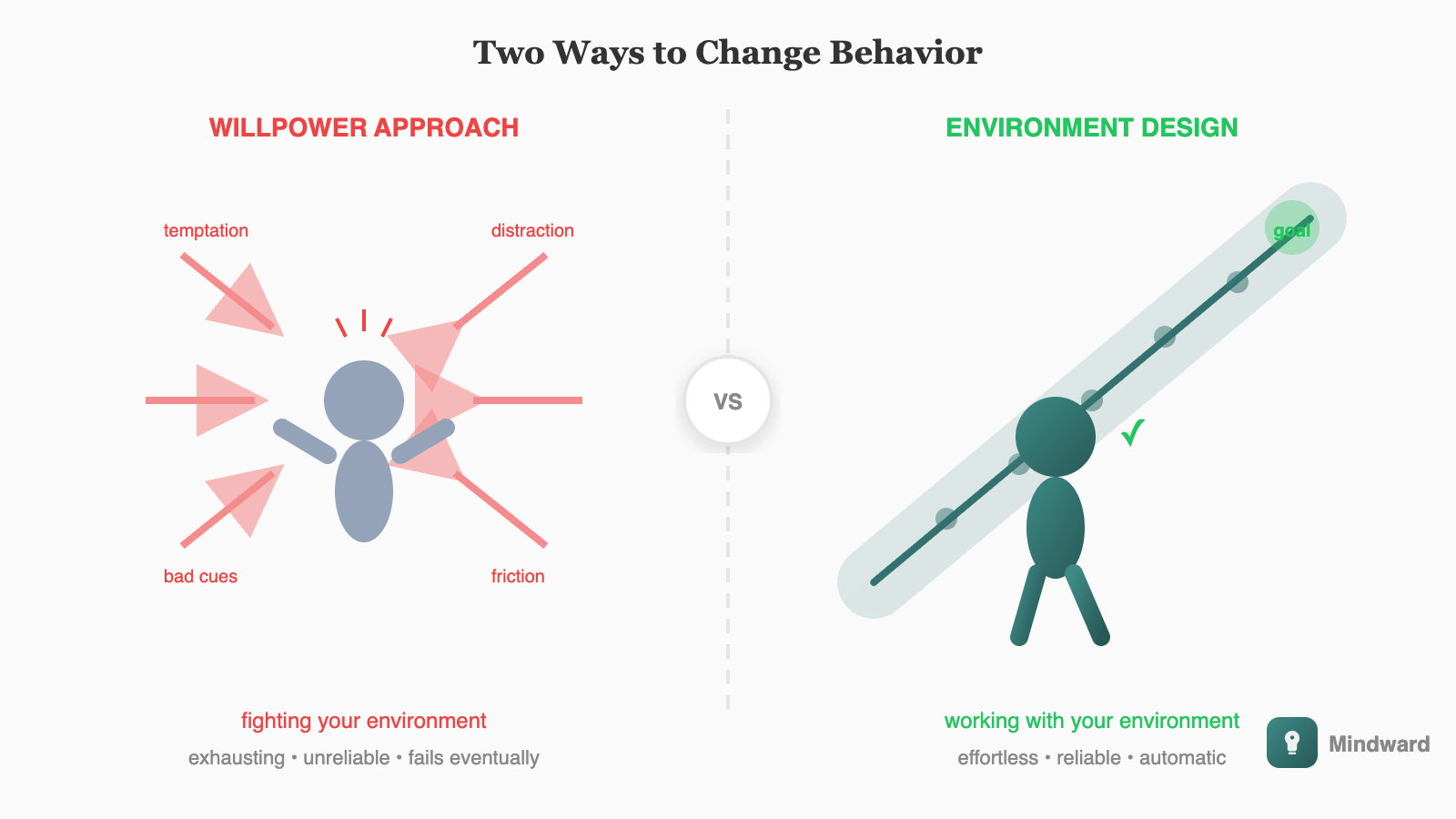
Most people try to change behavior through willpower—gritting their teeth, making promises, forcing themselves to choose differently in the same environment that shaped the old behavior. This approach fails reliably because it fights human nature instead of working with it.
The alternative is environment design: restructuring your surroundings so the behavior you want becomes the path of least resistance.
Why Environment Wins
Every behavior has a context. You don't just decide to eat a cookie—you see the cookie, smell the cookie, remember cookies taste good, and then eat the cookie. The decision happens downstream from the environment.
Research consistently shows that environmental cues drive behavior more than intentions or motivation. People eat more from larger plates. They watch more TV when the remote is within reach. They check their phones when notifications are visible. The environment votes first; willpower gets whatever's left.
You don't rise to the level of your goals. You fall to the level of your environment.
This isn't weakness. It's efficiency. Your brain is constantly looking for ways to conserve energy, and following environmental cues requires less effort than overriding them. The path of least resistance isn't laziness—it's biology.
The implication is profound: if you want different behavior, create a different environment. Don't rely on making better choices in the same context. Change the context.
The Two Levers: Friction and Cues
Environment design works through two primary mechanisms: friction and cues.
Friction is the effort required to perform a behavior. Every additional step, second, or obstacle reduces the likelihood you'll do something. To encourage a behavior, reduce friction. To discourage a behavior, increase friction.
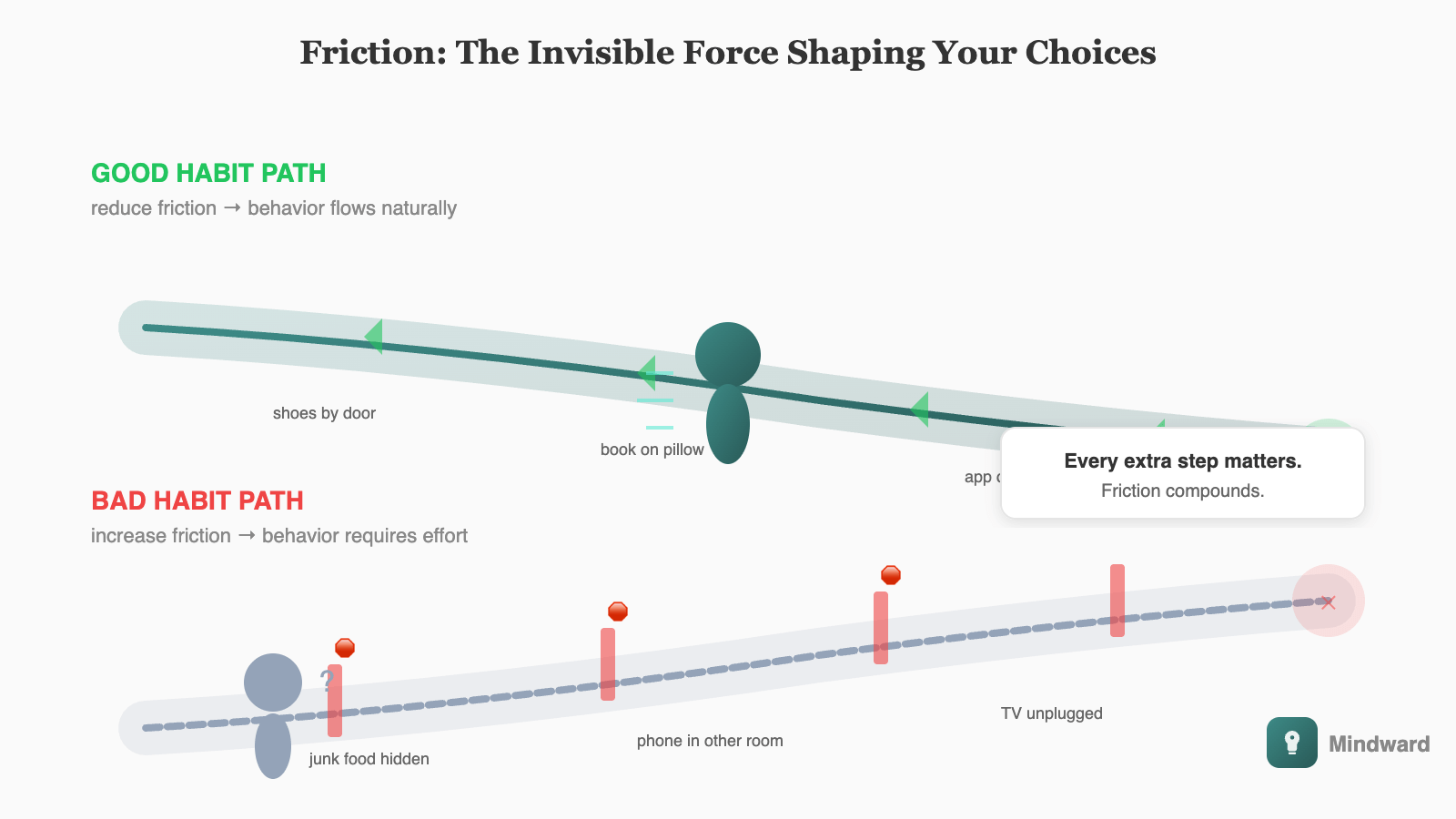
- Want to exercise? Sleep in your workout clothes. Put your shoes by the door.
- Want to eat better? Keep fruit on the counter. Put junk food in an opaque container on a high shelf.
- Want to read more? Leave a book on your pillow. Remove the TV from your bedroom.
- Want to check your phone less? Delete social apps. Charge it in another room.
- Want to practice guitar? Keep it on a stand in plain sight, not in a case in the closet.
Cues are the triggers that prompt behavior. Your brain is constantly scanning for signals about what to do next. A visible cookie jar cues snacking. A guitar on a stand cues playing. An open browser tab cues distraction.
To build good habits, make the cues obvious. To break bad habits, make the cues invisible. Your environment should constantly remind you of who you want to be—not who you're trying to stop being.
The Visibility Principle
Out of sight, out of mind. In sight, in mind. This simple truth drives more behavior than most people realize.
A study of hospital cafeteria workers found that simply rearranging the drink coolers—putting water at eye level and moving sodas to the bottom shelf—increased water consumption by 25% and decreased soda consumption by 11%. No one was told to change their behavior. The environment did the work.
The same principle applies everywhere. The items you see first in your refrigerator are the items you'll eat. The apps on your home screen are the apps you'll open. The tasks visible on your desk are the tasks you'll work on.
If you want to do something more, make it visible. If you want to do something less, hide it.
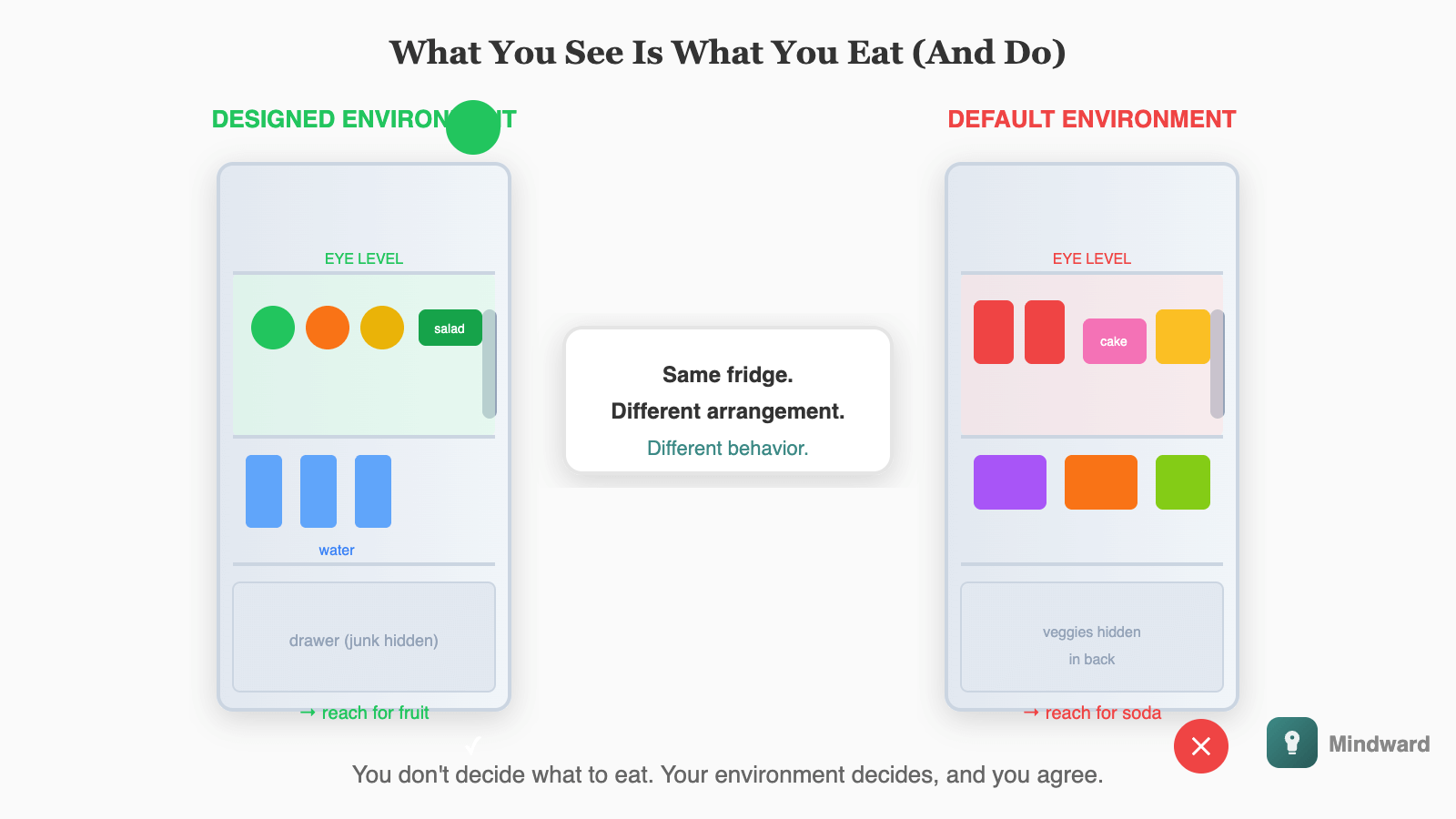
This isn't about restriction or deprivation. It's about defaults. The visible option becomes the default option. Design your defaults, design your behavior.
One Space, One Use
Context matters. Your brain associates spaces with activities, and these associations are powerful.
If you work, eat, watch TV, and scroll your phone in the same spot on the couch, that space has no clear behavioral signal. Your brain doesn't know what to do there, so it defaults to whatever requires the least effort—usually the least productive option.
But if your desk is only for working, your brain shifts into work mode when you sit there. If your bedroom is only for sleeping, falling asleep becomes easier. The space itself becomes a cue.
- Work happens at the desk, not in bed
- Sleep happens in the bedroom, not on the couch
- Eating happens at the table, not in front of screens
- Exercise happens in a designated spot, even if it's just a corner
- Relaxation has its own chair or space
If you don't have separate rooms, create separate zones. Even small distinctions—this side of the couch is for reading, that side is for TV—help your brain understand what behavior belongs where.
Design for Your Future Self
The person designing the environment is different from the person living in it.
Right now, you're rational, motivated, thinking clearly. You have good intentions. You want to make good choices. But the version of you who comes home tired, stressed, and depleted doesn't have access to those resources. That version will take the path of least resistance—whatever the environment makes easy.
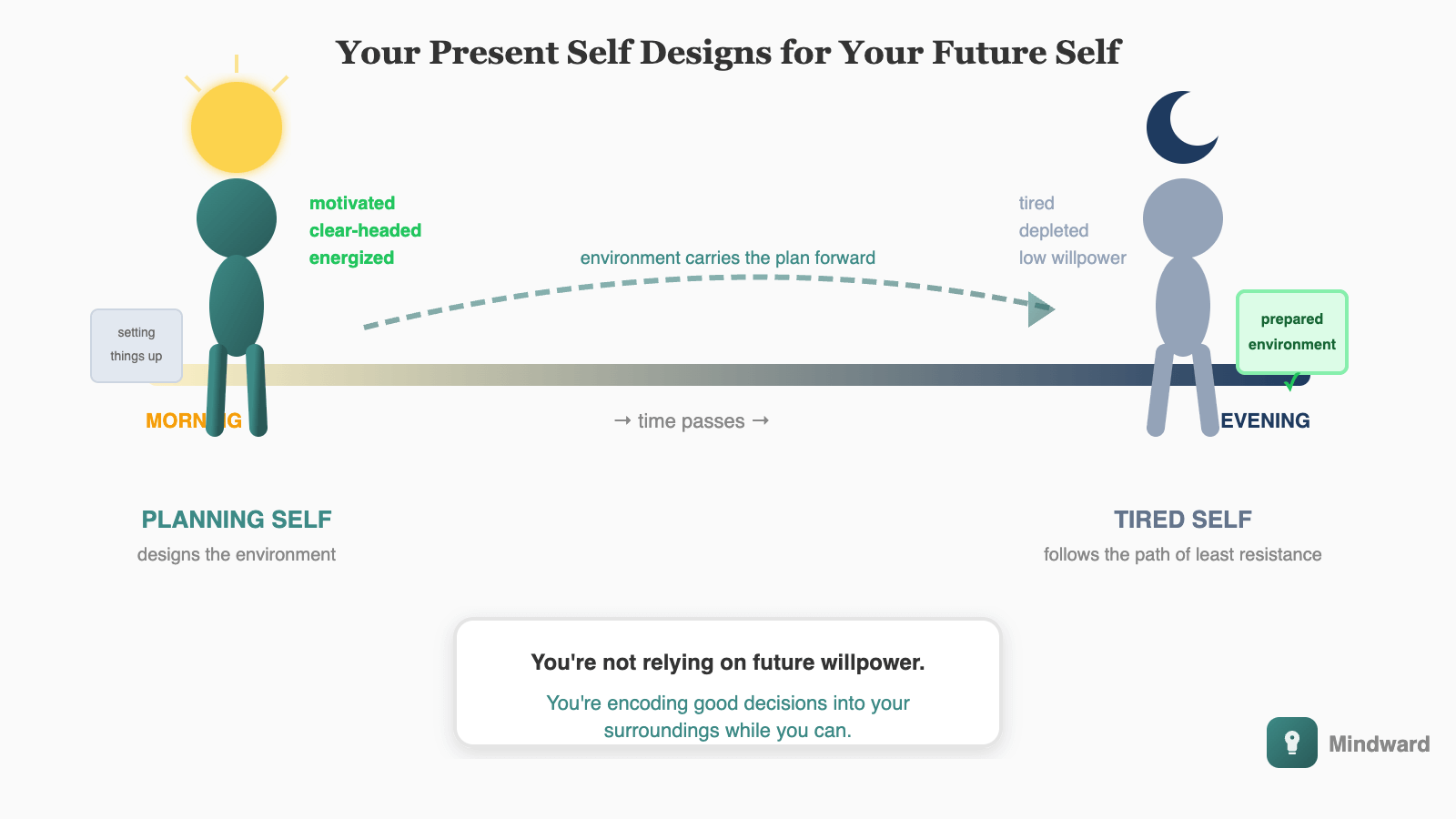
This is why environment design works when willpower fails. You're not relying on your future self to make good decisions. You're making the decisions now, in advance, and encoding them into your surroundings.
Set up your environment when you have energy. Your depleted self will thank you—not in words, but in actions, by effortlessly following the path you created.
The Reset Ritual
Environments decay toward disorder. Friction accumulates. Good cues get buried. Without maintenance, your carefully designed environment reverts to chaos, and chaos favors bad habits.
The solution is a reset ritual—a regular practice of restoring your environment to its intended state.
This might mean five minutes each night putting things back where they belong. It might mean a Sunday reset where you prepare the week's environment: laying out workout clothes, prepping meals, clearing your workspace, charging devices in their designated spots.
A reset ritual isn't cleaning. It's reloading your behavioral defaults for the days ahead.
The reset takes effort, but it's concentrated effort—a small investment that pays dividends across many future moments of decision. Instead of fighting friction repeatedly, you eliminate it once.
Start With One Space
You can't redesign your entire environment overnight. Trying to creates overwhelm and usually leads to nothing changing.
Instead, pick one space. One room. One corner. One habit you want to support. Apply the principles: reduce friction for the behavior you want, increase friction for the behavior you don't, make good cues visible, hide bad cues.
Maybe it's your kitchen counter—clearing everything except a fruit bowl and water bottle. Maybe it's your nightstand—replacing your phone with a book. Maybe it's your desk—removing everything except what you need for your most important work.
One environment, properly designed, will change one behavior. That behavior will compound. Then you can expand to the next space, the next habit, the next layer of design.
Your environment is constantly shaping you. The question is whether you'll shape it back—intentionally, strategically, in service of who you want to become. The design isn't optional. Only whether you're the designer.


Comments
How did you like this article?
No comments yet. Be the first to share your thoughts!