You're Not a Visual Learner. Nobody Is.
The idea that you learn best in one particular format has been tested for decades and never held up. What replaces it is simpler, more useful, and takes the pressure off.
Somewhere along the way, someone handed you a label. Visual learner. Auditory learner. Hands-on type. Maybe it came from a questionnaire in a classroom, a training day at work, or a quiz you took at sixteen and never questioned. Since then it has quietly shaped how you approach anything difficult — which explanations you trust, which formats you skip, and how you explain it to yourself when something doesn't stick.
The label doesn't hold up. Researchers have spent decades looking for evidence that matching instruction to a person's preferred style improves how much they actually learn, and the evidence has never arrived. This isn't a fringe position or a recent reversal. It is one of the most repeatedly tested and consistently unsupported ideas in education.
The claim that was actually tested
It helps to be precise about what got examined, because the interesting part isn't that learning styles were dismissed. It's how specifically they were measured. The claim — researchers call it the meshing hypothesis — says instruction works better when its format matches the learner's style. A visual learner should outperform an auditory learner when both are given a diagram, and the pattern should reverse when both are given a lecture.
That is a testable prediction. Sort people by style, randomly assign them to matched or mismatched instruction, test everyone on the same material, and look for the reversal. When Harold Pashler and colleagues reviewed the literature in 2008, they found that almost no studies had used this design at all — and the few that had produced results contradicting the hypothesis. A large study by Massa and Mayer, comparing verbal and pictorial versions of the same lesson, found no advantage for the learners who received their preferred format.
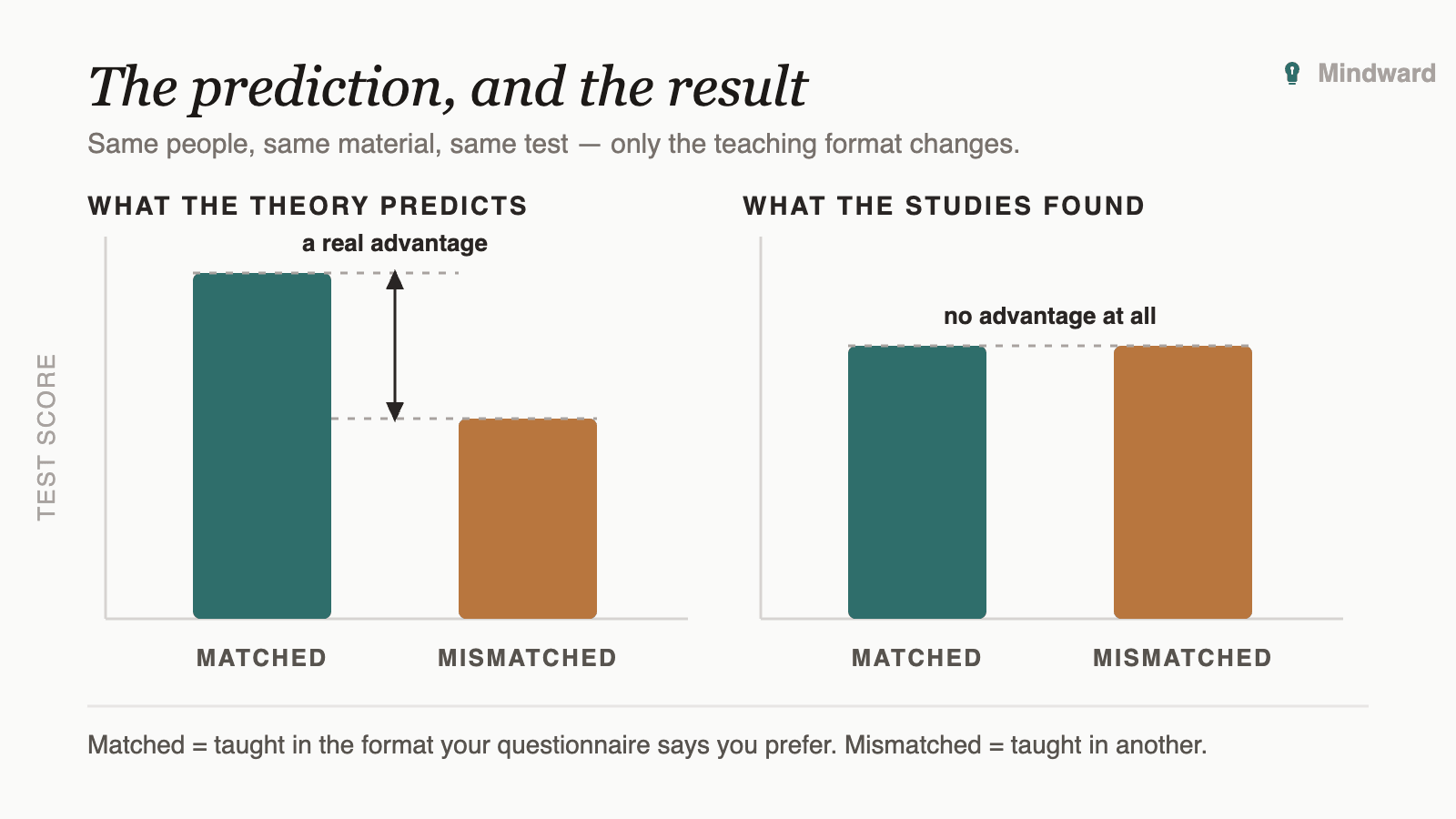
The pattern has held since. A 2019 study followed anatomy students who had been sorted by the VARK questionnaire. Most of them didn't study in ways consistent with their assigned style in the first place — and the students who did showed no advantage on exams. Preference didn't predict performance, and honoring the preference didn't change the outcome.
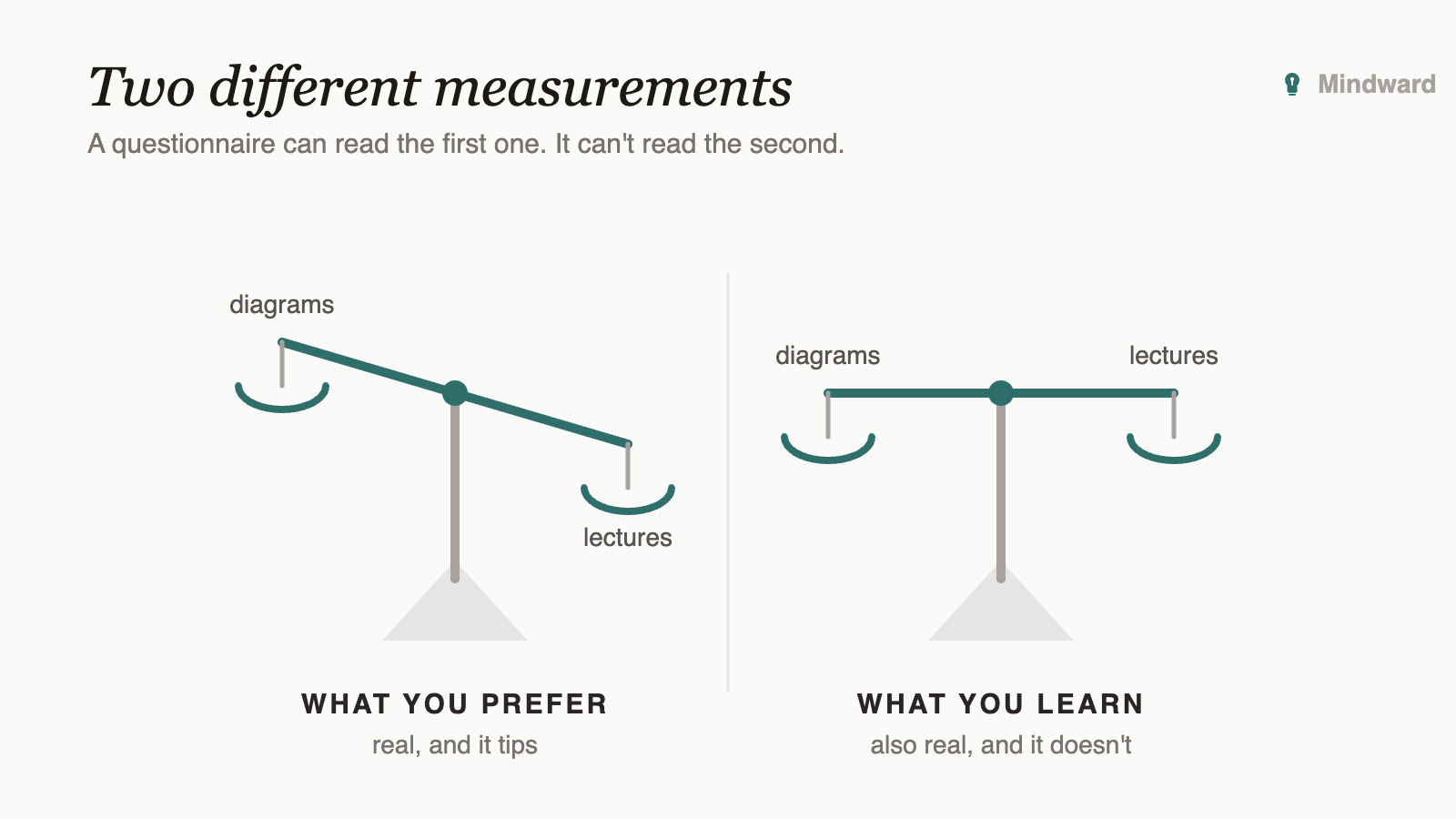
Your preference is real. There are formats you enjoy more and formats you find easier to sit with. What isn't real is the idea that your preference predicts how much you'll learn.
Why the idea survives anyway
Belief in learning styles remains close to universal among teachers — surveys across dozens of countries consistently put it above eighty percent — and it survives for reasons that have very little to do with evidence.
It feels diagnostic. A questionnaire produces a result, and a result feels like a finding. It's also flattering: being told you're a visual thinker sounds like a description of a mind rather than a description of a taste. And it is generous about failure. If a subject defeated you, the mismatch takes the blame instead of you.
There's a quieter tell, too. A 2004 review catalogued seventy-one distinct learning-styles models in circulation. Seventy-one competing taxonomies is not what a field looks like when it converges on something true. It's what an idea looks like when people keep rebuilding it because they want it to work.
The format should match the material, not you
Here is what replaces the label, and it is considerably more useful than what it replaces. The best format for learning something is determined by the thing being learned.
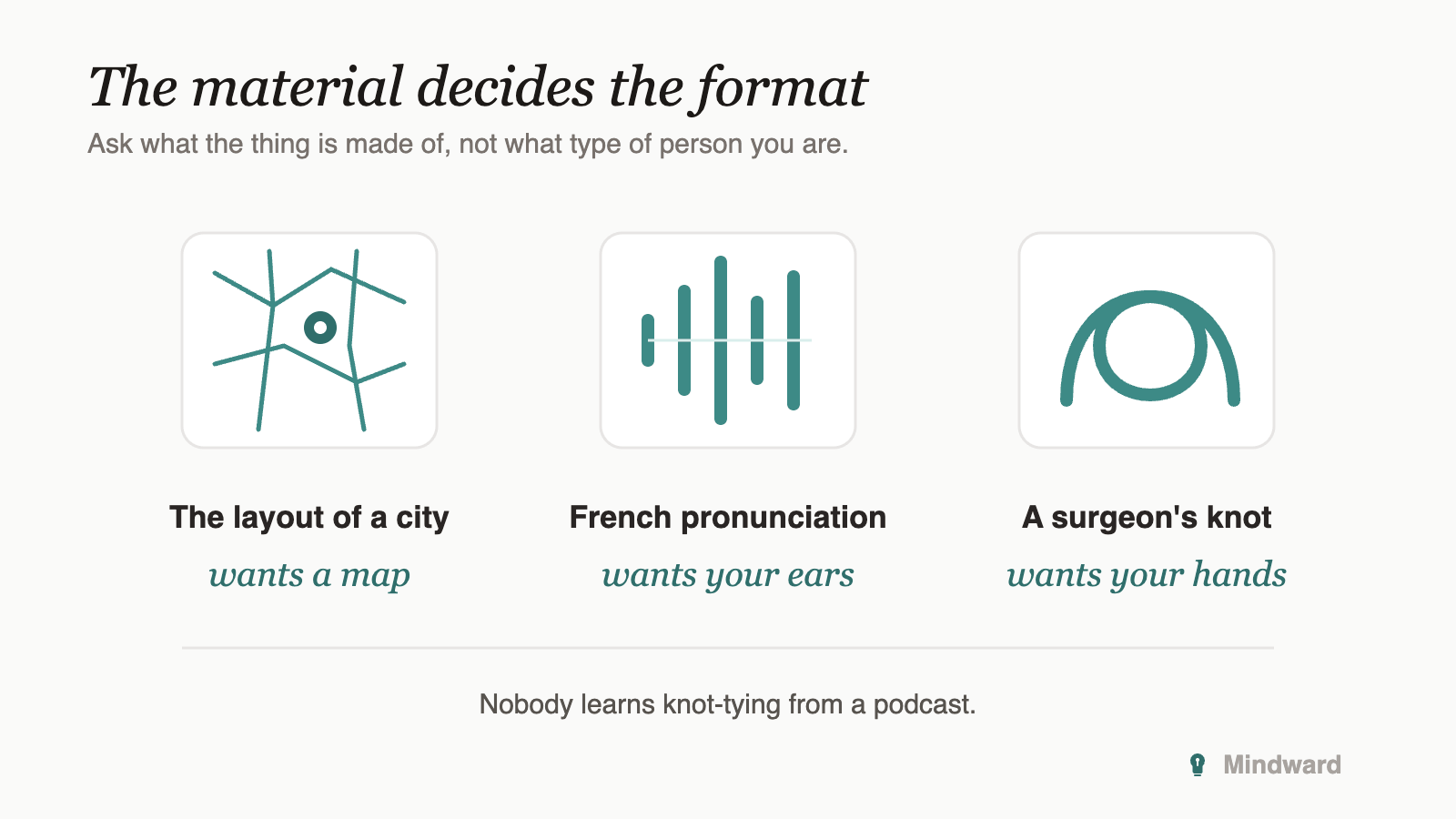
If you're learning the layout of a city, you need a map — not because you're a visual person, but because a city has a shape and words are a clumsy way to carry it. If you're learning French pronunciation, you need your ears, because the information is literally made of sound. If you're learning to tie a surgeon's knot, you need your hands and a length of rope. Nobody learns knot-tying from a podcast, whatever their questionnaire said.
So the question worth asking isn't which format suits me. It's what is this material actually made of. That question has a real answer, and the answer changes with every subject you pick up.
What works, and it works for everyone
The research that failed to find learning styles didn't leave a vacuum behind it. It left a set of methods that hold up across people, subjects, and ages — which is exactly what you'd expect from techniques built on how memory operates rather than on who you are.
- Match the format to the content. Spatial information wants a diagram, sound wants audio, procedure wants your hands.
- Pair words with visuals. The combination beats either one alone — for everyone, not just for the self-identified visual types.
- Do something with the material. Memory keeps what you thought about, so summarize it, argue with it, or apply it rather than passing your eyes across it.
- Pull information out rather than putting it back in. Closing the book and recalling beats rereading every time it has been tested.
- Space your sessions apart. The forgetting that happens in between is doing work.
None of these require you to know anything about yourself first. That's the point of them. They work on encoding and retrieval, which operate the same way in your head as they do in everyone else's.
What the label was costing you
The reason this matters isn't accuracy for its own sake. It's that a style label draws a boundary, and boundaries get respected.
If you decided at nineteen that you can't learn from reading, you have spent years routing around books. If you're not a numbers person, you've probably skipped every domain that arrives with a chart attached. The label started as a description of a preference and hardened into a description of a limit — and that limit was never actually tested, because you stopped walking toward the edge of it.
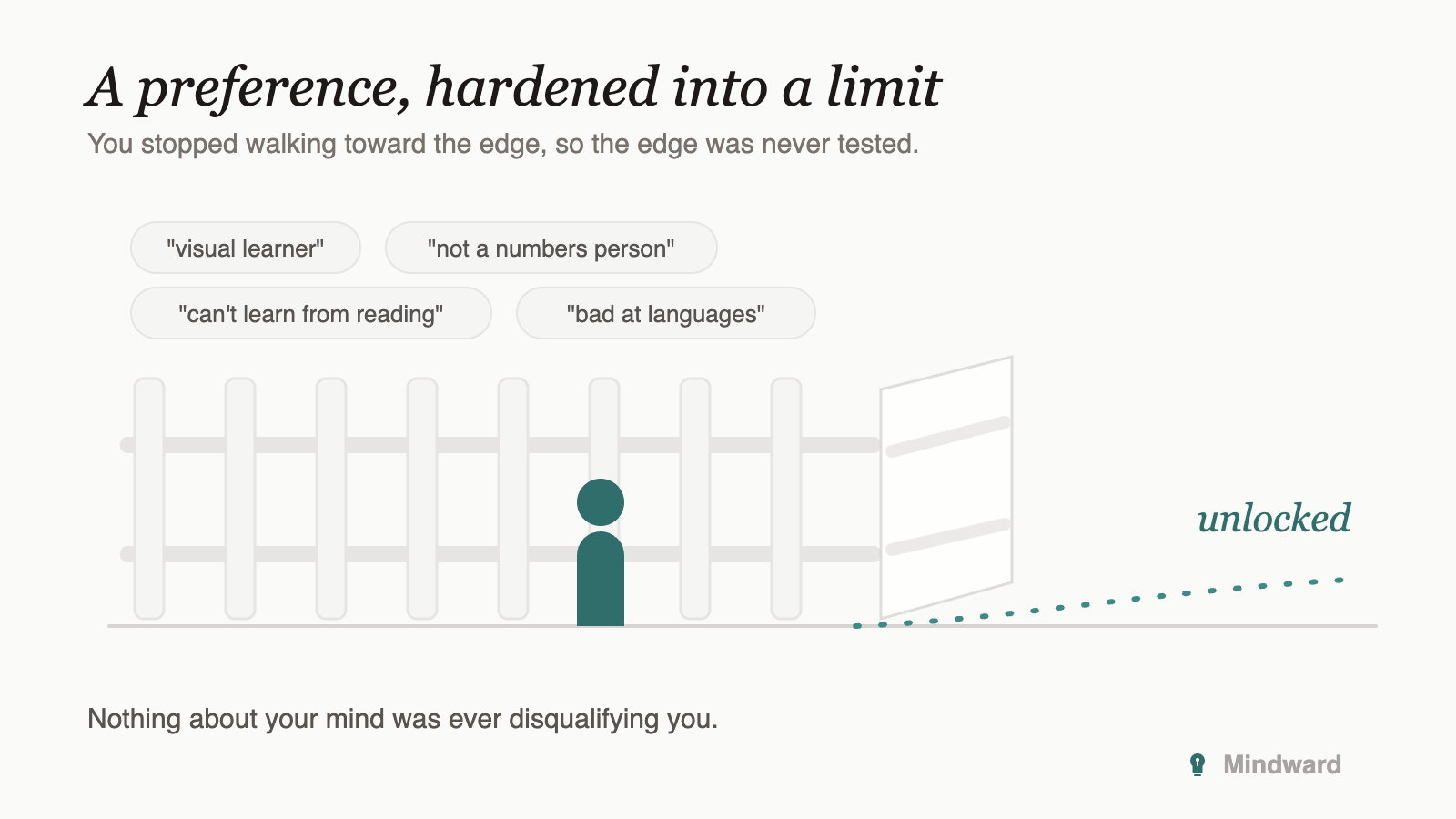
So there is something here to put down. You don't need to be diagnosed before you can begin. There is no correct format waiting to be discovered, no missing key, nothing about the particular shape of your mind that has been quietly disqualifying you this whole time.
The next time something won't go in, you don't have to wonder whether it arrived in the wrong format for you. Ask what the material is made of, choose the format that fits it, then do something with what you've read. It will still be hard. Difficulty isn't a signal that you've been miscategorized — it's what learning feels like, for everyone, in every format there is.


Comments
How did you like this article?
No comments yet. Be the first to share your thoughts!