The Story You Tell Yourself Becomes the Life You Live
Your internal narrative isn't just describing your life—it's shaping it. Here's how to rewrite the script.

You have a story about yourself. Everyone does. It runs in the background, narrating your life, explaining your choices, predicting your future.
I'm not good with money. I'm not the kind of person who exercises. I always mess up relationships. I'm just not creative. I don't have what it takes.
These stories feel like observations—neutral descriptions of reality. But they're not. They're scripts. And you're following them.
Stories Shape Perception
Your internal narrative acts as a filter. It determines what you notice, what you remember, and what you ignore. If your story says you're unlucky, you'll catalog every misfortune and dismiss every break. If your story says you're bad at something, you'll interpret struggle as confirmation rather than as part of learning.
The story doesn't just describe your experience—it curates it. You see what the narrative tells you to see.
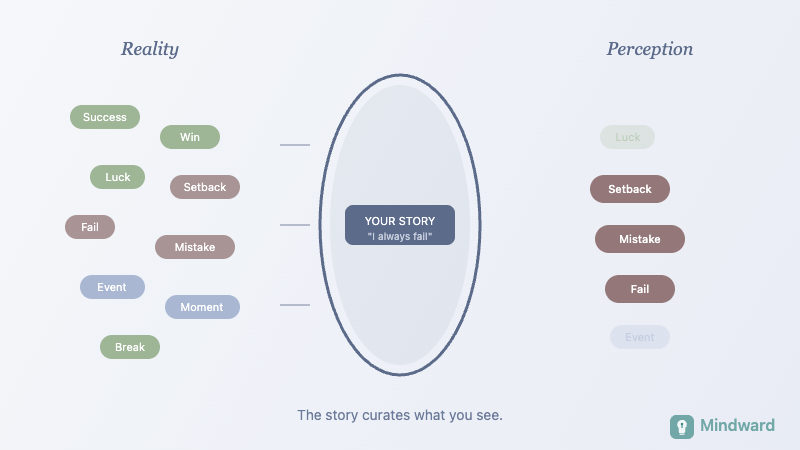
This is why two people can have nearly identical experiences and draw completely different conclusions. The difference isn't the experience. It's the story each person is telling about it.
Stories Shape Action
More importantly, your story determines what you attempt. If you believe you're not good with money, you won't try to learn. If you believe you always fail at relationships, you'll either avoid them or unconsciously sabotage them. If you believe you're not creative, you won't create.
The story becomes a self-fulfilling prophecy. Not because it was true, but because you acted as if it were true, and your actions made it so.
You don't act according to reality. You act according to your story about reality. And then reality conforms.
This is the trap: the story feels like it's based on evidence, but much of the evidence was generated by acting out the story. You can't tell where the story ends and you begin.
Where Stories Come From
Most of your core narratives weren't chosen. They were absorbed—from parents, from early experiences, from moments of pain or embarrassment that crystallized into conclusions about who you are.
A child who struggles with math once and gets laughed at might build a story: I'm not a math person. That story then shapes decades of choices, avoidances, and self-limitations. Not because the story was accurate, but because it was never questioned.
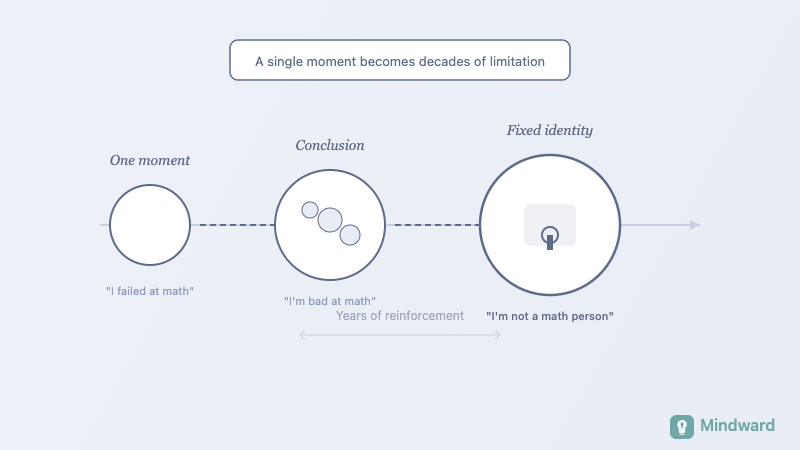
The stories that run deepest are often the ones you've never examined. They feel like facts because you've never treated them as interpretations.
Identifying Your Scripts
Listen for the phrases that start with "I'm the kind of person who..." or "I always..." or "I never..." These are narrative markers. They signal a story that's running.
Pay attention to what you explain away. When something good happens and you dismiss it as luck, that's a story. When you try something and fail and conclude it proves something about you, that's a story. When you don't try at all because you already know how it will go, that's a story.
- "I'm not good at..." — limiting identity
- "I always..." — deterministic pattern
- "I could never..." — closed possibility
- "That's just how I am" — fixed trait
- "People like me don't..." — group limitation
These aren't observations. They're predictions disguised as descriptions. And predictions have power—they tend to produce themselves.
Rewriting Is Possible
The good news is that stories can be changed. Not easily, not overnight, but genuinely. You are the author, even if you've been writing on autopilot.
The first step is simply noticing the story. Treating it as a story rather than as truth. Asking: Is this actually true? Or is this just what I've been telling myself?
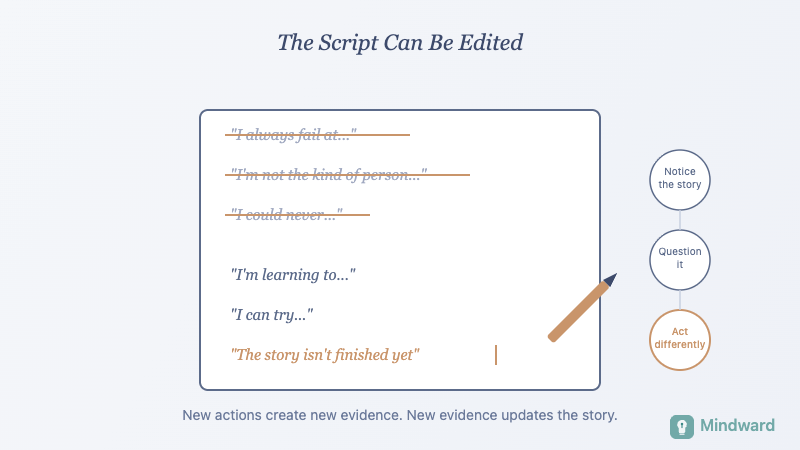
The second step is finding counter-evidence. Not to prove you're the opposite of what you believed, but to prove the story isn't complete. There are exceptions. There are moments that don't fit. The story is simpler than reality.
You don't have to believe a new story immediately. You just have to stop treating the old story as fact.
Acting Into a New Story
Ultimately, you rewrite your story by acting differently and then updating the narrative based on new evidence. Not the other way around.
You don't wait until you believe you're disciplined to build discipline. You act with discipline—even once, even imperfectly—and then you have new data. The story shifts because the evidence shifts.
This is uncomfortable. It means behaving in ways that contradict your current self-concept. It means tolerating the dissonance of acting like someone you don't quite believe you are yet.
But that dissonance is the space where change happens. The new story emerges from new actions, not from thinking alone.
You Are the Author
Your story is not your destiny. It's a draft. One that's been running for years, accumulating weight, feeling permanent—but still just a story. Still editable.
You get to decide what it means when you fail. You get to decide what your past says about your future. You get to decide whether today is another chapter of the same story or the beginning of a different one.
The story you tell yourself becomes the life you live. So it matters, tremendously, what story you choose to tell.


Comments
How did you like this article?
No comments yet. Be the first to share your thoughts!