The Repair Is the Relationship
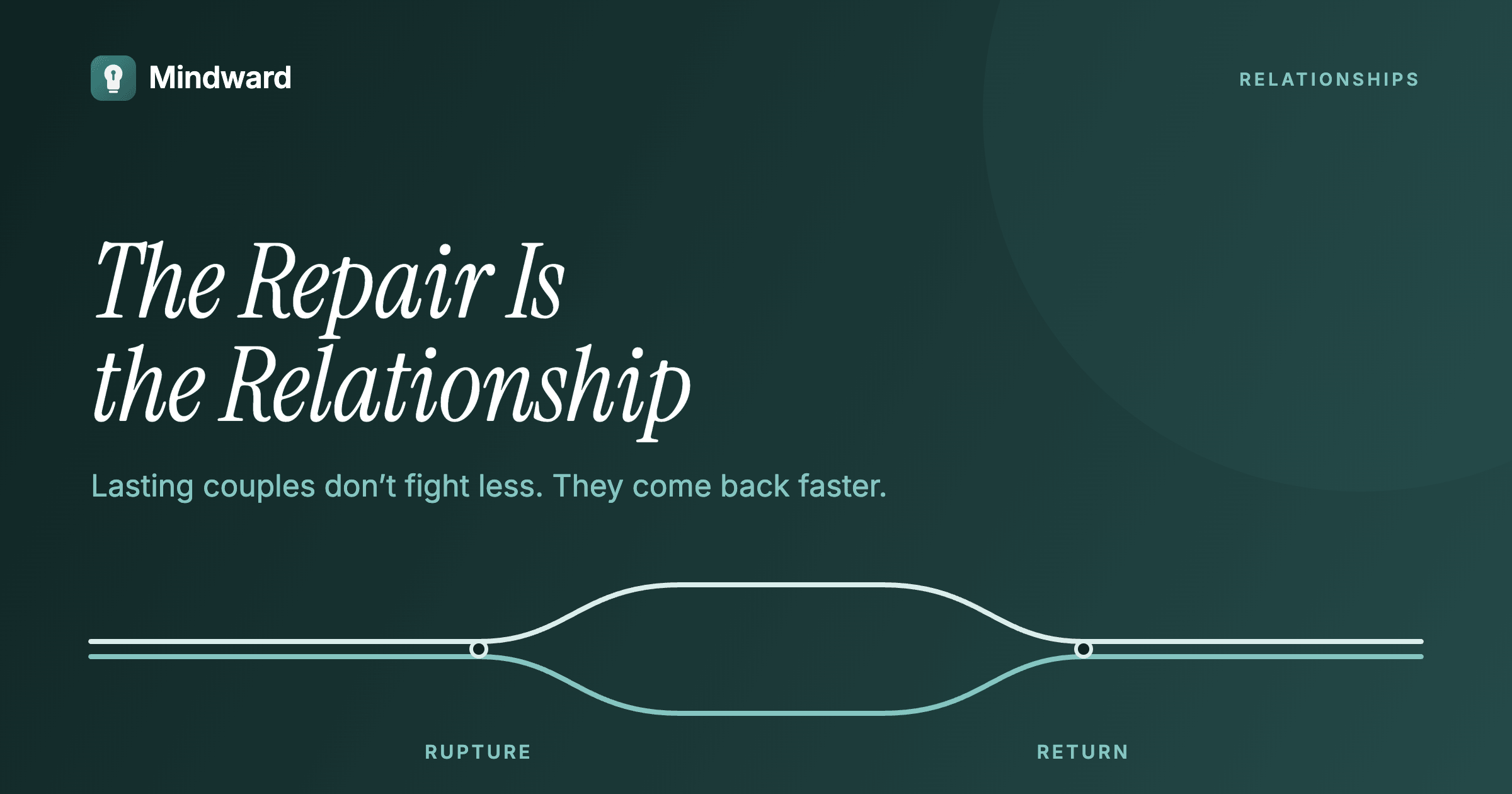
Lasting couples don't fight less. They come back faster. The skill that holds a relationship together isn't avoiding rupture — it's what happens in the hours after one.
You have probably absorbed the idea that healthy couples don't fight much. That the solid ones communicate so cleanly they rarely reach raised voices, slammed doors, or the specific silence of two people in the same room refusing to look at each other. It's a comforting picture. It's also wrong, and believing it does real damage, because it teaches you to read every argument as evidence that something is broken.
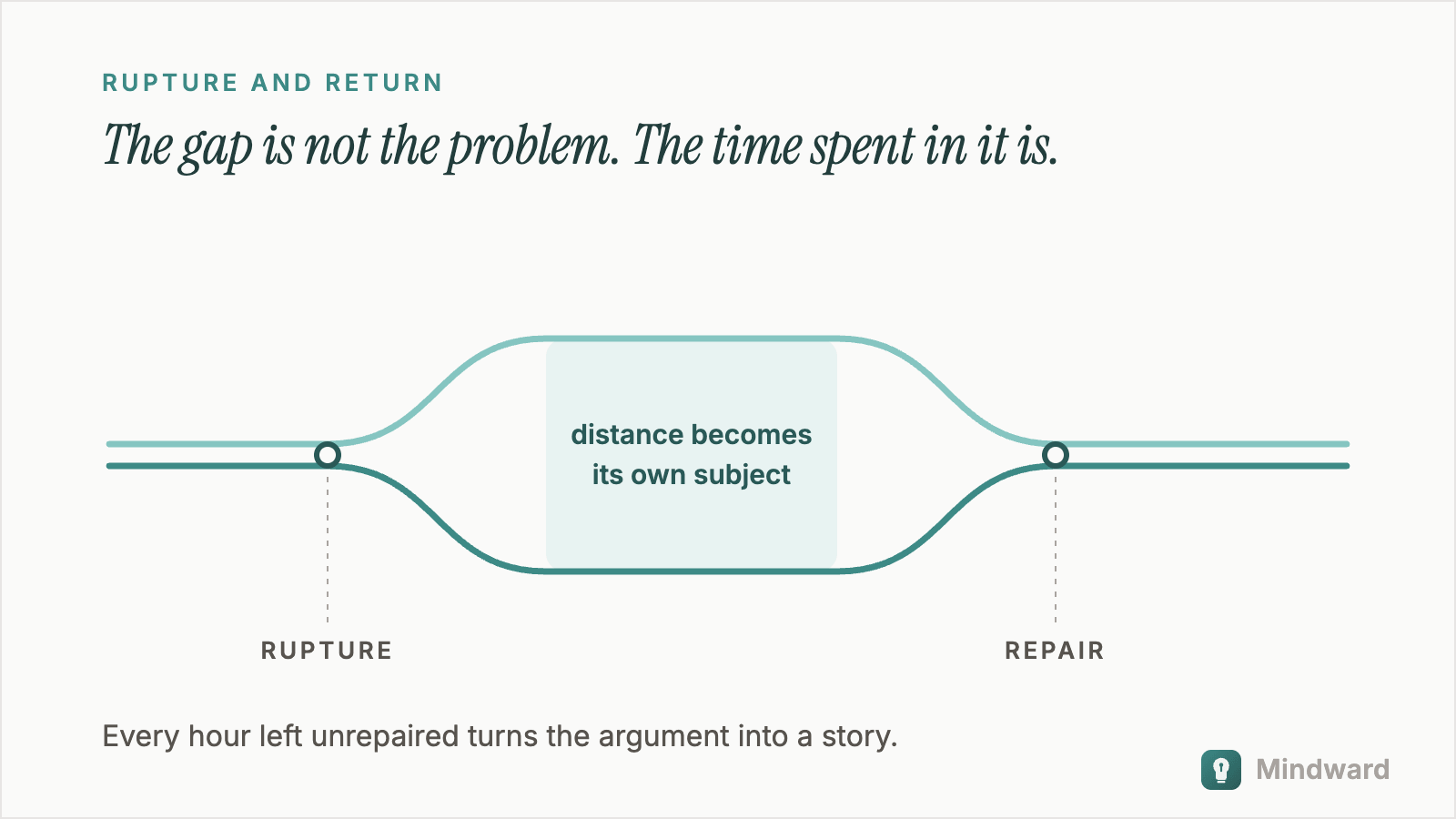
Conflict is not the variable. Every couple fights about money, time, attention, in-laws, sex, and whose turn it was. What separates the relationships that last from the ones that quietly erode is not whether the rupture happens. It's what happens in the twenty minutes, the two hours, or the three days afterward.
The thing holding a relationship together is not the absence of rupture. It's the presence of repair.
Most of Your Fights Are Never Going to Be Solved
John Gottman spent decades watching couples argue in an observation apartment wired for sound and physiology. One of his most useful findings is also the least romantic: roughly two-thirds of conflict in long-term relationships is perpetual. It doesn't get resolved. It's rooted in durable differences in personality, temperament, and values — one of you needs more closeness, the other needs more space; one runs early, the other runs late; one wants the weekend planned, the other wants it open.
These are not problems with solutions. They're the terms of being two different people. Which means if your standard for a good relationship is "we worked through it and it never comes up again," you have set a standard almost nobody meets. The same argument will return in six weeks wearing a slightly different outfit.
That sounds bleak until you see what it frees you from. If the fight isn't the failure, you can stop treating its recurrence as a verdict on the relationship. The work moves somewhere far more learnable: getting good at the return.
What a Repair Attempt Actually Sounds Like
A repair attempt is any move — verbal or not — that tries to lower the temperature and reach across the gap while the conflict is still live. In Gottman's research, the ability of a couple to make and accept these attempts was one of the clearest markers separating the pairs who stayed together from the ones who didn't.
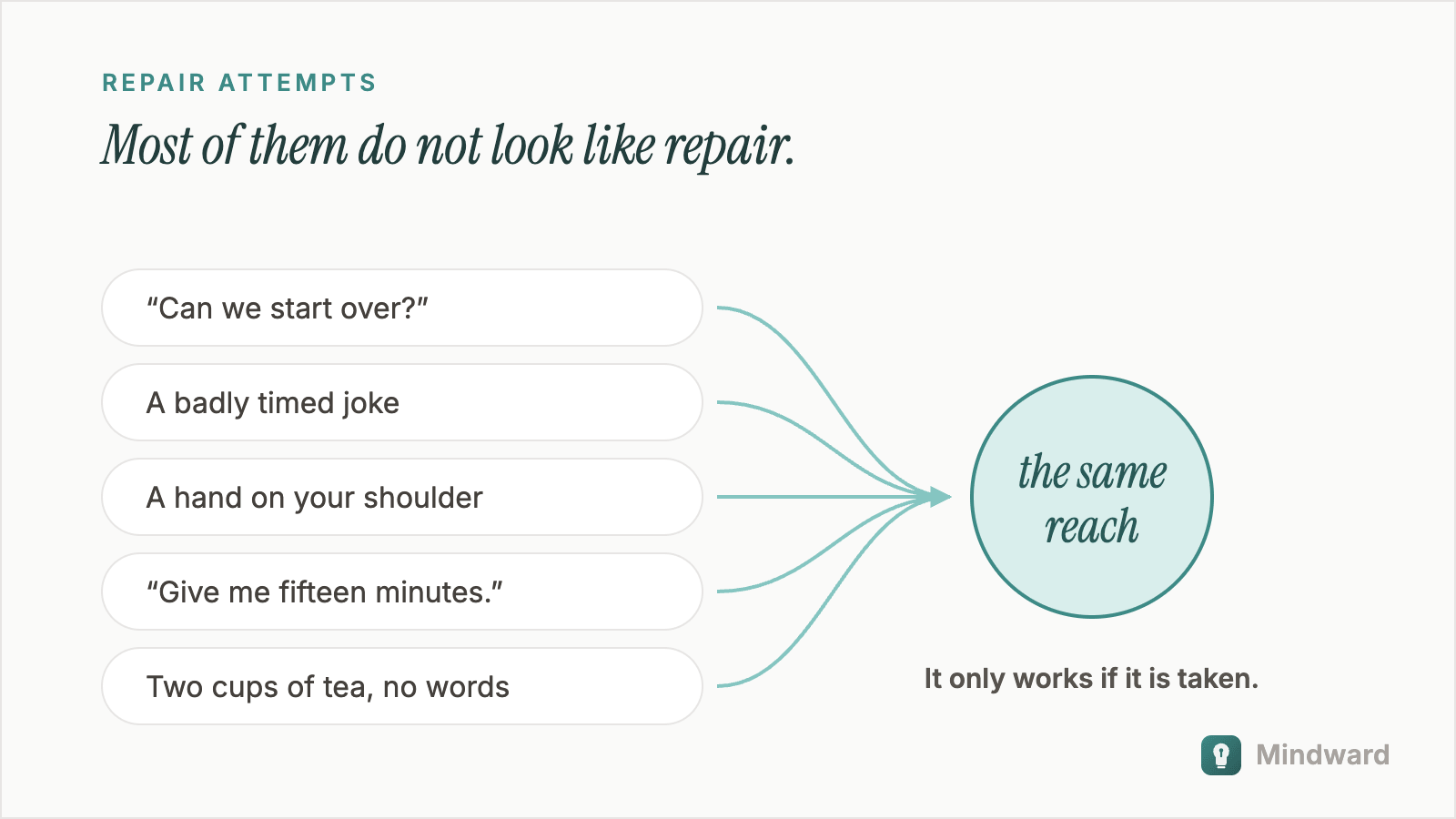
The word "attempt" is doing a lot of work there. Repairs are rarely graceful. They almost never arrive as a well-formed apology. More often they look like this:
- "Can we start this over? I don't like how I said that."
- A badly timed joke in the middle of a serious argument.
- A hand on the shoulder while walking past.
- "I'm getting too worked up. Give me fifteen minutes."
- "That came out wrong."
- Asking a completely unrelated question about dinner.
- Making two cups of tea and putting one down next to you without a word.
Half of those don't look like repair at all. They look like deflection, or avoidance, or someone refusing to take the conversation seriously. That's exactly why so many of them fail — not because they weren't offered, but because they weren't recognized as an offer.
A repair attempt is a hand reaching out mid-argument. It doesn't matter how elegantly it's extended. It matters enormously whether the other person takes it.
Most Repairs Fail on the Receiving End
Here is the part that changes how you fight. When a couple is in a good stretch, a clumsy repair lands easily. The joke gets a reluctant laugh. The hand on the shoulder gets accepted. When a couple has been accumulating unaddressed friction, the exact same gesture reads as mockery, manipulation, or an attempt to skip past something that mattered.
The gesture didn't change. The interpretive frame did. Once you've built a running case against someone, every neutral act gets filed as evidence for it. Your partner isn't reaching for you, they're managing you. They're not defusing, they're dodging. And so the hand stays out there, unmet, and the person who extended it learns not to bother next time.
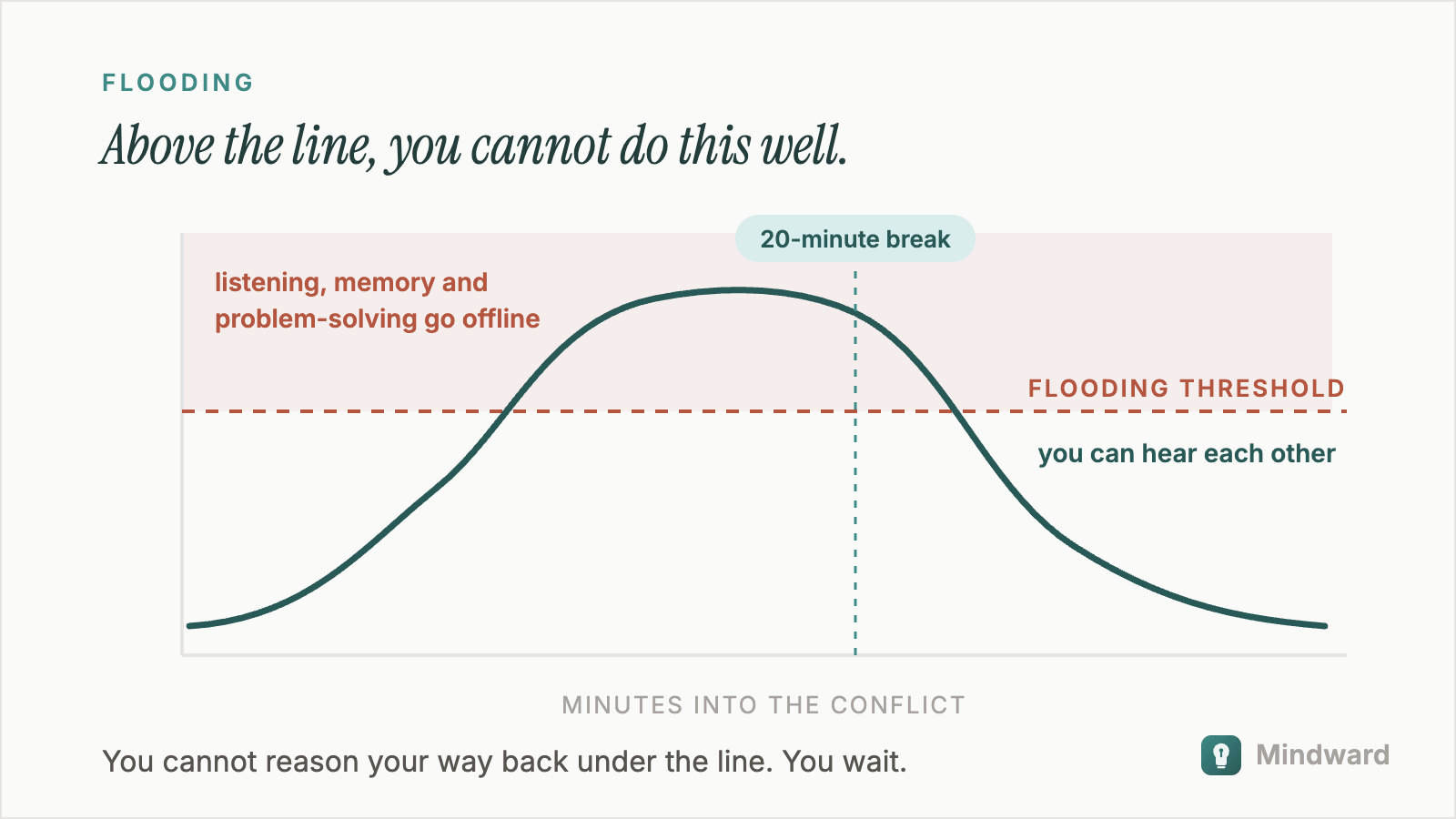
There's a physiological layer underneath this too. During intense conflict, heart rate climbs and the body shifts into a stress response — Gottman called the threshold state flooding. Above it, you lose access to the parts of yourself that listen well, remember your partner's good qualities, or generate a creative solution. You are, functionally, a worse partner for the next twenty minutes regardless of your intentions. You cannot reason your way out of that state. You can only wait it out.
Which means the single most useful thing you can do mid-argument is not win it. It's notice when you have stopped being capable of having it.
Speed Matters More Than Elegance
An unrepaired rupture doesn't sit still and wait for you. It hardens into narrative. On day one it was a bad night. By day four it's a data point in a story about who your partner is and what they think of you. The distance stops being about the original argument and starts being about the distance itself.
This is why a fast, awkward repair beats a perfect one delivered next week. Waiting until you can articulate it flawlessly is usually just pride with a better vocabulary. "I hated how that went and I don't want to be like this with you" is enough. It doesn't resolve the issue. It isn't supposed to. It restores the connection so the issue can be discussed by two people who are on the same side again.
Repair Is a Skill, Not a Temperament
People treat this as a personality trait — some couples just bounce back, some don't. But nearly everything that makes repair work is a specific, practicable behavior. If it feels impossible in your relationship, that usually means nobody has been taught the moves, not that you're incompatible.
- Name the state, not the person. "I'm too flooded to do this well" opens a door. "You're impossible to talk to" closes one.
- When you take a break, name the return time. An unannounced exit isn't a pause, it's abandonment, and it escalates everything. Twenty minutes, and mean it.
- Use the break to actually settle. Rehearsing your argument keeps you flooded. Walk, shower, do something with your hands.
- Lead the return with your own part. Waiting to be approached first is a contest nobody wins. Someone has to go first, and it can be you more often than feels fair.
- Lower the bar for what counts as a repair. If your partner offers something clumsy, take it. Grading their apology is how a repair becomes another fight.
- Do the post-mortem later, calm. "What happened for you in that?" is a question for Tuesday afternoon, not Sunday midnight.
Notice that none of these require the underlying disagreement to be settled. That's the point. Repair and resolution are different jobs, and trying to do them at the same time is why so many arguments run until 2am and end with both people worse off than when they started.
You are not trying to end the conflict. You are trying to make sure the conflict doesn't take the relationship with it.
What This Actually Buys You
There's something counterintuitive in the research on close relationships: ruptures that get repaired well don't just return you to baseline. They tend to leave the bond stronger than it was. Not because conflict is good for you, but because a successful repair is proof of something you can't get any other way — that this relationship can absorb a bad moment and survive it. Every clean recovery makes the next disagreement less frightening, because you both have evidence about what happens on the other side.
A relationship where nothing ever goes wrong has never been tested. A relationship with a hundred small ruptures and a hundred repairs is one where both people know, in their body rather than in theory, that a hard conversation is survivable. That knowledge is what lets people be honest with each other.
You are not going to stop having the same fight. You will have some version of it for as long as you're together, because it isn't a malfunction — it's the friction of two separate people sharing a life. The couple whose ease you envy is not fighting less than you. They are getting back faster, with less ceremony, and with far less riding on who was right.
So the next time it goes badly — and it will — pay less attention to how the argument started and more to what happens after. That's where the relationship actually lives. Not in the rupture. In the return.


Comments
How did you like this article?
No comments yet. Be the first to share your thoughts!