Love Is Built in the Moments You Almost Miss
The couples who last aren't the ones who fight less or love harder. They're the ones who answer when their partner reaches for them in small, forgettable ways.

You probably assume your relationship will be decided by the big things. The fight about money. The move across the country. The moment one of you says something you can't take back. Those feel like the hinges everything turns on. They're not. Your relationship is being decided right now, in a moment so small you might not even register it happening — the moment your partner says something and waits, quietly, to see whether you'll look up.
That small moment has a name. Psychologist John Gottman calls it a bid: any attempt, however minor, to get your attention, affection, or presence. "Look at that bird." "I had the strangest dream." A hand resting on your shoulder. A sigh you're clearly meant to ask about. Most of these aren't really about the bird or the dream. Underneath the words is a quieter question. Are you here with me?
The Numbers Are More Extreme Than You'd Guess
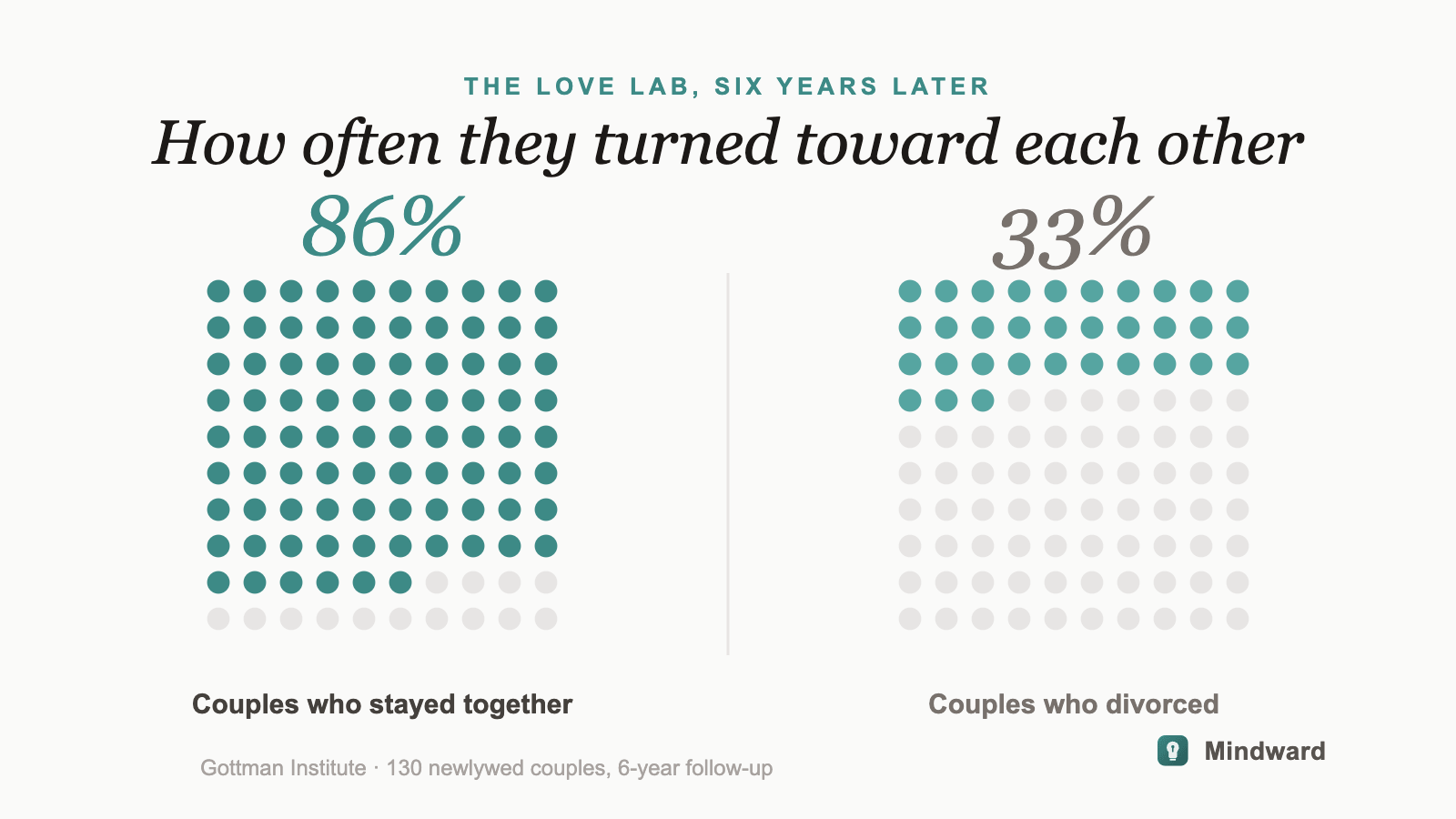
Gottman spent years watching couples in an observation apartment near the University of Washington, a space that came to be called the Love Lab. He brought in newlyweds, watched them do ordinary things, and tracked how often each person turned toward the other's bids instead of ignoring them. Then he waited six years to see who was still together.
The couples who stayed married had turned toward each other's bids about 86% of the time. The couples who divorced had turned toward only 33%. Read those two numbers again, because the gap is the entire point. The difference between the couples who lasted and the ones who didn't wasn't whether they fought, or how much chemistry they had, or whether they agreed about money. It was how often they answered when the other person reached out in some tiny, forgettable way.
You Have Three Options, and Two of Them Cost You
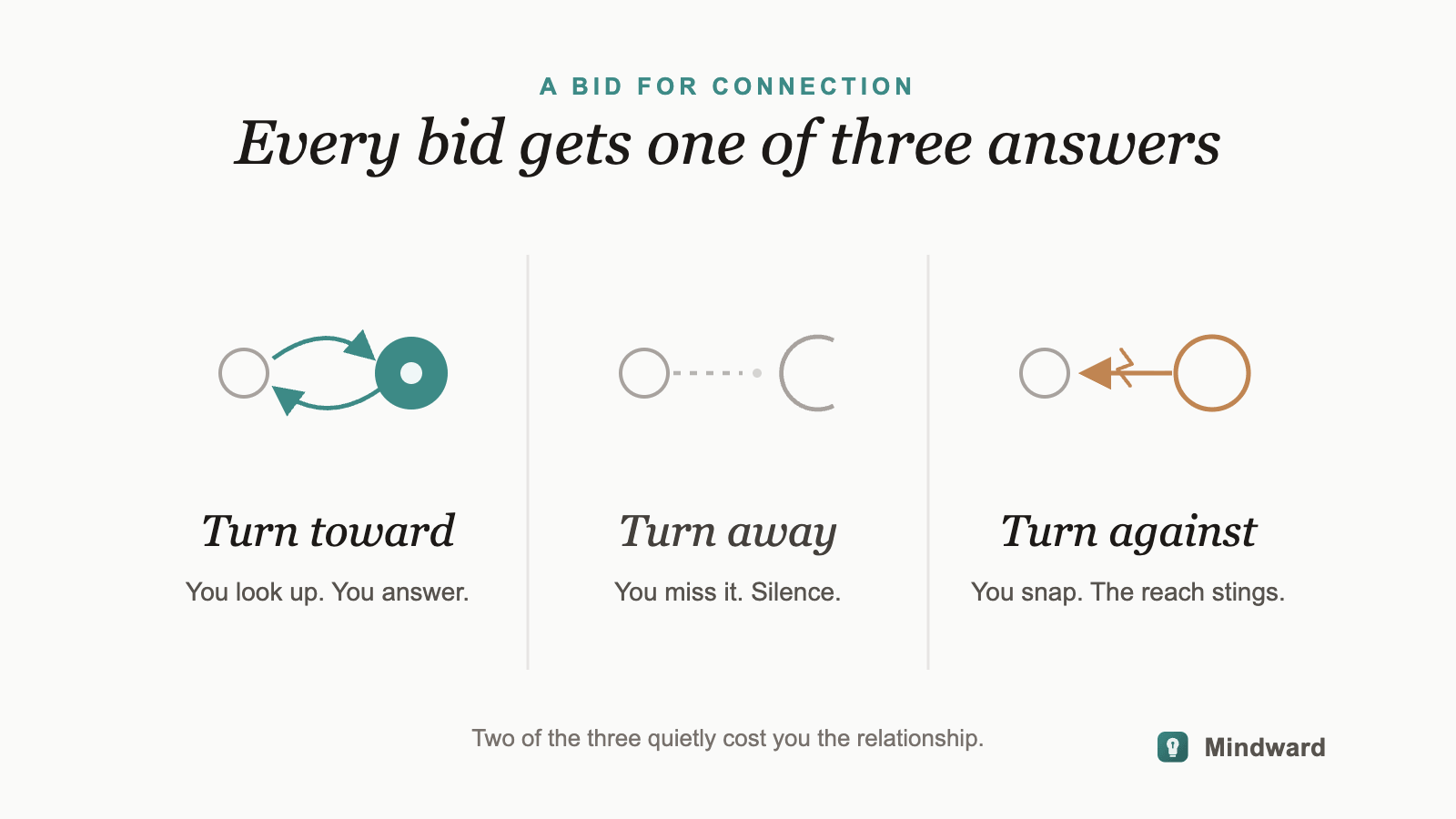
Every bid gets one of three responses. You can turn toward it: look up, answer, engage, even briefly. You can turn away from it: miss it, stay on your phone, meet the comment with silence. Or you can turn against it: snap, criticize, treat the reach as an interruption.
Turning away rarely feels like rejection in the moment, and that's exactly what makes it dangerous. Nobody storms out over an unanswered comment about a bird. But your nervous system is keeping a tally you're not aware of, logging every reach that landed and every one that didn't. Over months, those small unanswered moments don't stay small. They harden into the distance couples mistake for falling out of love.
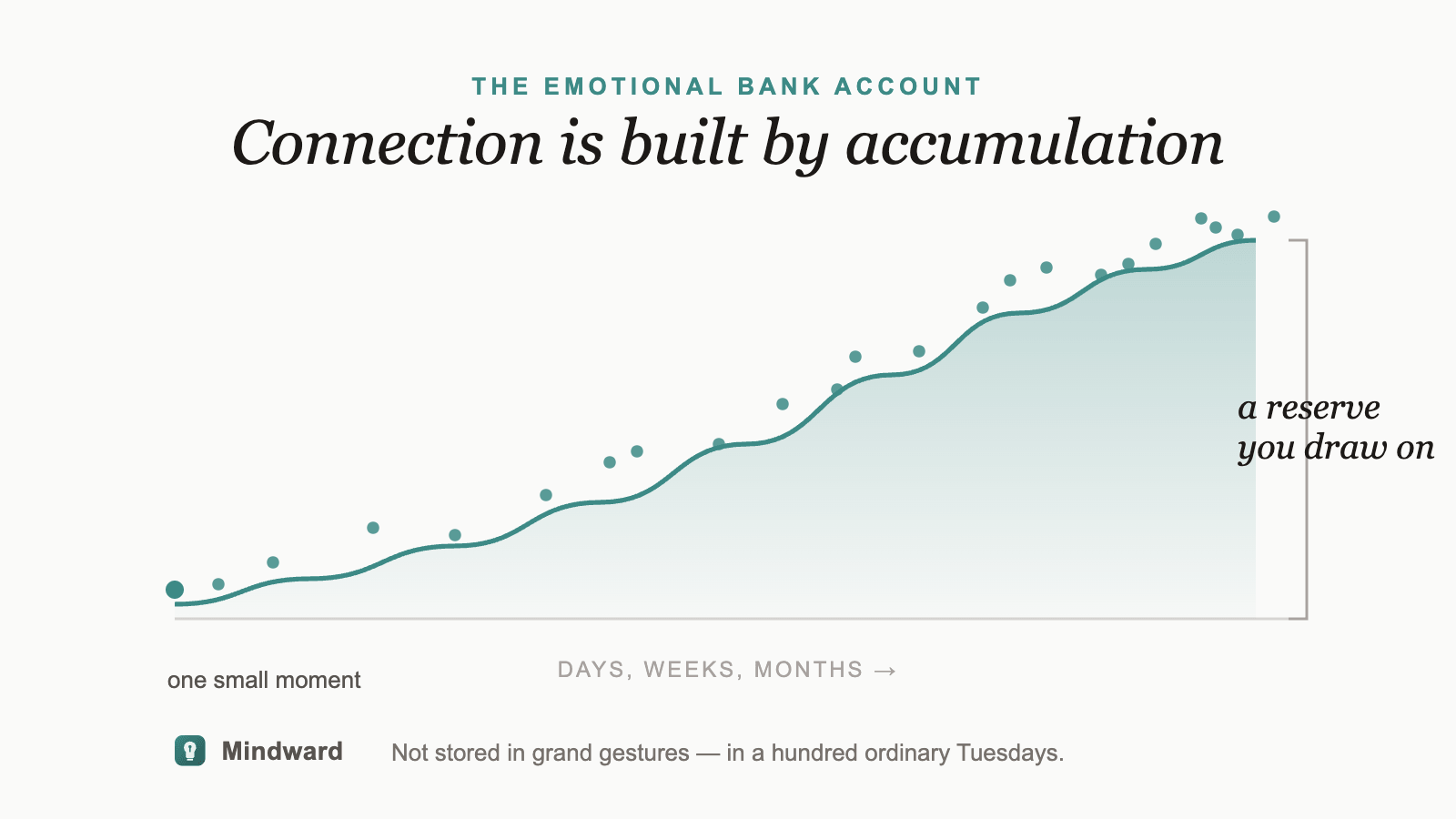
When your partner reaches for you in a small way and you meet them, you're not just being nice. You're making a deposit in an account you'll both draw on during the hard moments. The big fights are survivable when the small ones have been adding up in your favor.
Why Small Beats Grand, Every Time
There's a tempting belief that you can neglect a relationship for weeks and then repair it with one spectacular date night. It doesn't work, and now you know why. Connection isn't stored in grand gestures. It's built in accumulation — the hundred tiny moments across an ordinary Tuesday, each one a small confirmation that you're still paying attention.
This is actually good news. It means you don't need more time, more money, or a better version of yourself to strengthen your relationship. You need to get better at noticing what's already happening right in front of you.
How to Actually Turn Toward
The hard part isn't responding to bids. It's seeing them. They come disguised as something else — a complaint, a random fact, a question that seems to have nothing to do with you. Once you start looking, you notice them everywhere.
- When they say "I'm exhausted," the bid isn't about their fatigue. It's an invitation to care. Turn toward it: "Rough day? Tell me."
- When they read something out loud from their phone, they aren't informing you. They're handing you a piece of their inner world. Look up.
- When they touch your arm as they pass, that's a bid. A touch back is an answer.
- When they bring up the same worry for the third time, they're not being repetitive. They're still not sure you've really heard them.
- You don't have to catch every one. The couples who lasted didn't either. You just have to catch most of them.
When You Miss One (and You Will)
You're going to miss bids. You'll be tired, distracted, mid-thought, half-lost in a screen. Missing one isn't the failure. The failure is not noticing that you missed it.
So circle back. "Hey, you were telling me something and I drifted. What was it?" That small repair does something surprising: it can matter more than never missing the bid at all, because it tells your partner that even when you wander off, you come back. That you're reachable. Reachability, more than perfection, is what makes someone feel safe with you.
Tonight, someone you love is going to reach for you in a way so small it would be easy to let pass. A comment. A glance. A hand. Nothing will announce that this is one of the thousand moments your relationship is quietly made of. That's the whole point. Look up anyway.


Comments
How did you like this article?
No comments yet. Be the first to share your thoughts!