The Question Behind the Question
Most questions aren't really about what they're asking. Learning to hear what's underneath changes how you respond—and whether your response actually helps.
Someone asks you a simple question. You give a direct answer. Technically accurate, completely responsive. And somehow it misses entirely.
They weren't really asking what they appeared to be asking. The surface question was a container for something else—a worry, a need, a doubt they couldn't or wouldn't state directly. You answered the words. You missed the person.
Questions as Containers
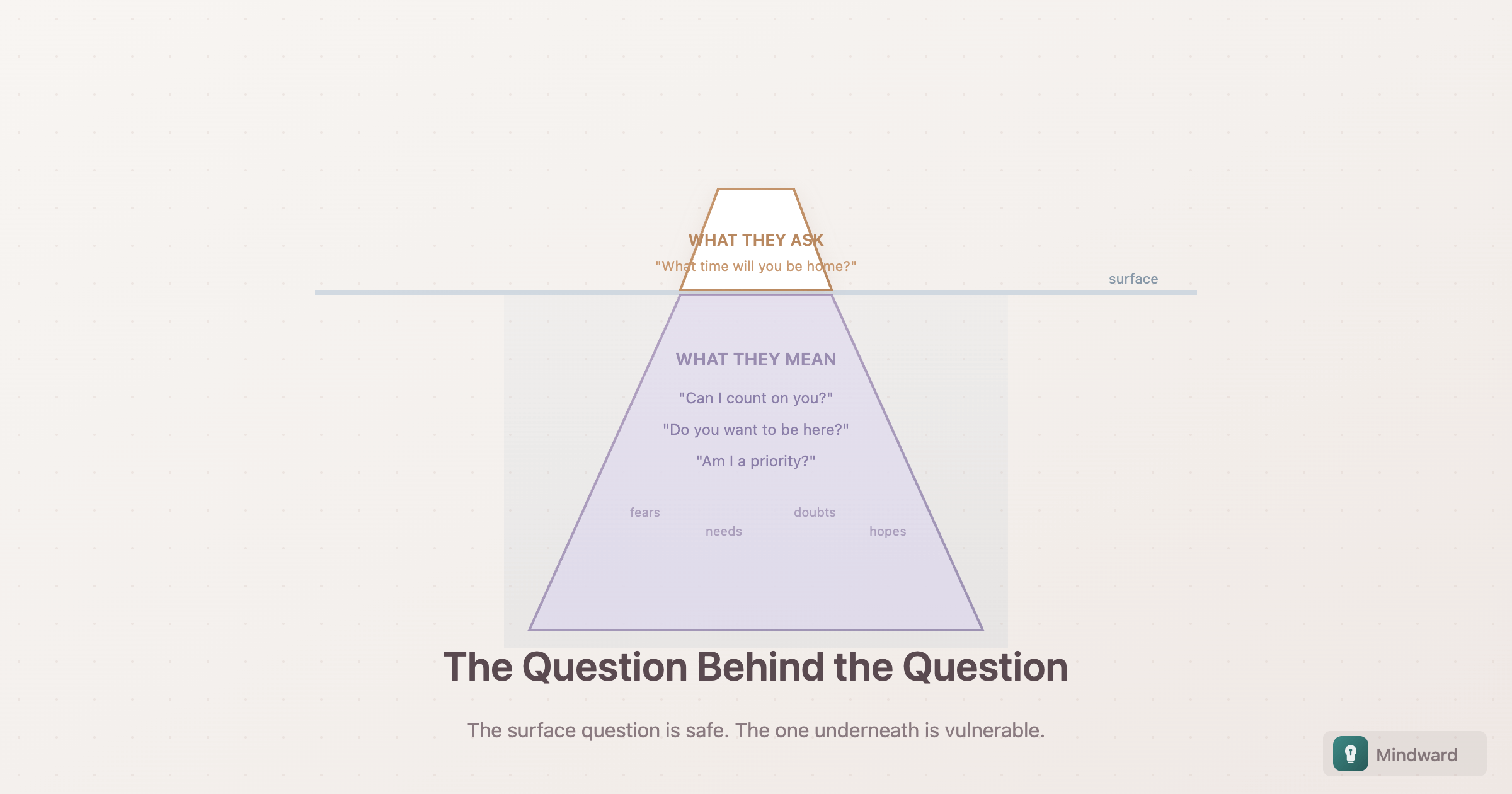
Most questions carry more than their literal content. 'What time will you be home?' might really be asking 'Can I count on you?' 'How did the meeting go?' might mean 'Am I in trouble?' 'Do you think this is a good idea?' often translates to 'Will you still support me if it fails?'
The surface question is safe. It's concrete, answerable, low-risk to ask. The question underneath is vulnerable. It exposes need, fear, or uncertainty. People bury the real question inside the safe one because asking directly feels like too much exposure.
The question they ask out loud is often just the vehicle for the question they can't.
Common Patterns
Once you start listening for it, patterns emerge. Questions about logistics often carry questions about priority. Questions about others' opinions often mask questions about your opinion specifically. Questions about hypotheticals often concern very real present situations.
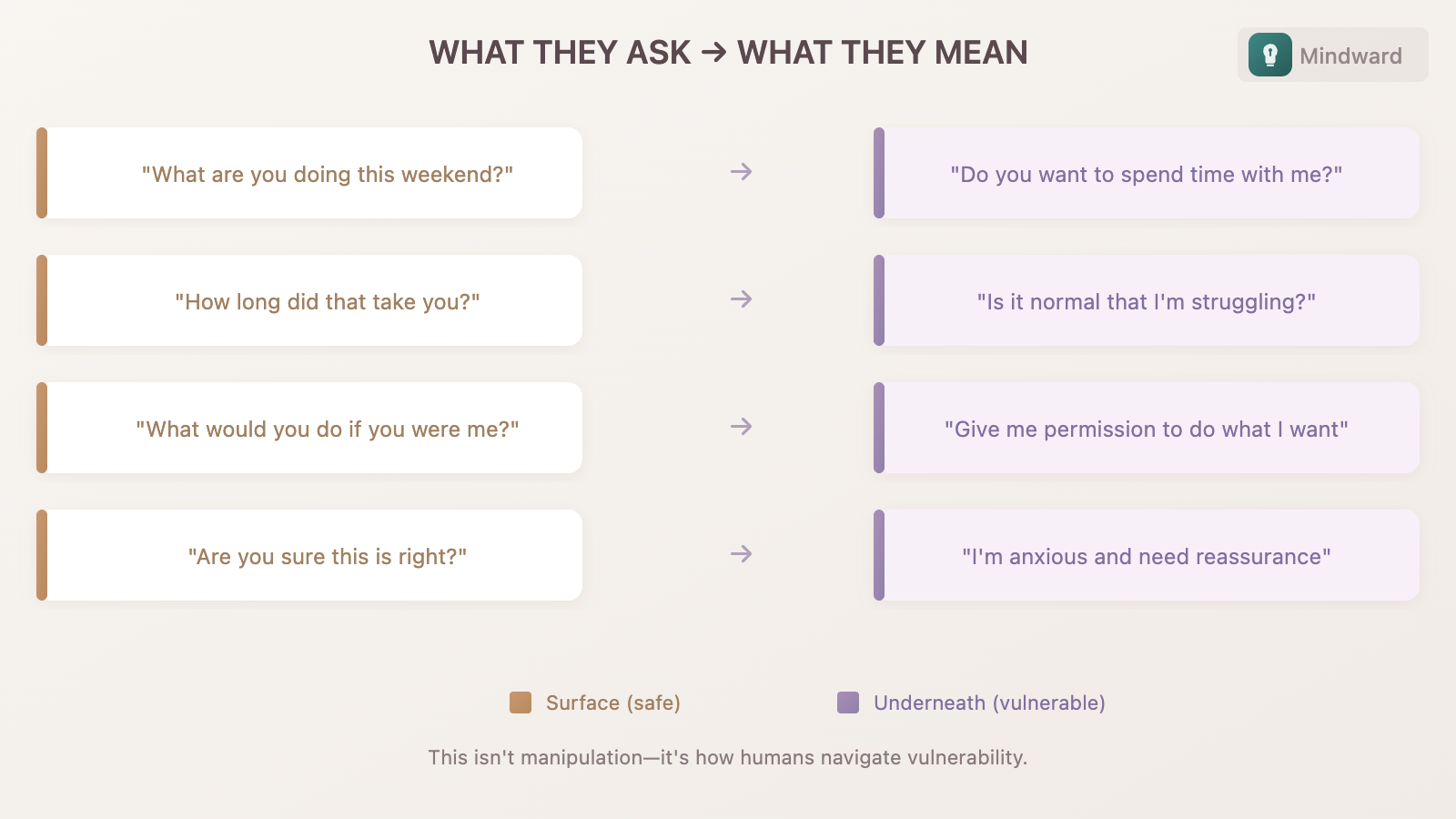
- 'What are you doing this weekend?' → 'Do you want to spend time with me?'
- 'How long did that take you?' → 'Is it normal that I'm struggling with this?'
- 'What would you do if you were me?' → 'I need permission to do what I'm already leaning toward'
- 'Did you hear about [person's failure]?' → 'Tell me that won't happen to me'
- 'Are you sure this is right?' → 'I'm anxious and need reassurance'
This isn't manipulation or dishonesty. It's how humans navigate vulnerability. We test the waters with safe questions before risking the real ones. We hint at what we need and hope someone catches it.
Why Direct Answers Miss
When you answer only the surface question, you leave the real question unaddressed. The person got information but not what they actually needed. They might ask again in different words. They might give up. Either way, something important was missed.
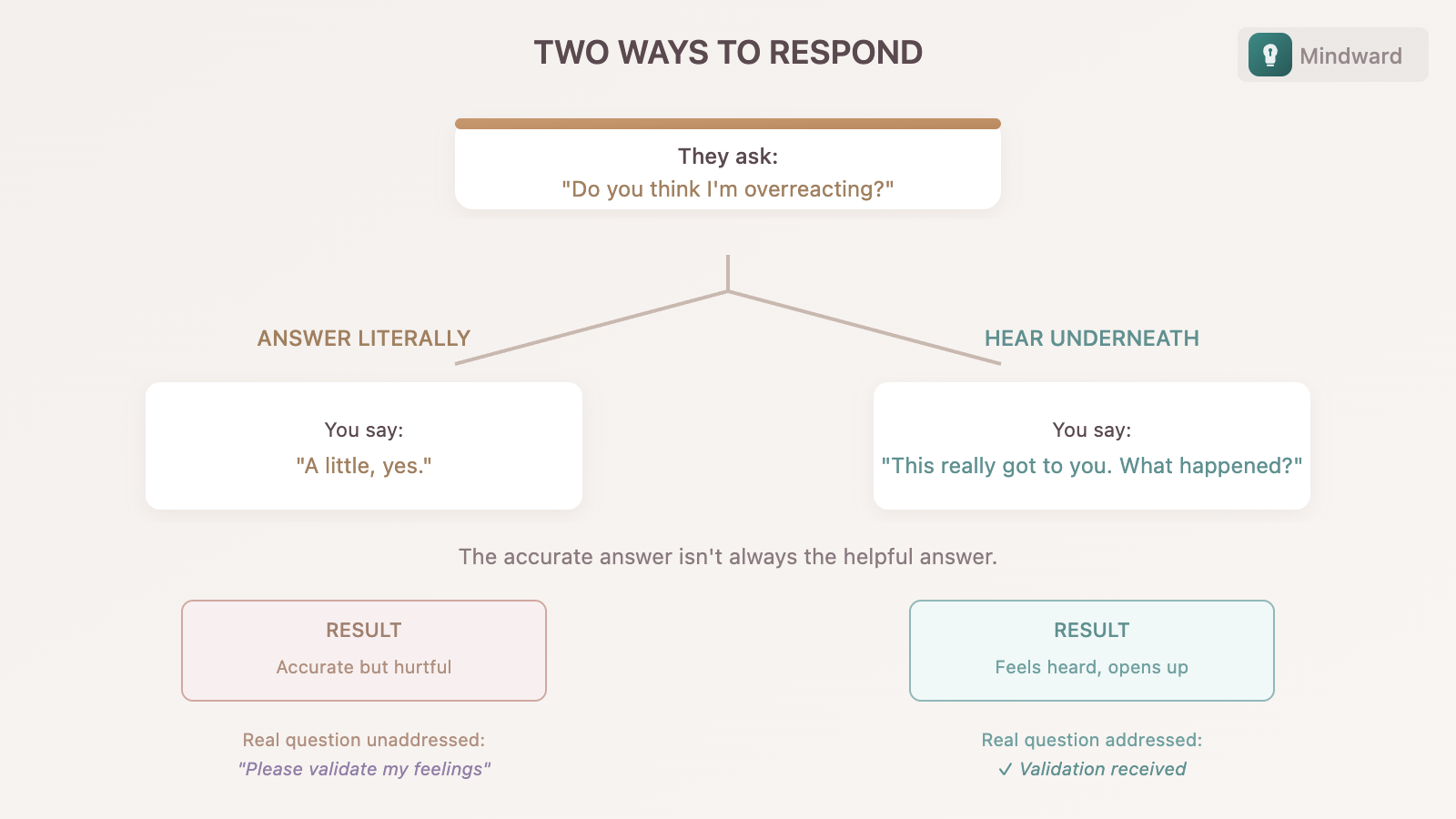
Sometimes a direct answer even makes things worse. If someone asks 'Do you think I'm overreacting?' and you say 'A little, yes'—you've answered honestly but missed that they were asking for validation, not assessment. The accurate answer damages rather than helps.
This doesn't mean literal answers are wrong. Sometimes people really do just want information. But when a simple answer doesn't seem to satisfy, or when the same question keeps returning in different forms, there's probably something underneath you haven't addressed.
How to Hear What's Underneath
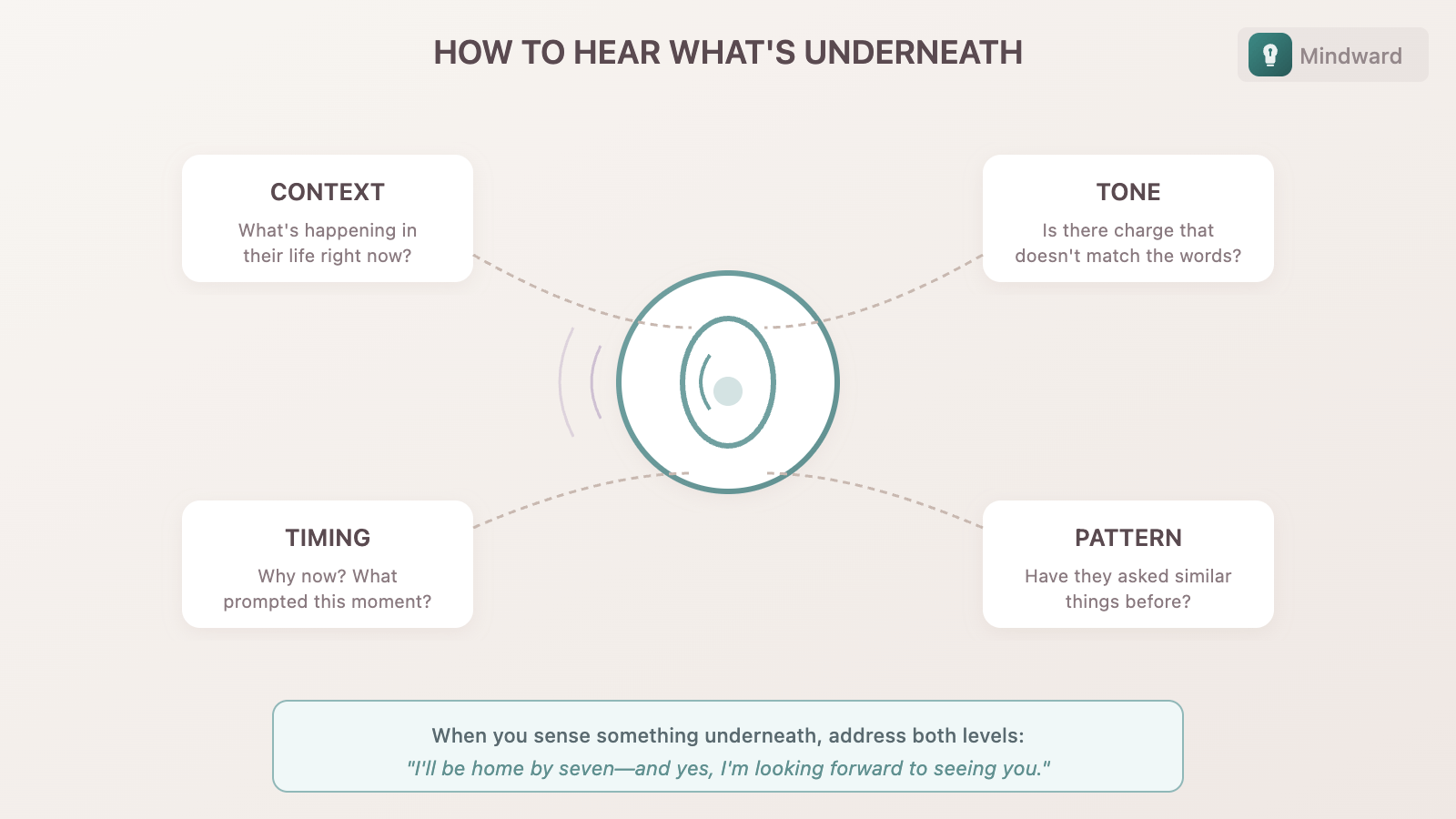
Hearing the question behind the question isn't mind-reading. It's attention. It's noticing context, tone, timing, and pattern.
- Context: What's happening in their life right now? What would make this question make sense?
- Tone: Is there tension, hesitation, or charge that doesn't match the neutral words?
- Timing: Why now? What prompted this question at this moment?
- Pattern: Have they asked similar things before? What connects them?
When you sense something underneath, you can address both levels. Answer the surface question, then gently acknowledge what might be beneath it. 'I'll be home by seven—and yes, I'm looking forward to seeing you.' 'The meeting went fine—your work came up and it was all positive.'
You don't have to be certain about what's underneath to acknowledge it might exist. 'Is there something more you're wondering about?' or 'It sounds like there might be more to this question' opens space without assuming.
When You're the One Asking
This works in reverse too. When you notice yourself asking indirect questions, you can choose to be more direct. Instead of 'What did they say about the project?' you can say 'I'm worried about how the project was received—can you tell me honestly?'
Direct questions are harder to ask but easier to answer. They give the other person a clear target instead of making them guess what you really need. Not every situation calls for full directness, but knowing you're being indirect is different from doing it unconsciously.
The clearer you can be about what you're actually asking, the more likely you are to get what you actually need.
Questions as Connection
Hearing the question behind the question is an act of care. It says: I'm paying attention to you, not just your words. I know there's more to you than what's on the surface. I'm willing to meet you where you actually are.
People remember when they're heard this way. Not because you had the right answer, but because you recognized what they were really asking. That recognition is often worth more than any information you could provide.
Next time someone asks you something simple, pause before answering. Consider what else might be traveling inside that question. You might find that the most helpful response addresses something they never quite said out loud.


Comments
How did you like this article?
No comments yet. Be the first to share your thoughts!