Being Too Good at Your Job Can Hold You Back
You made yourself indispensable. Now you are stuck. The very thing that made you valuable in your role is the thing preventing you from leaving it.
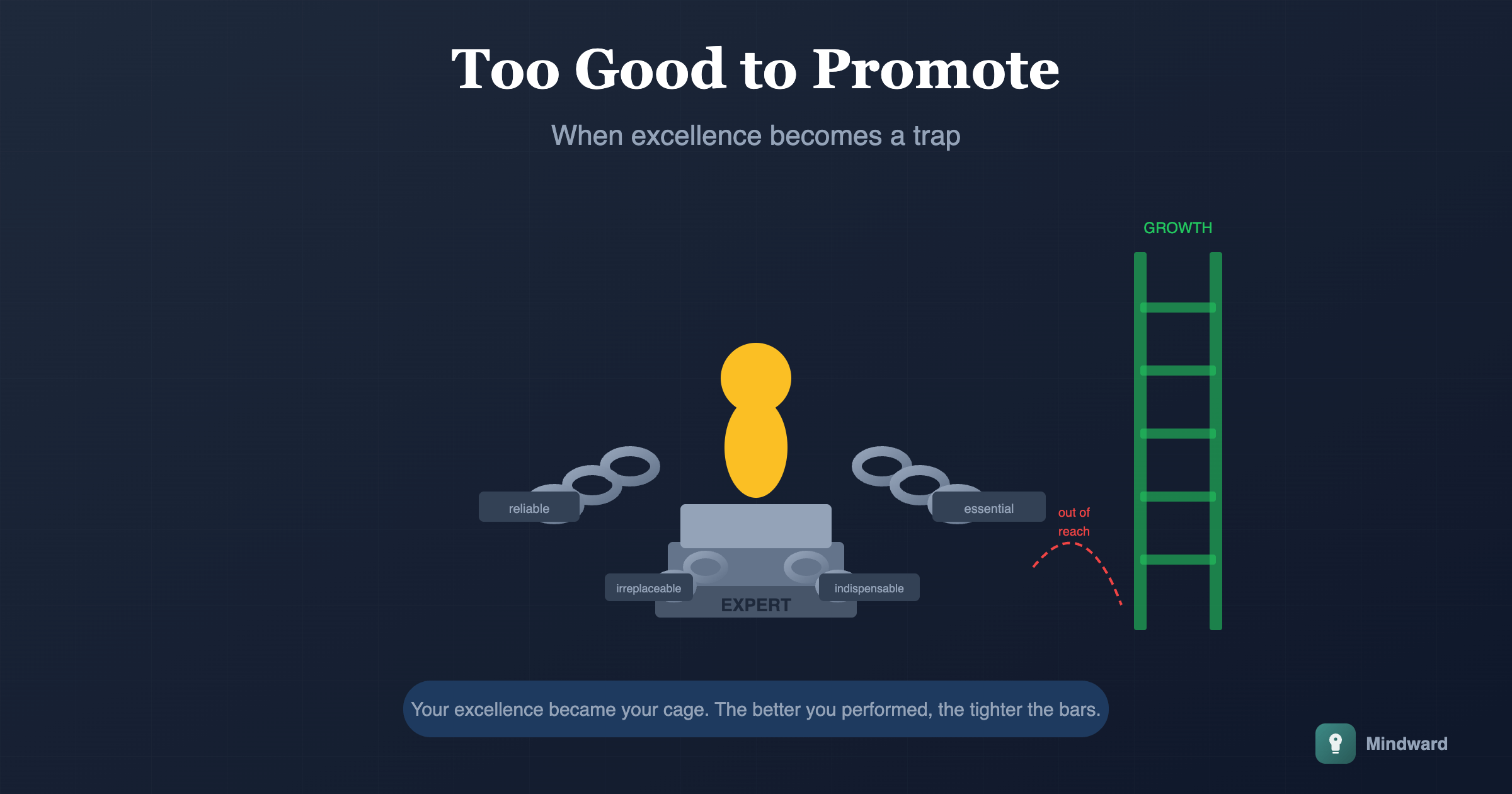
You did everything right. You learned your role deeply. You became the person everyone relies on. When problems arise, they come to you. When questions need answers, you have them. You are indispensable.
And now you are stuck.
The promotion you expected has not come. The interesting projects go to others. When you bring up growth, your manager nods sympathetically but nothing changes. You have become so valuable where you are that no one can imagine you anywhere else.
This is the indispensability trap. The very excellence that should propel your career has become the anchor holding it in place.
How the Trap Works
From your manager's perspective, the math is simple. You in your current role equals a smoothly running operation. You somewhere else equals problems, training costs, and risk. Even if they genuinely want to help your career, promoting you creates an immediate headache they have to solve.
So they delay. They say the timing is not right. They promise to think about it. Meanwhile, someone less critical to current operations gets the opportunity because moving them is easier.
The cruel irony is that your competence created this situation. If you were mediocre, replacing you would be no loss. Because you are excellent, replacing you feels impossible.
Your value became your cage. The better you performed, the tighter the bars.
Signs You Are Trapped
The trap often builds gradually. You do not notice until it is already constraining you. Here are the warning signs.
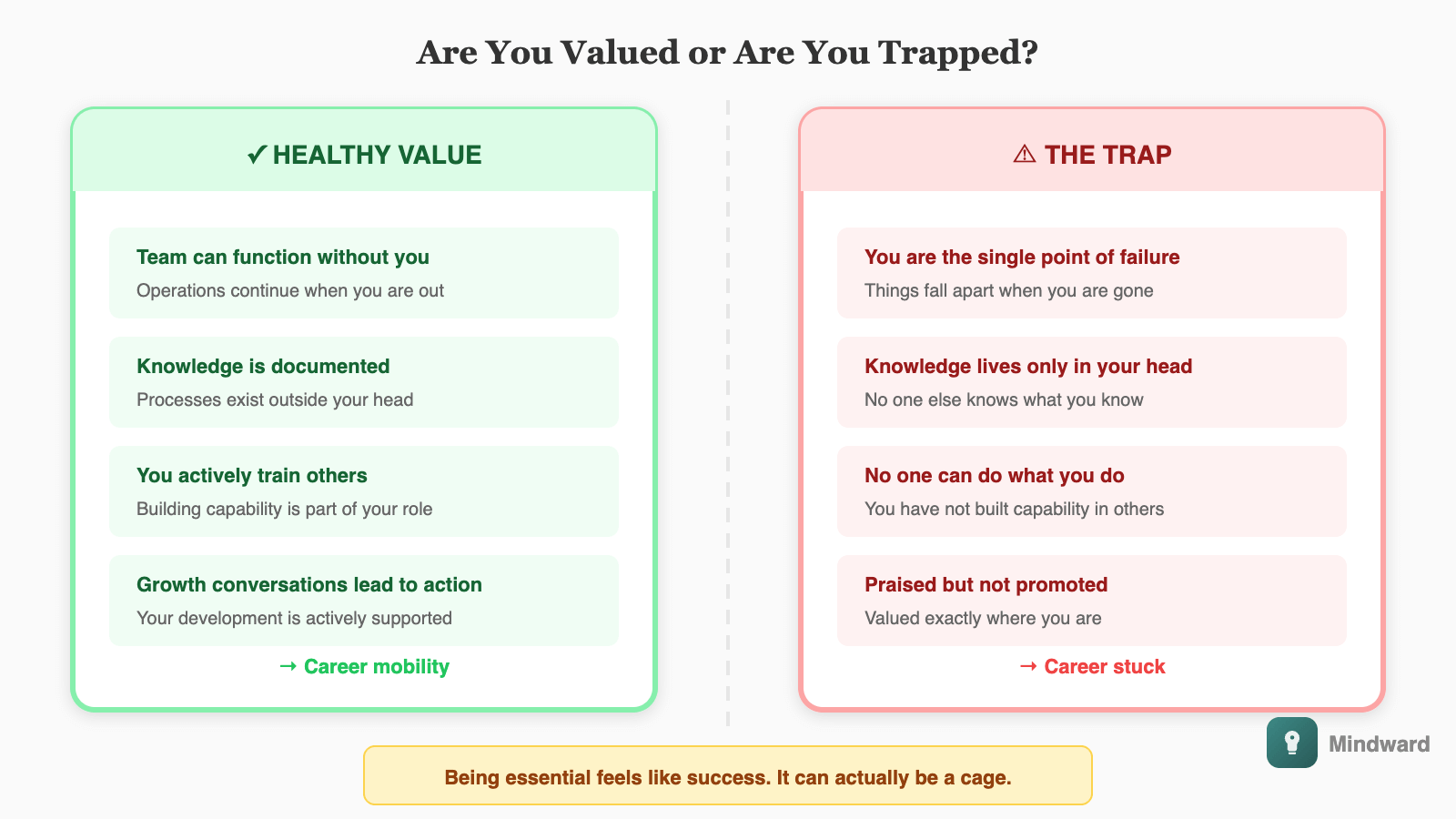
You are the single point of failure for critical processes. If you take vacation, things fall apart. If you are sick, people panic. Your knowledge lives only in your head.
Growth conversations go nowhere. Your manager agrees you are ready for more but nothing materializes. There is always a reason to wait.
- You are the only one who knows how to do key tasks
- Your vacation creates visible problems
- Promotions keep going to less experienced people
- You hear 'we cannot afford to lose you' as a compliment
- New responsibilities never stick - you always return to your core role
- You have been in the same position significantly longer than peers
You get praise but not progress. The recognition flows freely. The advancement does not. You are valued right where you are, which is exactly the problem.
Escaping the Trap
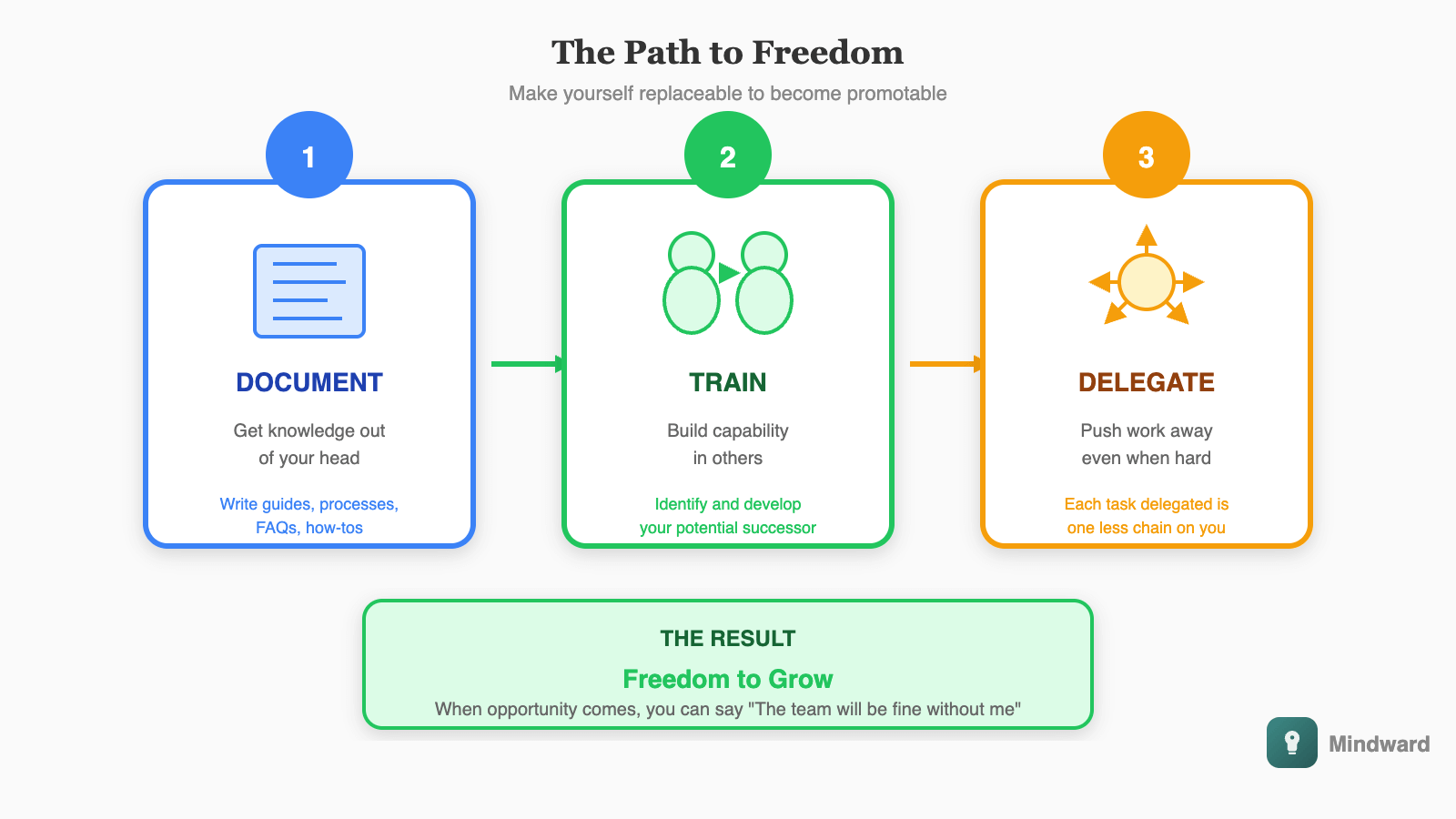
The solution is counterintuitive. To move up, you must first make yourself replaceable. Not less valuable - but less uniquely necessary in your current position.
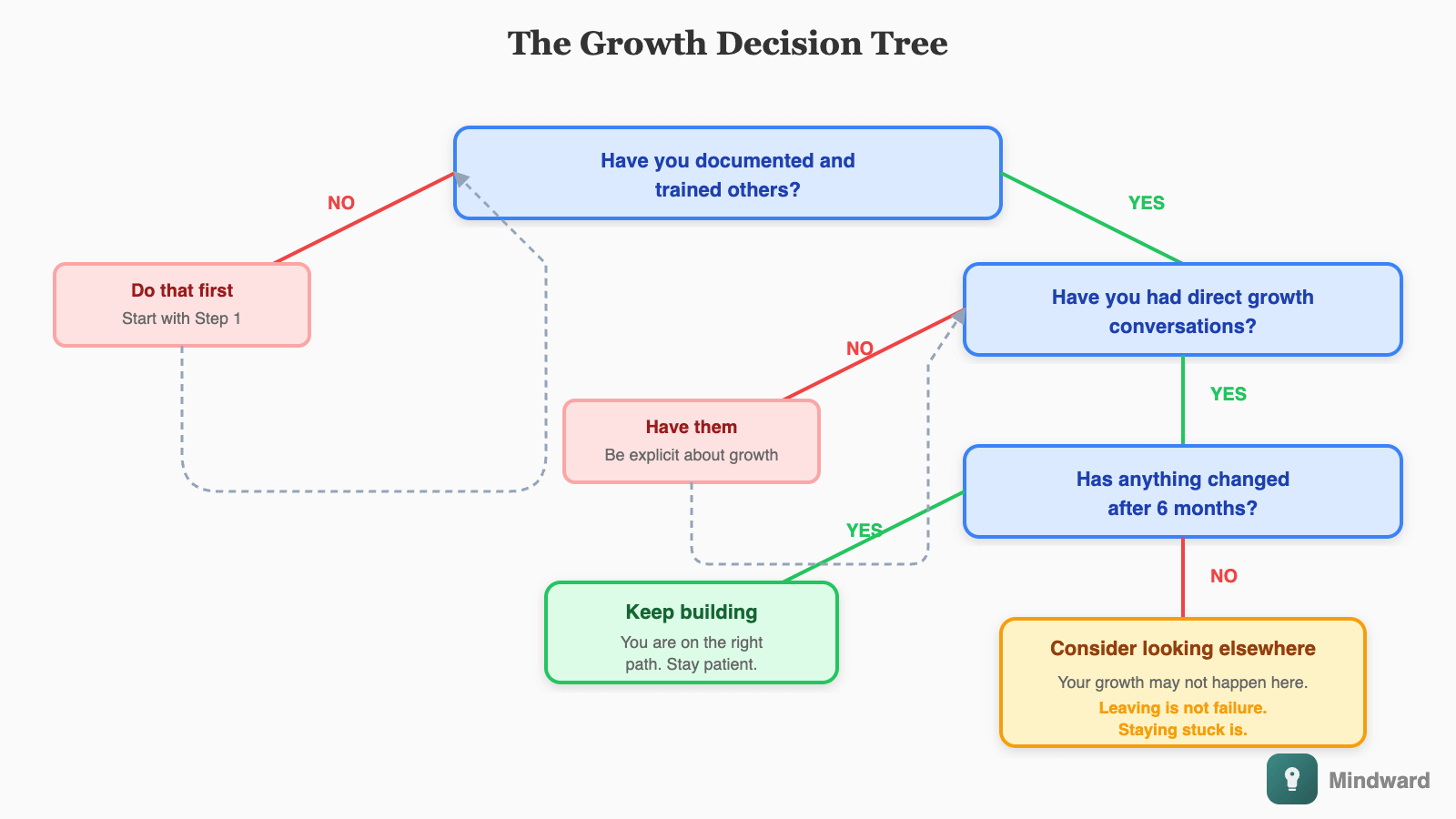
Document everything. The knowledge that makes you indispensable should not live only in your head. Write it down. Create guides, processes, FAQs. This is not giving away your power. It is proving you can build systems that outlast your direct involvement.
Train your replacement before you need one. Identify someone who could take over parts of your role. Teach them actively. When growth opportunities arise, you can say with confidence that the team will be fine without you. Your manager's biggest objection disappears.
Delegate visibly. Push work to others even when you could do it faster yourself. Yes, there is short-term friction. But each task you delegate is one less chain holding you in place.
Reframe Your Value
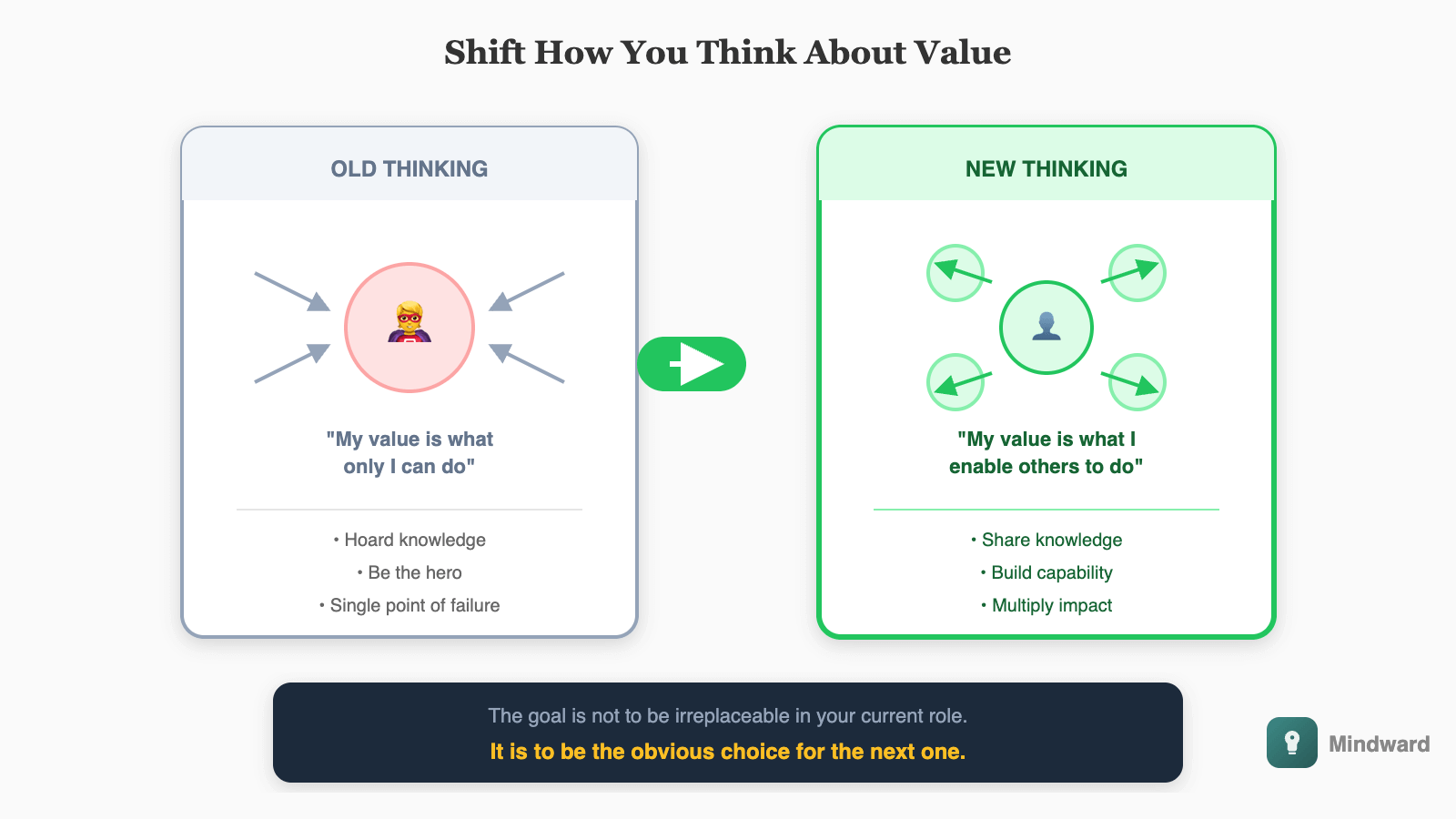
The deeper shift is in how you think about your worth. Your value should not be in what only you can do. It should be in what you enable others to do.
Individual contributors are valuable for their direct output. Leaders are valuable for multiplying output across teams. If you want to grow into leadership, you need to demonstrate that multiplier effect. Hoarding knowledge and being the hero who saves every crisis is the opposite of that.
Start thinking like a leader now. Ask yourself: if I left tomorrow, would the team survive? If the answer is no, that is not a point of pride. It is a problem you need to solve.
The goal is not to be irreplaceable in your current role. It is to be the obvious choice for the next one.
Have the Direct Conversation
Sometimes the trap exists because no one has named it. Your manager may not realize they are holding you back. They may think they are complimenting you by calling you essential.
Have the explicit conversation. I want to grow into a bigger role. I am concerned that my current responsibilities make it hard for the team to imagine me elsewhere. Here is my plan to make myself replaceable so I can be considered for growth opportunities.
This reframes the situation. You are not complaining about being stuck. You are proposing a solution. You are showing leadership by identifying a problem and taking ownership of fixing it.
When to Walk Away
Sometimes the trap is organizational, not personal. Some companies will never promote from within. Some managers will always prioritize their own convenience over your development. Some roles are designed as dead ends.
If you have documented, trained, delegated, had direct conversations, and still nothing changes, the message is clear. Your growth will not happen here. The skills that made you excellent in this role will make you excellent elsewhere too.
Leaving is not failure. Staying stuck is.
Build for Mobility
The best career insurance is never becoming so embedded that you cannot move. From the start of any role, think about eventual transition. Document as you learn. Train others as you go. Build relationships beyond your immediate team.
This is not disloyalty. It is professionalism. You can be fully committed to your current role while also ensuring you have options. The people who advance are not the ones who make themselves irreplaceable. They are the ones who make themselves consistently valuable in whatever context they find themselves.
Be excellent. Be reliable. Be the person everyone wants on their team. But never let your excellence become a cage. Your career is too long to spend it stuck in a role you have outgrown.


Comments
How did you like this article?
No comments yet. Be the first to share your thoughts!